 MineArchive
Lady Rashleigh Mine
| Also known as | Lady Rashleigh Consols |
|---|---|
| Location | Luxulyan Valley, near Trevanny, Luxulyan, Cornwall — 50.3736, -4.7310 (approximate) |
| Commodity | Tin |
| Type | Metal |
| Worked | By 1850s–1881 |
| Maximum depth | Unknown. |
Overview
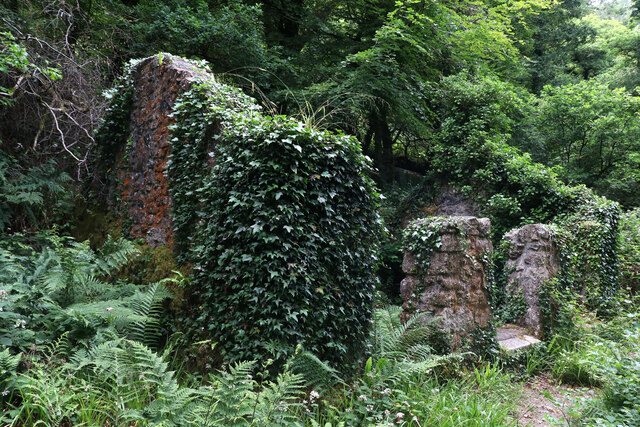
One of the two sizeable metal mines of the Luxulyan Valley, a tin working on a lode crossing the valley near Trevanny Dry that probably last worked in the 1850s, was retried as Lady Rashleigh Consols about 1881, and by one account ran on to a liquidation in 1909; its ivy-covered mine office stands in the woods.
History
Deep mining for metals in the Luxulyan Valley is said to go back to the sixteenth century, on a small scale. Two sizeable mines worked within the valley: Prideaux Wood, above the Carmears Rocks, which had a steam engine, and Lady Rashleigh, near where the Trevanny china-clay dry now stands. The mine takes its name from the Rashleigh family of Prideaux. When Joseph Treffry took the valley in hand in the 1830s he did not care to sink more money into either mine, and they probably last worked in the 1850s.
An attempt was made to rework the mine as Lady Rashleigh Consols about 1881; the Friends of Luxulyan Valley call it unsuccessful, and the abandonment plan of Lady Rashleigh Consols, for tin ore at 32 yards to the inch, is dated 1881. A 2023 account on Geograph has the lode worked from about 1500, the mine reopened in 1881, in liquidation in 1909 and closed in 1910. The database puts the shafts at about SX 064 565 with a query, and the mine office, an ivy-grown ruin with a sawpit below it, stands in the woods on the valley side.
Geology
A tin lode crossing the Luxulyan Valley near Trevanny, on the southern edge of the St Austell granite.
Geological setting: Veins and Lodes (historical documentary reference)
Workings
Shafts on the valley side, recorded at about SX 064 565, with the mine office and a sawpit below them; the extent of the workings is not recorded.
Closure
Probably idle after the 1850s; the 1881 retrial as Lady Rashleigh Consols ended with the abandonment plan of that year, or ran on to a liquidation in 1909 and closure in 1910, the accounts differ.
What remains
The former mine office stands as an ivy-covered ruin in the woods, with a lower overgrown sawpit, photographed in 2023.
The ruined mine office and sawpit; shafts on the hillside.
Redevelopment
Trevanny Dry, a china-clay dry, was built near the mine.
Nearby mines
- Fowey Consols — 1.4 miles (2.3 km) E
- Cuddra Mine — 2.4 miles (3.9 km) S
- Great Crinnis Mine — 2.6 miles (4.1 km) S
- Wheal Regent — 2.5 miles (4.1 km) S
- Carclaze Pit — 2.6 miles (4.2 km) SW
Straight-line distance, within 9 miles (15 km). Show on the map.
What's uncertain
Points where sources disagree or the record could not be settled; both accounts are kept. All open questions in the archive.
- An unsuccessful attempt was made to rework Lady Rashleigh in 1881. (disputed) 1,2
- The mine was reopened in 1881, went into liquidation in 1909 and ceased in 1910. (disputed) 3
- The shafts are recorded at about SX 064 565. (uncertain) 4
Recorded claims
Individual factual claims, each attached to the source(s) that support it below. Where sources disagree, both are kept.
- Lady Rashleigh, near where Trevanny Dry now is, and Prideaux Wood were the two sizeable metal mines that worked within the Luxulyan Valley. 1
- Treffry did not sink money into the valley's mines and they probably last worked in the 1850s. 1
- An unsuccessful attempt was made to rework Lady Rashleigh in 1881. (disputed) 1,2
- The mine was reopened in 1881, went into liquidation in 1909 and ceased in 1910. (disputed) 3
- The abandonment plan of Lady Rashleigh Consols, for tin ore at 32 yards to the inch, is dated 1881. 2
- The shafts are recorded at about SX 064 565. (uncertain) 4
- The former mine office stands as an ivy-covered ruin with an overgrown sawpit below it. 3
Photographs & further reading
Stephen Austin's history of the valley, with its two metal mines.
View sourceGrid reference and references to Collins (1912) and Dines (1956).
View sourceSources
- (secondary) History (Stephen Austin) — The Friends of Luxulyan Valley
- (primary) BGS mine plan: Lady Rashleigh Consols, tin ore, abandoned 1881 — British Geological Survey
- (observational) Lady Rashleigh Mine, Luxulyan Valley (photograph, 2023) — Geograph
- (secondary) Lady Rashleigh Cons. (Buddlepit Mine Database) — Buddlepit
Record created: 19 October 2026 · Last researched: 21 October 2026