 MineArchive
Restormel Royal Iron Mine
| Also known as | Trinity Mine, Restormel Mine, Restormel Royal Mine |
|---|---|
| Location | Restormel, near the castle, north of Lostwithiel, Cornwall — 50.4164, -4.6775 (approximate) |
| Commodity | Iron |
| Type | Iron |
| Worked | By 1797–1883 |
| Maximum depth | Unknown. |
| Operators | John Taylor & Sons (?–1883), Duchy of Cornwall, Adam Thompson |
Overview
An iron mine near Restormel Castle, north of Lostwithiel, first called Trinity Mine; Queen Victoria and Prince Albert rode into it by candlelight in 1846, and it took the name Royal. It closed in 1883.
History
The mine began in the 1790s as Trinity Mine, and in 1797 the collector Philip Rashleigh obtained fine crystallised goethite from it. A tramway built in 1836 linked it with the quays at Lostwithiel. It was first opened by Adam Thompson as the Restormel Mine. In September 1846 Queen Victoria and Prince Albert visited, drawn into the level in a truck pulled by the miners, with candles set along the walls. The mine captain recalled that Albert took the pick and got a bit of ore, and that 120 miners, red from the ore of the main lode, cheered them away. The Queen ordered fifty gold sovereigns to be shared among the men, and the mine was renamed Restormel Royal.
In 1873 it was held from the Duchy of Cornwall on a 21-year lease at a royalty of one-fifteenth and worked by John Taylor and Sons of London as the Restormel Royal Iron Mine Company, a cost-book company of 48 shares. It worked a single north-south lode of iron, quartz and flucan in slate, a mile from the Lanlivery granite. All the workings lay above the deep adit that drained the mine, and the ore was brought out by horses on railways through the levels, which was unusual in Cornwall. It produced about 128,000 tons of ore between 1855 and 1883, and closed in 1883.
Geology
A single north-south lode of iron ore, quartz and flucan, dipping a foot in the fathom, in slate a mile from the Lanlivery granite; noted for crystallised goethite.
Workings
Several levels, all above the deep adit, with ore hauled out by horses on railways.
Closure
Closed in 1883.
What remains
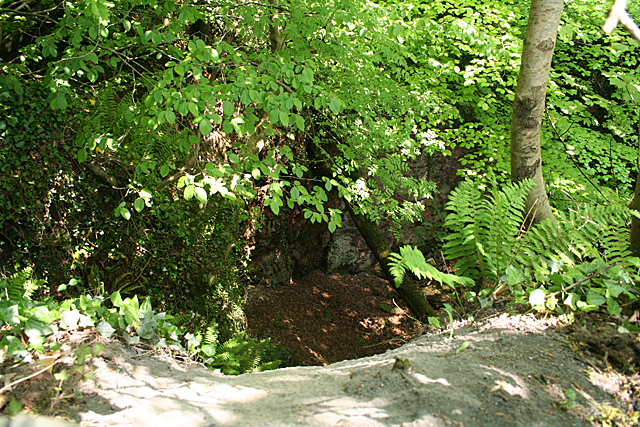
Remains of the surface workings survive, with a deep cutting at the probable entrance to the deep adit.
Surface workings and a cutting at the probable adit entrance.
Redevelopment
Unknown.
Nearby mines
- Fowey Consols — 3.1 miles (5.0 km) S
- Cuddra Mine — 6.0 miles (9.7 km) SW
- Herodsfoot Mine — 6.0 miles (9.7 km) E
- Great Crinnis Mine — 6.1 miles (9.8 km) SW
- Wheal Regent — 6.1 miles (9.8 km) SW
Straight-line distance, within 9 miles (15 km). Show on the map.
Recorded claims
Individual factual claims, each attached to the source(s) that support it below. Where sources disagree, both are kept.
- The mine was originally called Trinity Mine; Philip Rashleigh obtained crystallised goethite from it in 1797. 1,2
- A tramway built in 1836 connected the mine to the quays at Lostwithiel. 3,2
- Queen Victoria and Prince Albert visited the mine in 1846 and it was renamed Restormel Royal; the Queen ordered 50 gold sovereigns for the miners. 1,3,4
- In 1873 it was held from the Duchy of Cornwall on a 21-year lease at 1/15th, worked by John Taylor and Sons as a cost-book company of 48 shares. 1
- Ore was drawn out by horses, unusual in Cornwall. 1,2
- The mine produced 128,000 tons of ore between 1855 and 1883. 2
- Restormel Royal Iron Mine closed in 1883. 1
Sources
- (secondary) Restormel Royal Iron Mine, Cornwall — Cornwall Calling
- (secondary) Restormel Royal Iron Mine, Lostwithiel, Cornwall, UK — Albion Fire and Ice
- (secondary) Restormel Royal Mine — iWalk Cornwall
- (secondary) Iron mining in Cornwall — Constantine Cornwall
Record created: 18 October 2026 · Last researched: 18 October 2026