 MineArchive
Ding Dong Mine
| Location | Madron, near Penzance, Cornwall — 50.1522, -5.5883 (exact) |
|---|---|
| Commodities | Tin, Copper |
| Type | Metal |
| Worked | documented from early 17th century–1928 |
| Operators | Richard Trevithick (1796–1796) |
Overview
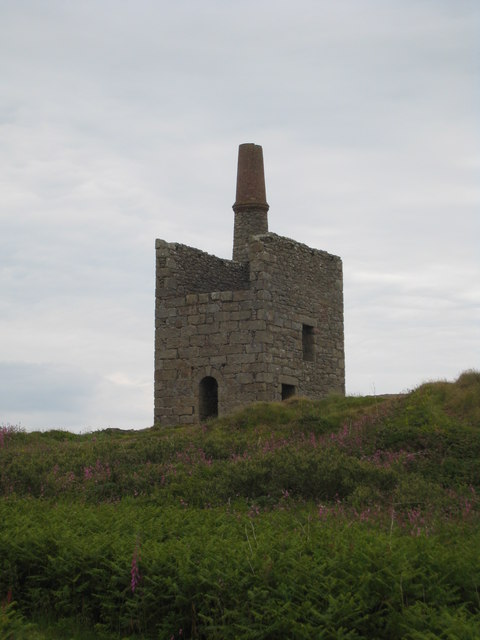
Ding Dong, on the high ground above Madron, is reputed by local legend to be the oldest mine in Cornwall — a claim no record can confirm or deny, since its documented history alone already runs back to the reign of James I, and three of its engine houses, including one of the oldest still standing anywhere in the county, survive today.
History
The earliest documented reference to mining at Ding Dong comes from the writer John Norden at the start of the 17th century, though local tradition holds it to be far older still — one old miner is said to have told the folklorist A. K. Hamilton Jenkin that only Dolcoath was older, and that Ding Dong 'was worked before the time of Jesus Christ'. By 1714 three separate small mines were at work on the site — Good Fortune, Wheal Malkin and Hard Shafts Bounds — and by 1782 as many as sixteen individual workings were active across the wider sett. These scattered workings were formally consolidated into a single mine, Ding Dong, in 1813, and reopened the following year; the celebrated engineer Richard Trevithick worked at the mine as early as 1796, engineering some of its earliest pumping arrangements. Employment peaked at 200-300 miners through the 1830s-1870s, and by 1823 the mine was consuming 900lb of candles and 300lb of gunpowder a month. As the mine's eastern ore was worked out by around 1850, activity shifted west to new workings around Greenburrow, Bolitho and Old Wheal Boys, and a large pumping engine house was built at Greenburrow in 1865 to keep the deeper western ground dry — the engine itself, a 40-inch Harvey's engine, had originally been erected elsewhere, at North Killiow shaft, in 1857, before being moved to Ding Dong in 1864. Falling tin prices, driven by the opening of rich alluvial tin deposits in Queensland, Australia, brought the mine's main working to a close on 11 July 1877. A brief revival followed once tin prices recovered: the Ding Dong Mine Syndicate worked the surface between September 1912 and March 1915, hand-picking ore and extracting 51 tons of tin using California stamps, before the First World War's collapsing metal prices ended the venture. Three further attempts to reopen the mine all failed, the first defeated by water, the later two by local opposition.
Geology
The mine worked tin- and copper-bearing lodes of the Land's End granite, part of the Cornubian orefield, following a group of named lodes including Good Fortune, Wheal Malkin, Bussas and New Lode across the wider Ding Dong sett.
Geological setting: Hydrothermal Deposits (well documented example), Veins and Lodes (well documented example)
Workings
Three engine houses survive on the site. The most prominent, at Greenburrow shaft, housed a 40-inch Cornish engine, built by Harvey's, originally built in 1857 for North Killiow shaft and moved to Ding Dong in 1864, installed in its present engine house the following year. A 25-inch whim engine house stands at Ishmael's shaft, and a 30-inch pumping engine house at Tredinneck and Providence shafts, built in 1825, is among the oldest surviving engine houses anywhere in Cornwall. Between 1855 and 1877 the mine yielded around 2,905 tons of black tin.
Closure
The mine's main working ceased on 11 July 1877 after an attempted sale as a going concern failed; a smaller 1912-15 revival working surface ore ended with the First World War, and three later attempts to reopen the mine all failed.
What remains
The ruined Count House is the sole surviving structure from Richard Trevithick's time as the mine's engineer in 1796. All three surviving engine houses were Grade II listed between 1986 and 1988.
The site forms part of the Cornwall and West Devon Mining Landscape UNESCO World Heritage Site, designated in 2006.
Nearby mines
- Carn Galver Mine — 1.7 miles (2.8 km) NW
- East Boscaswell Mine — 3.2 miles (5.1 km) W
- Parkenoweth Mine — 3.4 miles (5.5 km) W
- Rosevale Mine — 3.5 miles (5.6 km) NE
- Balleswidden Mine — 3.6 miles (5.9 km) SW
Straight-line distance, within 9 miles (15 km). Show on the map.
Recorded claims
Individual factual claims, each attached to the source(s) that support it below. Where sources disagree, both are kept.
- Between 1855 and 1877 the mine yielded around 2,905 tons of black tin; employment peaked at 200-300 miners through the 1830s-1870s. 1
- Richard Trevithick worked at the mine as its engineer as early as 1796, and the surviving Tredinneck and Providence engine house, built in 1825, is among the oldest still standing in Cornwall. 2
- The British Geological Survey holds a longitudinal section and assay plan of Ding Dong Mine (MP24082) and a plan of the mine (MP24083), both viewable online, with further sections of the Good Fortune, Wheal Malkin and Bussas lodes. 3,4
Photographs & further reading
The scanned plan of Ding Dong Mine, viewable online.
View sourceA local history of the mine from Norden's first mention to the twentieth-century revivals.
View sourceSources
- (secondary) Ding Dong mines — Wikipedia
- (secondary) Ding Dong Mine - A History — Peter Joseph and Gerald Williams
- (primary) DING DONG MINE LONGITUDINAL SECTION & ASSAY PLAN (Mine plan MP24082, BGS mine plans catalogue) — British Geological Survey / Mining Remediation Authority
- (primary) PLAN OF DING DONG MINE (Mine plan MP24083, BGS mine plans catalogue) — British Geological Survey / Mining Remediation Authority
- (primary) Ding Dong Mine Longitudinal Section & Assay Plan (BGS Mine Plans Catalogue) — British Geological Survey
Record created: 22 August 2026 · Last researched: 24 September 2026