 MineArchive
Ailsa Craig
| Location | Ailsa Craig, Firth of Clyde, South Ayrshire — 55.2530, -5.1120 (exact) |
|---|---|
| Commodity | Granite |
| Type | Quarry |
| Worked | 1850s (curling stones)–Still active |
| Operators | Kays of Scotland (1851–?), Ailsa Craig Granite Company (1907–1907) |
Overview
Ailsa Craig, a small granite island in the Firth of Clyde, has led two very different quarrying lives: a tiny, highly specialised trade supplying the world's curling stones since the 1850s, and a short-lived, heavily capitalised roadstone operation from 1907 that never turned a profit.
History
Ailsa Craig's distinctive microgranite — an unusually low-aluminium, riebeckite-bearing rock prized for its hardness and resistance to impact — has been quarried on a small scale for curling stones since at least the 1850s, when the firm later known as Kays of Scotland began making stones from it under rights granted by the Marquess of Ailsa, the island's owner. In 1907 a far larger operation began: the Ailsa Craig Granite Company, led by Kilsyth quarrymaster William Wilson, took out contracts to supply roadstone aggregate to construction projects across Scotland, England and Ireland, opening a substantial quarry at Kennedy's Nag and building a mineral railway to move stone to the shore. The venture proved hugely unprofitable, and quarrymen worked in primitive conditions on an island whose lighthouse would not even be connected by telegraph until 1935. The roadstone operation did not last, but the much older, smaller-scale curling-stone trade endured: Kays of Scotland has held exclusive rights to quarry the island's granite since the early 1990s, harvesting it only occasionally — roughly once a decade, most recently in 2013 and 2020 — because the island is now a protected seabird reserve and quarrying is restricted to a short window outside the breeding season.
Geology
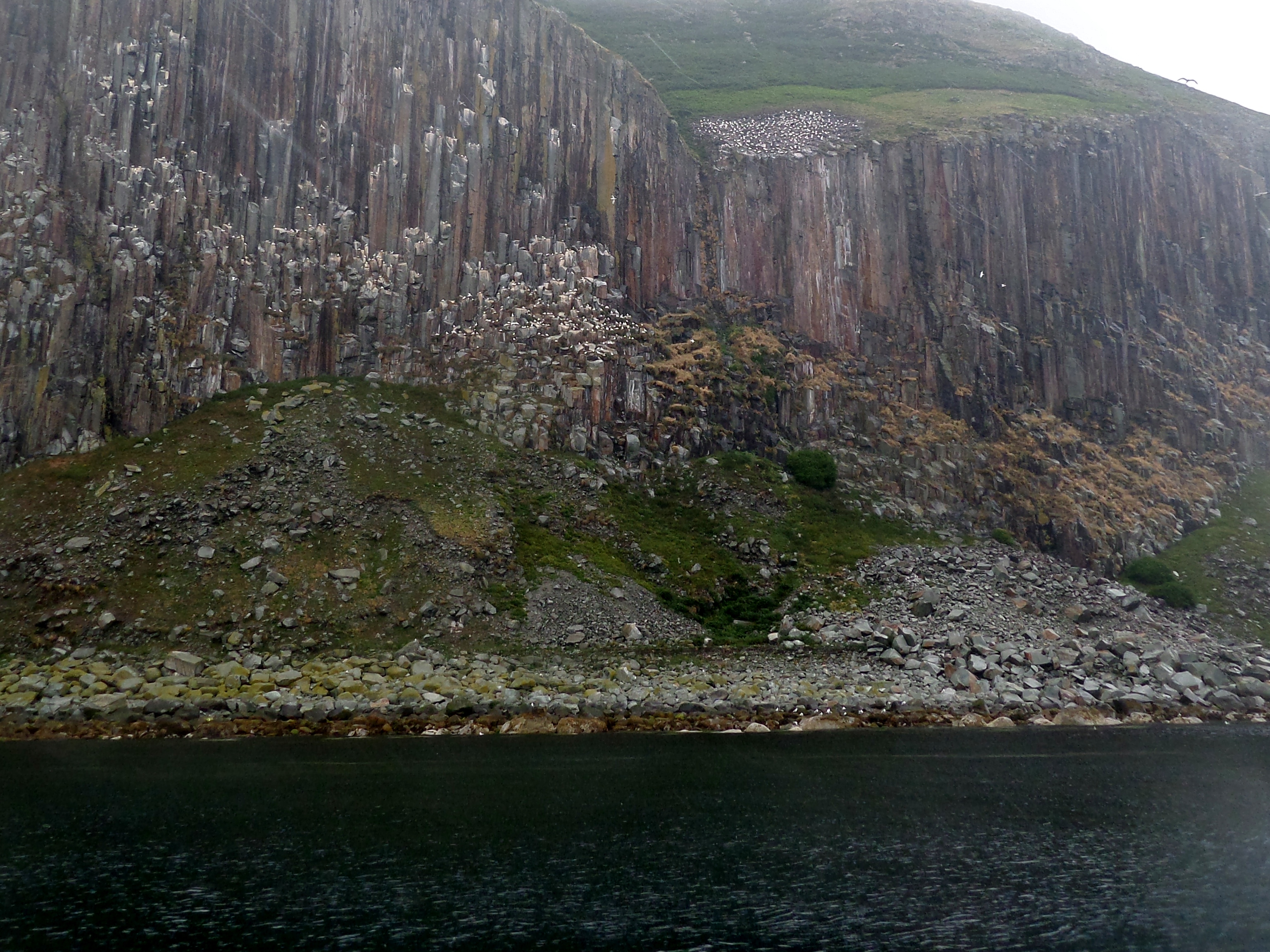
The island is the eroded remnant of a Palaeogene volcanic plug, formed around 60 million years ago, composed of a distinctive microgranite containing the blue-black mineral riebeckite; two named varieties, 'Common Green' and the higher-quality, low-water-absorption 'Blue Hone', are prized specifically for curling stone manufacture.
Workings
The 1907 roadstone quarry at Kennedy's Nag was served by a mineral railway carrying stone to the shore for shipment; the much smaller-scale curling-stone quarrying, by contrast, involves selectively hand-picking and cutting blocks of the island's two named granite varieties, harvested only occasionally to minimise disturbance to the island's seabird colonies.
Closure
The 1907 roadstone venture proved commercially unviable and did not continue for long; curling-stone quarrying, by contrast, has never fully ceased, continuing on an occasional, tightly regulated basis to the present day.
What remains
Ailsa Craig is now a Site of Special Scientific Interest and RSPB nature reserve, home to one of Britain's largest gannet colonies; Kays of Scotland retains exclusive rights to quarry its granite for curling stones, harvesting it roughly once a decade under conditions designed to protect the island's wildlife.
The abandoned roadstone quarry at Kennedy's Nag survives along with remnants of its mineral railway; the island's lighthouse, now automated, and the ruins of a castle also survive.
Recorded claims
Individual factual claims, each attached to the source(s) that support it below. Where sources disagree, both are kept.
- The island's microgranite includes two named varieties, 'Common Green' and 'Blue Hone', both specifically prized for curling stone manufacture. 1,2
- The 1907 roadstone quarry at Kennedy's Nag, opened by the Ailsa Craig Granite Company under William Wilson, proved hugely unprofitable. 3
- Kays of Scotland has held exclusive rights to quarry the island's granite since the early 1990s, harvesting it roughly once a decade, most recently in 2013 and 2020. 1
Photographs & further reading
A two-day visit in August 2015 by a party who kayaked the ten miles out to the island. Covers the industrial buildings left from the granite working alongside the rest of what is on Ailsa Craig — the workers' and lighthouse keepers' quarters, disused foghorns, the railway built to move stone, an old signal tower and the freshwater spring and cistern.
View sourceSources
- (secondary) Ailsa Craig And Its Curling Stones — Amusing Planet
- (secondary) Ailsa Craig — Wikipedia
- (secondary) The 'ownership' of Ailsa Craig and the opening of the Wilson quarry, 1907 — Scottish Leisure History
Record created: 24 August 2026 · Last researched: 24 August 2026