 MineArchive
Tonfanau Quarry
| Also known as | Tonfanau Granite Quarry |
|---|---|
| Location | Tonfanau, about two and a half miles north of Tywyn, Gwynedd — 52.6125, -4.1248 (exact) |
| Commodity | Granite |
| Type | Quarry |
| Worked | 1892–1998 |
| Maximum depth | Surface quarrying; no depth figure applies. |
| Operators | William Williams Jones (1892–?), Hanson (?–1998) |
Overview
A coastal granite quarry north of Tywyn, opened in 1892 by a group of local men and worked for 106 years — an unusual thing on this coast, where almost everything else quarried was slate. Its stone is said to be among the hardest granite in Europe, it built the seafront at Tywyn, and it went out by rail on the Cambrian coast line. German prisoners of war worked here in 1918 and 1919, and one of them died of his injuries.
History
In 1892 a group of local men opened a granite quarry north of the village of Tonfanau. Among them was William Williams Jones, a draper from Tywyn who tried to open several quarries in the district — Dolgoch, Melinllynpair and Nantcynog among them, all unsuccessful. Tonfanau was his only enduring venture.
The quarry was unusual for its district: almost all the other workings on this coast produced Welsh slate, and Tonfanau was granite only. Steam engines brought the stone from the quarry down to the Cambrian coast main line, and it went mainly around Wales but further afield too. The seafront houses and buildings on Marine Parade at Tywyn were built from Tonfanau granite in the quarry's early days. The village was served by Tonfanau railway station, opened by the Cambrian Railways and first appearing in Bradshaw in July 1896.
During the First World War several German prisoners of war housed at Tywyn worked at the quarry between June 1918 and November 1919, before being transferred to the Frongoch internment camp near Bala. One of them was fatally injured at the quarry and died of his injuries at Machynlleth Cottage Hospital.
The quarry was latterly run by Hanson and closed in 1998, 106 years after it opened, most of the plant and machinery being removed at that time.
Geology
Tonfanau worked granite on a stretch of the Gwynedd coast otherwise given over almost entirely to slate — the reason the quarry stands out in its district. The stone has a reputation for extreme hardness, described as among the hardest granite in Europe, which is what suited it to roadstone and to the hard-wearing building work it went into at Tywyn.
Workings
An open quarry on the coast north of Tywyn, worked in benches. Steam locomotives brought stone down from the workings to the Cambrian coast main line for despatch — the quarry's whole economics resting, as at Nant Gwrtheyrn and Penlee, on being able to move heavy low-value stone off a remote coast.
Closure
The quarry closed in 1998 under Hanson, 106 years after opening, and most of the plant and machinery was removed. Note that the Wikipedia article is internally inconsistent on this point, stating in one place that a granite quarry existed north of the village 'until 1992' and in another that the quarry closed in 1998; the 1998 date is the one given in the article's own section on the quarry and is followed here.
What remains
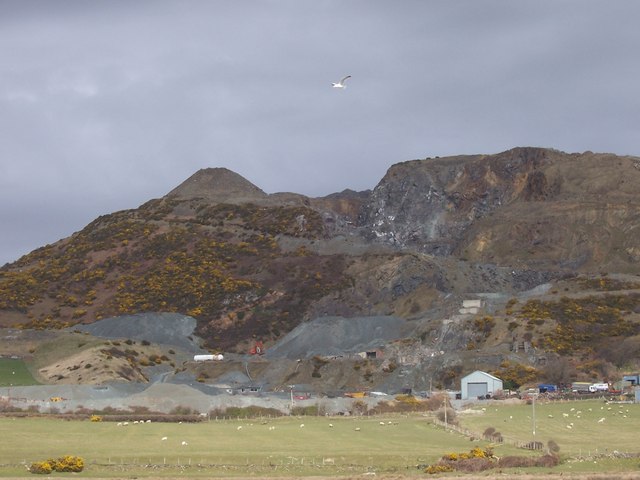
Disused. Most of the plant and machinery was removed at closure in 1998, but the quarry faces and remaining structures are accessible enough to have been the subject of a 2015 exploration report. The former army camp at Tonfanau stands nearby, and the railway station still serves the village.
Quarry faces and the remnants of structures left after the plant was stripped out in 1998.
Nearby mines
- Dolgoch Quarry — 5.5 miles (8.9 km) E
- Cwm Ebol Quarry — 7.9 miles (12.7 km) E
- Bryn Eglwys Quarry — 8.2 miles (13.3 km) E
Straight-line distance, within 9 miles (15 km). Show on the map.
What's uncertain
Points where sources disagree or the record could not be settled; both accounts are kept. All open questions in the archive.
- The quarry closed in 1998, 106 years after opening, under Hanson, with most of the plant and machinery removed. The same Wikipedia article states elsewhere that a granite quarry existed north of the village only 'until 1992'. (disputed) 1,2
Recorded claims
Individual factual claims, each attached to the source(s) that support it below. Where sources disagree, both are kept.
- A group of local men opened a granite quarry north of Tonfanau in 1892, among them William Williams Jones, a draper from Tywyn whose other quarrying ventures at Dolgoch, Melinllynpair and Nantcynog were all unsuccessful. 1
- Tonfanau was a granite-only quarry, unusual on a coast where almost all the other quarries and mines produced Welsh slate; its stone is reputed to be among the hardest granite in Europe. 2
- Steam engines brought the granite down to the Cambrian coast main line, and the seafront houses and buildings on Marine Parade at Tywyn were built from the quarry's stone in its early days. 2
- Several German prisoners of war housed at Tywyn worked at the quarry between June 1918 and November 1919, before transfer to the Frongoch internment camp near Bala; one was fatally injured and died at Machynlleth Cottage Hospital. 1
- The quarry closed in 1998, 106 years after opening, under Hanson, with most of the plant and machinery removed. The same Wikipedia article states elsewhere that a granite quarry existed north of the village only 'until 1992'. (disputed) 1,2
Photographs & further reading
A photographic account of the quarry after closure, with notes on the hardness of its granite and the buildings at Tywyn that were made from it.
View sourceSources
- (secondary) Tonfanau — Wikipedia
- (observational) Tonfanau Quarry, near Tywyn, February 2015 — 28DaysLater
Record created: 3 September 2026 · Last researched: 3 September 2026