 MineArchive
Dolgoch Quarry
| Location | Dol-gôch ravine, between Bryn-crug and Abergynolwyn, Gwynedd — 52.6201, -3.9943 (exact) |
|---|---|
| Commodity | Slate |
| Type | Slate |
| Worked | January 1868–April 1884 |
| Maximum depth | Unknown. |
| Operators | Dolgoch Slate and Slab Company Limited (1872–1884) |
Overview
A short-lived slate quarry in the Dol-gôch ravine, worked commercially from 1877 to 1884 and named for the stream running through it, sharing the same Broad and Narrow slate veins as the much larger Bryn Eglwys Quarry a mile and a half to the west.
History
W. W. Jones, a local prospector, discovered the slate deposit at Dol-gôch (Welsh for 'red meadow', after the stream running through the ravine) in January 1868 and leased the ground. The Dolgoch Slate and Slab Company Limited took over in April 1872, securing a 40-year lease from landowner Athelstan John Soden Corbet at an annual rent of £30, and commercial quarrying began in January 1877. The quarry worked the same Broad Vein and Narrow Vein as the neighbouring Bryn Eglwys Quarry, around a mile and a half to the west, extracting a silver-grey slate; slate was hand-carried to Dolgoch railway station on the Talyllyn Railway, giving the quarry more favourable transport links than many of its neighbours despite never working at significant scale. A severe storm in August 1880 badly damaged the workings, and the quarry never recovered its footing; financial difficulty forced the landowner's estate to auction the ground in 1878, and Edward Lyon of Staffordshire subsequently purchased the Dolgoch farm containing the quarry. Commercial working ceased in April 1884. The site saw two later, unsuccessful revival attempts tied directly to troubles at Bryn Eglwys: in 1910, when Bryn Eglwys's own workforce tried quarrying at Dolgoch during that quarry's 1909-1911 closure, and again in 1921 amid a labour dispute at Bryn Eglwys -- neither attempt lasted.
Geology
The Broad and Narrow Veins in the Dol-gôch ravine, the same veins worked by the other quarries of the Abercorris group.
Workings
Slate hand-carried from the workings to Dolgoch railway station on the Talyllyn Railway; the quarry worked the same Broad Vein and Narrow Vein as Bryn Eglwys Quarry, extracting a silver-grey slate.
Closure
Commercial quarrying ceased in April 1884, its short working life effectively ended by severe storm damage in August 1880; brief, unsuccessful revival attempts followed in 1910 and 1921, both tied to periods of closure or dispute at the neighbouring Bryn Eglwys Quarry.
What remains
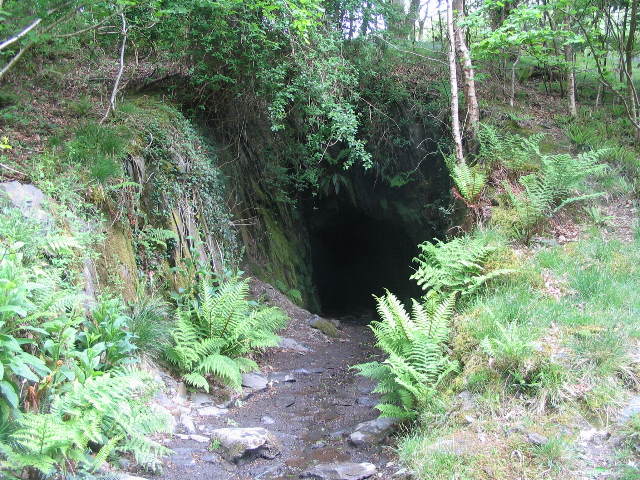
Disused adits and quarry workings survive in the Dolgoch valley.
Several disused slate adits, including accessible tunnel entrances, survive in the valley.
Related mines
- Bryn Eglwys Quarry — The two quarries worked the same Broad Vein and Narrow Vein a mile and a half apart.
Nearby mines
- Bryn Eglwys Quarry — 2.8 miles (4.5 km) E
- Cwm Ebol Quarry — 2.9 miles (4.6 km) SE
- Tonfanau Quarry — 5.5 miles (8.9 km) W
- Braichgoch Slate Mine — 6.5 miles (10.4 km) E
- Abercwmeiddaw Slate Quarry — 6.5 miles (10.5 km) NE
Straight-line distance, within 9 miles (15 km). Show on the map.
Recorded claims
Individual factual claims, each attached to the source(s) that support it below. Where sources disagree, both are kept.
- W. W. Jones discovered the slate deposit at Dol-gôch in January 1868; the Dolgoch Slate and Slab Company Limited took over in April 1872 with a 40-year lease from Athelstan John Soden Corbet at £30 a year, and commercial quarrying began in January 1877. 1
- Dolgoch worked the same Broad Vein and Narrow Vein as the Bryn Eglwys Quarry, about a mile and a half to the west. 1
- A severe storm in August 1880 badly damaged the quarry's workings, from which it never recovered; commercial working ceased in April 1884. 1
- Bryn Eglwys's own idle workforce twice tried to revive quarrying at Dolgoch -- in 1910, during Bryn Eglwys's 1909-1911 closure, and again in 1921 amid a labour dispute there -- but neither attempt lasted. 1
- Located at about 52.620 N, 3.994 W. 1
Sources
- (secondary) Dolgoch quarry, Gwynedd — Wikipedia
- (observational) Adit, Dolgoch — Geograph Britain and Ireland (E Gammie)

Record created: 30 August 2026 · Last researched: 30 August 2026