 MineArchive
Bryn Eglwys Quarry
| Location | Abergynolwyn, near Tywyn, Gwynedd — 52.6333, -3.9314 (exact) |
|---|---|
| Commodity | Slate |
| Type | Slate |
| Worked | 1847–1946 |
| Maximum depth | Worked through shafts and tunnels extending 250-350 metres, following the Broad Vein (some 600 feet thick, mostly too poor-quality for roofing slate) and the narrower, premium-quality Narrow Vein (around 60 feet thick). |
| Operators | Aberdovey Slate Company (1863–1879), Abergynolwyn Slate & Slab Company Limited (1911–1946) |
Overview
A large slate quarry near Abergynolwyn that employed over 300 men at its height, famous chiefly for the narrow-gauge Talyllyn Railway built to carry its slate to the coast -- a railway whose 1951 volunteer preservation, forced by the quarry's own 1946 closure, is now credited as the start of the modern heritage railway movement.
History
A local miner from Aberdyfi, John Pugh, obtained leasing rights to the quarry in 1844 and began commercial extraction in 1847, at first carrying finished slates out by pack horse to the ports at Pennal and Aberdyfi. Manchester mill owners led by William McConnel took over as the Aberdovey Slate Company in 1863, investing heavily -- around £160,000, worth roughly £17.6 million today -- in expanding the quarry and building the purpose-made village of Abergynolwyn to house its workforce, which grew to more than 300 men, the principal employer in the area. McConnel bought the quarry and its railway outright in 1879 after a sale attempt failed, but operations ceased in December 1909 under his son's management. The Liberal MP Henry Haydn Jones bought the quarry in 1911, forming the Abergynolwyn Slate & Slab Company Limited and resuming production, which continued until a serious structural collapse on 26 December 1946 made the workings unsafe. Remaining stocks were cleared out by 1948, and the quarry was sold to the Forestry Commission; its surviving buildings were demolished in the early 1980s.
Geology
Worked two slate veins of very different character: the Broad Vein, around 600 feet thick but mostly too coarse for roofing slate, and the much narrower, higher-quality Narrow Vein roughly 60 feet thick.
Workings
Underground working through shafts and tunnels 250-350 metres long, following the Broad and Narrow slate veins; a mill converted the raised rock into finished roofing slate.
Closure
A serious collapse on 26 December 1946 made the workings unsafe and ended slate production for good; stocks were cleared by 1948.
What remains
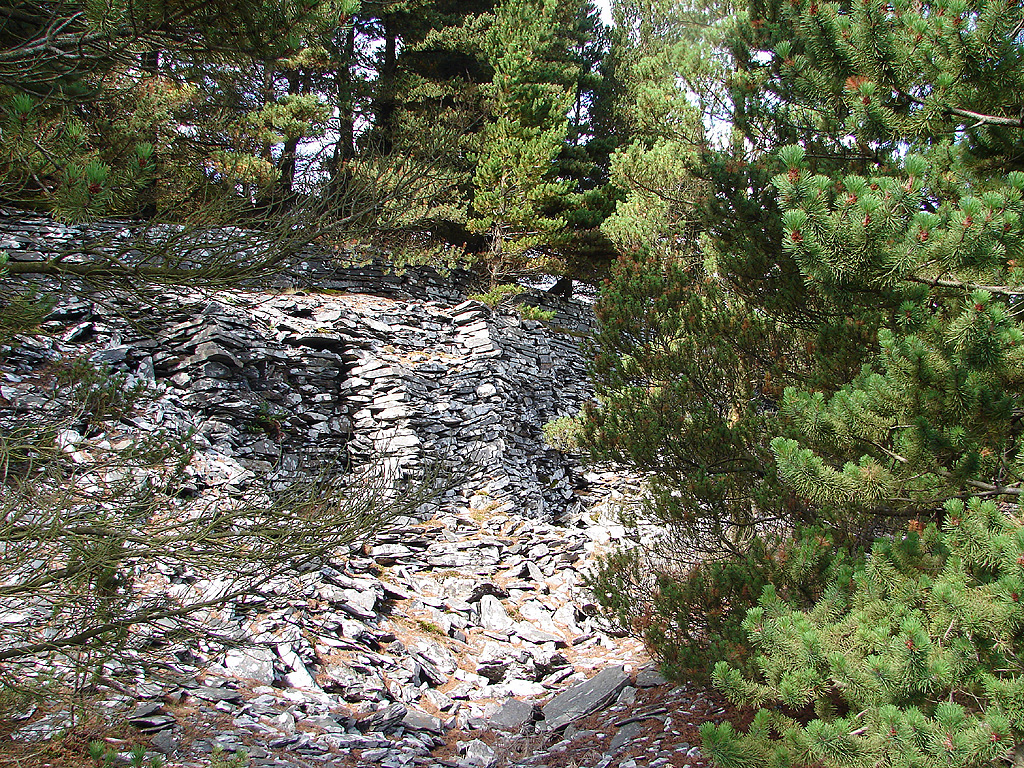
Now under Forestry Commission plantation; most inclines and quarry infrastructure have been reclaimed by forestry, though footpaths give access and substantial ruined structures survive.
Ruined quarry buildings, spoil tips, a winding house and a wagon turntable survive among the forestry plantation that now covers most of the site.
Related mines
- Dolgoch Quarry — The two quarries worked the same Broad Vein and Narrow Vein a mile and a half apart.
Nearby mines
- Cwm Ebol Quarry — 2.5 miles (4.1 km) S
- Dolgoch Quarry — 2.8 miles (4.5 km) W
- Braichgoch Slate Mine — 3.7 miles (5.9 km) NE
- Gaewern Quarry — 3.7 miles (6.0 km) NE
- Abercwmeiddaw Slate Quarry — 3.8 miles (6.1 km) NE
Straight-line distance, within 9 miles (15 km). Show on the map.
Recorded claims
Individual factual claims, each attached to the source(s) that support it below. Where sources disagree, both are kept.
- More than 300 men worked at Bryn Eglwys at its height, making it the principal employer in the area; the Aberdovey Slate Company built the village of Abergynolwyn specifically to house them. 1
- The narrow-gauge Talyllyn Railway carried slate from Bryn Eglwys down to Tywyn Wharf from 1866 until the quarry's 1946 closure; its 1951 preservation by volunteers, made possible by that same closure, is considered the first railway in the world to be run by volunteers and a founding moment of the heritage railway movement. 1
- A serious structural collapse on 26 December 1946 rendered the quarry unsafe; remaining slate stocks were removed by 1948. 1
Photographs & further reading
A detailed account of the quarry's ownership history, workforce and its Talyllyn Railway connection.
View sourceSources
- (secondary) Bryn Eglwys quarry — Wikipedia
- (observational) Extensive remains in Bryn-Eglwys Quarry — Geograph Britain and Ireland (John Lucas)

Record created: 30 August 2026 · Last researched: 30 August 2026