 MineArchive
Diorite
| Category | Commodities |
|---|---|
| Commodity page | Diorite → |
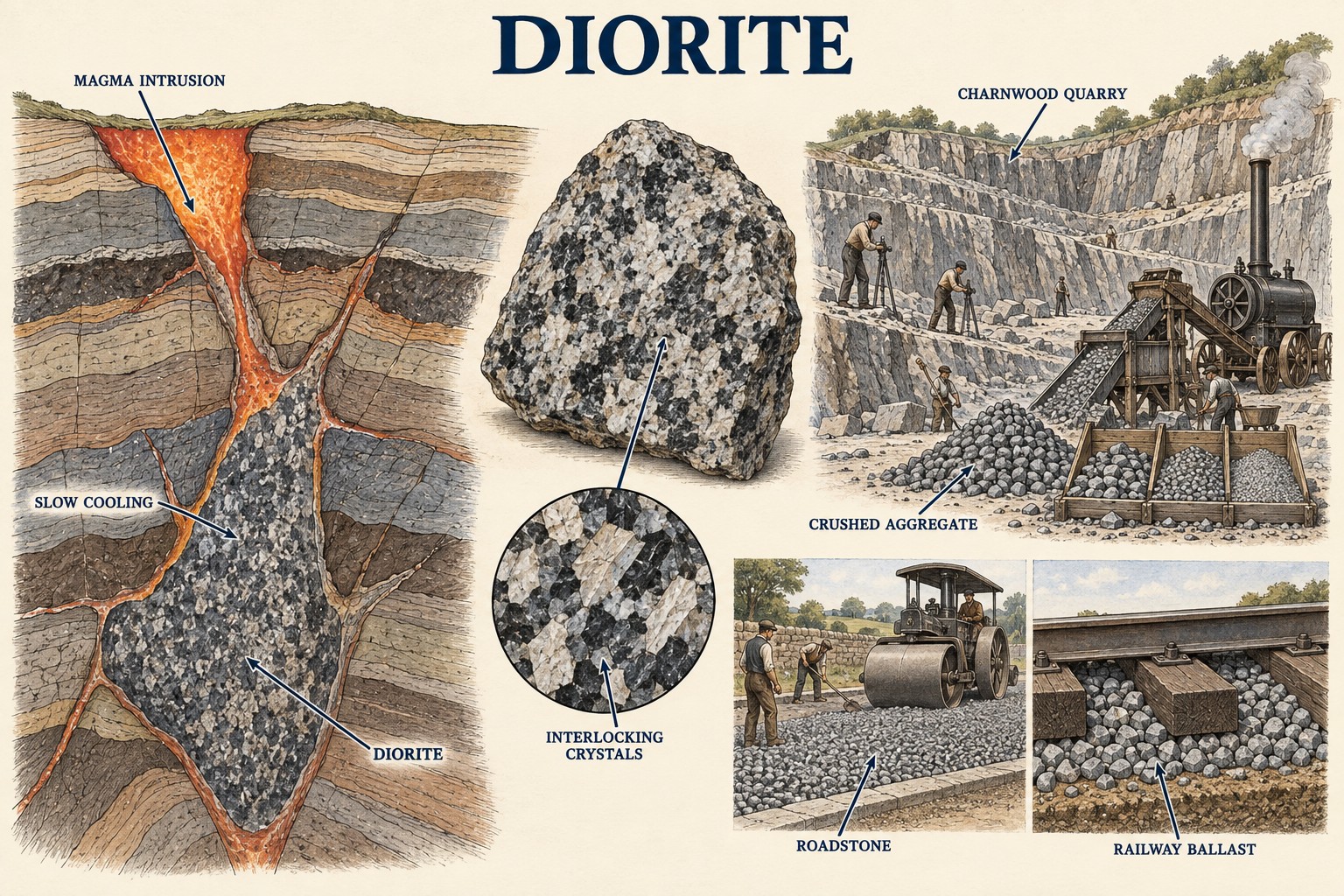
A coarse-grained igneous rock, intermediate in composition between granite and gabbro, quarried commercially across Charnwood Forest for roadstone and railway ballast rather than for any decorative or chemical use -- sold commercially as 'granite', a name geologically inexact but long-established in the trade.
Historical usage
Charnwood Forest diorite was already a significant source of roadstone by the late 19th century: by 1890 it had become the main source of aggregate for the country from the Midlands southwards, with Leicestershire quarries producing over a million tonnes a year by 1900. Longcliffe Quarry, already researched on this site, is the type section of the North Charnwood Diorite specifically.
How it worked
Formed around 600 million years ago in the late Precambrian, when molten magma intruded into surrounding sedimentary and volcaniclastic rock deep underground and cooled slowly enough to grow large, interlocking crystals -- producing the hard, blocky stone that made the rock so valuable for roadstone. Two separate intrusions are recognised in Charnwood Forest: the South Charnwood Diorite, quarried around Markfield (historically sold as 'Markfieldite'), and the North Charnwood Diorite, for which Longcliffe Quarry is the type section.
Why it was used
Diorite's hardness and interlocking crystal structure made it resistant to the crushing and abrasion of road traffic and rail ballast -- exactly the properties that mattered for 19th- and 20th-century infrastructure, rather than any chemical or decorative value.
Related terminology
Mines associated with this term
Included only where MineArchive's own research gives a reasonable evidential basis — not every mine where this might plausibly apply.
- Longcliffe Quarry — Leicestershire (well documented example)
Longcliffe Quarry is the type section of the North Charnwood Diorite, named specifically in the mine's own summary. - Midland Quarry — Warwickshire (well documented example)
Named 3 times in this record, first in the history: “…Precambrian rocks that break the surface at Nuneaton — a hard, dark diorite alongside the Cambrian sandstones and quartzites — which made the…”
See every mine that worked diorite →
Sources
- (primary) Coventry and Nuneaton, sheet 169, memoir for 1:50 000 geological map — British Geological Survey
- (secondary) The Rock Quarries of Charnwood Forest — East Midlands Geological Society
Record created: 31 August 2026 · Last researched: 1 September 2026