 MineArchive
Old Pit Radstock
| Location | Radstock, Somerset — 51.2920, -2.4460 (approximate) |
|---|---|
| Commodity | Coal |
| Type | Coal |
| Worked | 1793–No reliable closure date has yet been located. |
| Operators | Waldegrave family (1793–1896) |
Overview
Sunk in 1793 on the Waldegrave family's Manor of Radstock, Old Pit was the founding colliery of what grew into the Somerset Coalfield's central mining town — a story now told at Radstock Museum, opened when the coalfield's last mines finally closed in 1973.
History
Coal had been dug from surface outcrops and shallow bell pits across north Somerset since at least the 15th century, and the Romans are thought to have burned local coal at Bath's Temple of Minerva centuries earlier still — but Radstock itself only became a mining town once Old Pit was sunk in 1793 on the Manor of Radstock, held by the Waldegrave family, who remained Lords of the Manor and the coalfield's dominant landowners from the English Civil War onward. Old Pit was sited between the later Middle Pit and Clandown Pit workings, and its opening set off a wave of deeper, more heavily capitalised sinkings across the district through the first half of the 19th century — Ludlows, Middle Pit, Smallcombe, Tynings and Wellsway among them — as steam winding and pumping technology made coal seams beyond the reach of earlier bell-pit working newly viable. By 1896 the Radstock pits, Old Pit among them, were held by the trustees of the late Countess Waldegrave, with colliery manager James McMurtrie's chief duty reportedly being to forward £2,000 a quarter to the Countess's estate, or explain why he could not. The wider Somerset Coalfield that Old Pit had opened up went on to reach a remarkable peak of 79 separate collieries and around 1.25 million tons of annual output by 1901, though narrow, difficult seams and chronic labour shortages meant the number of working pits had already fallen to about 14 by the mid-1930s. Old Pit itself does not appear to have survived into the coalfield's 20th-century contraction; the district's remaining mines were nationalised on 1 January 1947, and the coalfield's story finally ended in September 1973 when its last two working pits, Kilmersdon and Writhlington, closed — bringing to a close some two thousand years of coal working in Somerset, reckoned from its earliest Roman use. Local people determined that the miners' contribution should not be forgotten, and the result, opened in 1989 and relocated to Radstock's restored Victorian Market Hall in 1999, is Radstock Museum, whose collections on Somerset Coalfield life also honour the pioneering geologist William Smith — sometimes called the Father of English Geology — who spent formative years working on the nearby Somerset Coal Canal.
Geology
Old Pit worked the Somerset Coalfield's Upper Coal Measures, a Carboniferous sequence notorious among British coalfields for its narrow, steeply folded and faulted seams — geology that made Somerset coal comparatively difficult and expensive to win even by the standards of the day, and which ultimately limited how far mechanisation could keep the coalfield competitive against larger, more regularly bedded coalfields elsewhere in Britain.
Workings
A deep shaft colliery, part of the first wave of steam-powered pits sunk across the Radstock district from the 1790s, working coal seams too deep for the shallow surface pits and bell pits that had served the area previously.
Closure
No precise closure date for Old Pit itself is recorded; the wider Somerset Coalfield it founded peaked at 79 collieries around 1901 before contracting through the 20th century, with the district's last mines nationalised in 1947 and the coalfield finally closing in September 1973.
What remains
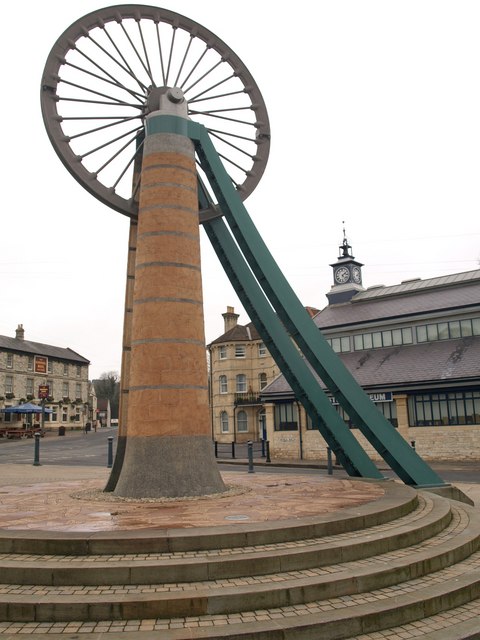
No surface remains specific to Old Pit itself are documented. The wider story of the colliery and the coalfield it founded is told today at Radstock Museum, in the town's restored Victorian Market Hall, whose collections include a restored colliery winding wheel displayed outside the building.
No surface remains specific to Old Pit itself are documented; the town's mining heritage more broadly is represented at Radstock Museum nearby.
Related mines
- Tyning Colliery — Both held by the Waldegrave family and named together on the same Mining Remediation Authority abandonment plan group.
Nearby mines
- Tyning Colliery — 1.0 km E
- Clandown Colliery — 1.8 km NW
- Braysdown Colliery — 2.5 km NE
- Norton Hill Colliery — 3.0 km W
- Camerton Colliery — 3.1 km N
Straight-line distance, within 15 km. Show on the map.
Recorded claims
Individual factual claims, each attached to the source(s) that support it below. Where sources disagree, both are kept.
- Old Pit was sunk in 1793 on the Manor of Radstock, held by the Waldegrave family, situated between the later Middle Pit and Clandown Pit workings. 1
- By 1896 the Radstock pits were held by the trustees of the late Countess Waldegrave; colliery manager James McMurtrie's chief duty was reportedly to forward £2,000 a quarter to the Countess's estate. 1
- The Somerset Coalfield peaked at 79 separate collieries and around 1.25 million tons of annual output by 1901, falling to about 14 working pits by the mid-1930s; remaining mines were nationalised on 1 January 1947, and the coalfield's last two pits, Kilmersdon and Writhlington, closed in September 1973. 1
- Radstock Museum, founded in 1989 and relocated to Radstock's restored Victorian Market Hall in 1999, tells the story of Somerset Coalfield life and also commemorates geologist William Smith, who worked on the nearby Somerset Coal Canal. 2
- Old Pit is named alongside Radstock, Smallcombe, Tyning, Middle, Ludlow and Wellsway on a combined abandonment plan (seam: Top Little) held by the Mining Remediation Authority, confirming it as one of the linked group of pits worked across the Radstock coalfield. 3
Photographs & further reading
Overview of the Somerset Coalfield and the Waldegrave family's Radstock pits.
View sourceWikipedia article on the museum that tells the story of the Somerset Coalfield Old Pit founded.
View sourceSources
- (secondary) Somerset Coal Mining – History! — Somer Valley Audio Trails
- (secondary) Radstock Museum — Wikipedia
- (primary) BGS/Mining Remediation Authority abandonment plan: Radstock/Smallcombe/Tyning/Middle/Ludlow/Wellsway/Old Pit — Mining Remediation Authority (via BGS OGC API)
Record created: 27 August 2026 · Last researched: 27 August 2026