 MineArchive
Mona Mine
| Location | Parys Mountain, near Amlwch, Anglesey — 53.3871, -4.3374 (exact) |
|---|---|
| Commodity | Copper |
| Type | Metal |
| Worked | 1764 (lease)–1899 (merger) |
| Operators | Parys Mine Company (1774–1802) |
Overview
One of the two great copper mines that made Parys Mountain briefly the largest copper mine in the world, worked alongside neighbouring Parys Mine under the industrialist Thomas Williams, whose combined operation supplied the copper sheathing for Britain's navy.
History
Copper has been worked at Parys Mountain, two miles south of Amlwch, for around 3,500 years, but large-scale industrial mining began only after the Bayley family — who held the eastern part of the mountain where Mona mine was later sunk — leased mining rights in 1764 to Roe and Company of Macclesfield for 21 years. A rich copper strike on 2 March 1768, close to the existing Golden Venture shaft, launched open-cast working on a new scale.
Boundary disputes with the neighbouring Parys mine were eventually resolved when the industrialist Thomas Williams gained control of both operations and formed the Parys Mine Company in 1774; by the late 1780s he had complete control of Anglesey's and Cornwall's combined copper production. Between 1785 and 1788 Williams invested over £61,000 modernising Mona mine and building a new quay at Amlwch Port, and at its peak under his management the combined Mona and Parys operation employed some 1,200 people. Parys Mountain copper, supplied in quantity, sheathed the hulls of the Royal Navy's fleet, coppered in its entirety between 1778 and 1782.
Production collapsed after Williams' death in 1802; by 1808 only 120 men remained employed. Control passed in 1811 to Lord Uxbridge (later Marquess of Anglesey) of Plas Newydd, and John Vivian of the Swansea copper family took a controlling interest, bringing in Cornish miners under manager James Treweek (1811-1851). The mine was redeveloped through deeper shafts and dewatering engines: by 1829 it was raising 16,400 tonnes of ore a year, about half its open-cast peak, and through the 1820s Mona mine ran sixteen smelting furnaces of its own, producing around 350 tons of copper metal a year. Strikes over wages hit the mine in 1860 and 1863 as the industry's fortunes weakened.
By 1879 operations had contracted to the mountain's ochre pits as copper output fell away further; Mona mine itself was leased to Thomas Fanning Evans and John Wynne Paynter from 1866. Mona and Parys formally merged in 1899 to form Mona and Parys Mines Ltd, by which point work was concentrated on the precipitation and ochre works at Dyffryn Adda; the 1901 census recorded just 141 workers. A receiver was called in by 1921. Across the mountain's full working life from 1768 to 1904, an estimated 3.5 million tons of ore was raised, yielding around 130,000 tons of copper metal, through some 20 kilometres of underground tunnels.
Geology
Parys Mountain is a volcanic-hosted massive sulphide (VMS) zinc-lead-copper deposit, formed where Ordovician shales meet an overlying sequence of Silurian rhyolite and basalt volcanics. Mona mine's own ore came chiefly from what is now called the Northern Copper Zone, where chalcopyrite-pyrite-rich veins and pods of semi-massive sulphide up to 15 metres thick were worked for copper from the 18th century onward; the mountain's separate zinc- and lead-rich 'bluestone' massive sulphides saw comparatively little production by contrast.
Workings
Worked first by open-cast quarrying from 1768, then increasingly by deep shafts with steam dewatering engines from the early 19th century as the shallow, richest ore was exhausted; ore was smelted in Mona's own bank of furnaces before being shipped from a purpose-built quay at Amlwch Port.
Closure
Copper production fell away through the mid-to-late 19th century as richer ore ran out; by 1879 work had shifted to ochre extraction, Mona and Parys merged formally in 1899, and a receiver was called in by 1921.
What remains
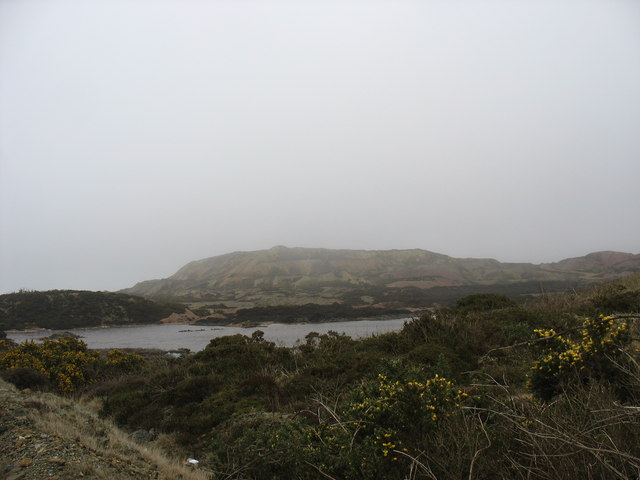
Extensive flooded and open pit workings, spoil and colourful mineral-stained ground survive across Parys Mountain, now managed as a heritage and geological site; modern exploration for polymetallic ore resumed from 1955, with further deposits identified in 1973.
Flooded copper pits, open workings and dramatically mineral-stained ground survive across Parys Mountain, alongside the remains of Amlwch's harbour infrastructure built to ship its ore.
Related mines
- Parys Mountain — Mona Mine was one of the two great mines making up Parys Mountain, worked at times as a single combined operation.
Nearby mines
- Parys Mountain — 0.7 miles (1.1 km) SW
- Morfa Du Mine — 1.0 miles (1.6 km) W
- Aber Quarry — 4.5 miles (7.3 km) SE
- Mynachdy (Rhosmynach and Carmel Head Copper Mines) — 8.9 miles (14.3 km) W
Straight-line distance, within 9 miles (15 km). Show on the map.
Old workings on Parys Mountain are hazardous — this entry describes history only, not an access guide.
Recorded claims
Individual factual claims, each attached to the source(s) that support it below. Where sources disagree, both are kept.
- The Bayley family leased mining rights on the eastern (Mona) part of Parys Mountain to Roe and Company in 1764; a rich copper strike on 2 March 1768 launched large-scale open-cast working. 1
- Thomas Williams formed the Parys Mine Company in 1774, invested over £61,000 modernising Mona mine by 1788, and at peak the combined operation employed around 1,200 people, supplying copper sheathing for the Royal Navy's fleet. 1
- Production collapsed after Williams' death in 1802; under Lord Uxbridge and the Vivian family from 1811 the mine was redeveloped but never regained its former scale, contracting to ochre extraction by 1879 and formally merging with Parys mine in 1899. 1
- Parys Mountain is a volcanic-hosted massive sulphide deposit; Mona mine's ore came chiefly from the chalcopyrite-pyrite-rich Northern Copper Zone. 2
Sources
- (secondary) History — Grwp Tanddaearol PARYS Underground Group — Grwp Tanddaearol PARYS Underground Group
- (secondary) Geology — Anglesey Mining plc
Record created: 27 August 2026 · Last researched: 27 August 2026