 MineArchive
Mundic
| Dialect | Cornish |
|---|---|
| Category | Place-names & Language |
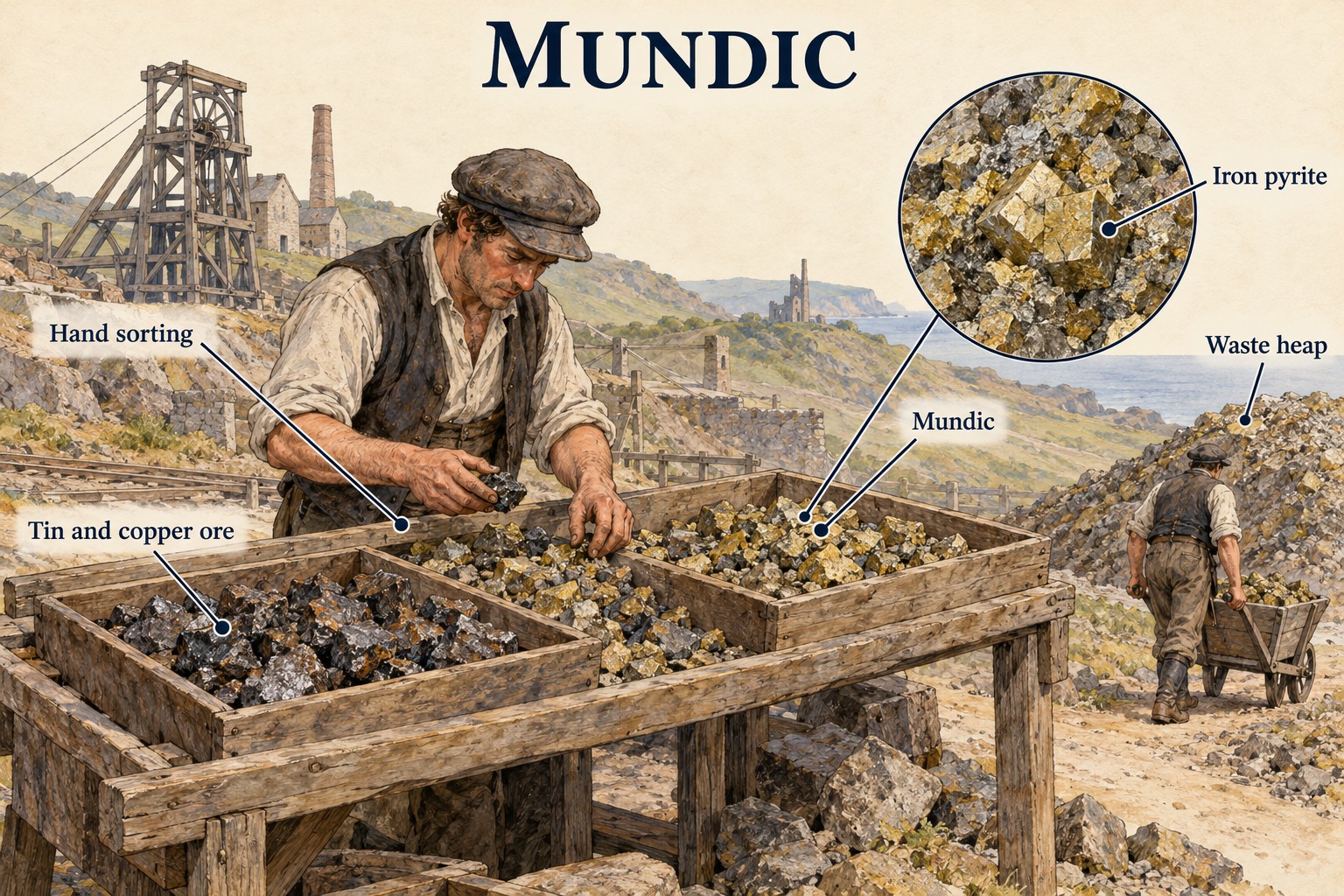
The Cornish and Devon word for iron pyrite (and, by extension, related sulphide minerals such as arsenopyrite) found alongside tin and copper ore in a mine's lodes — worthless, and often actively troublesome, waste rock rather than the metal being sought.
Historical usage
Mundic occurs abundantly in the tin and copper lodes of Cornwall and Devon, and generations of miners raised and dumped vast quantities of it as waste alongside their genuine ore. The word survives today mainly through the 'mundic block problem': between around 1900 and 1965, mine waste containing mundic was widely used as aggregate in concrete blocks across Cornwall and west Devon, and the slow oxidisation of the pyrite within those blocks — reacting with water and oxygen to form sulphate, which expands and destroys the concrete's structural integrity — has caused serious, ongoing problems for buildings constructed from them, still a live concern for surveyors and mortgage lenders in the region today.
Why it was used
Miners needed a quick, everyday word to distinguish the pyrite-bearing waste rock that came up alongside genuine tin or copper ore from the valuable mineral itself — mundic served that purpose on the dressing floor as much as underground, wherever ore had to be sorted from worthless sulphide-rich rock.
Risks & limitations
Mundic-rich rock could complicate ore processing, since arsenopyrite in particular had to be roasted off before the underlying tin or copper could be smelted cleanly; its long afterlife as a building-aggregate hazard, discovered only decades after mining had ended, shows how a mine's waste rock could keep causing problems long after the mine itself was forgotten.
Regional variation
A specifically Cornish and Devon term, tied to the tin and copper lodes of the South West rather than being general British mining vocabulary.
Related terminology
Mines associated with this term
5 examples chosen from 6 linked records — the term page is not an index.
- Devon Great Consols — Devon (well documented example)
The copper lodes carried large quantities of mundic — arsenical pyrite — which is what made the mine's later arsenic industry possible. - Gawton Mine — Devon (well documented example)
Named 3 times in this record, first in the history: “…January 1899: roughly 30 tons of overhanging rock collapsed on the mundic lode at the 95-fathom level some fifteen minutes after a blast that…” - Nangiles Mine — Cornwall (well documented example)
Named in this record’s geology: “Nangiles worked the Mundic (or Baldu) and Nangiles Copper lodes, part of the same…” - New Consols Mine — Cornwall (well documented example)
The mine's own recorded history explicitly describes extensive arsenic-processing plant added to roast mundic-rich ore. - Tomnadashan Copper Mine — Perth and Kinross (well documented example)
Named in this record’s geology: “The deposit consisted of chalcopyrite, iron pyrites (mundic) and arsenic- and antimony-bearing grey copper ore hosted in…”
Sources
- (secondary) Mundic — Wikipedia
- (secondary) Mundic Info — Petrolab
Record created: 23 August 2026 · Last researched: 23 August 2026