 MineArchive
Cobscar Mill
| Location | Redmire, Wensleydale, North Yorkshire — 54.3330, -1.9103 (exact) |
|---|---|
| Commodities | Lead, Zinc |
| Type | Metal |
| Worked | 1762–c. 1830 |
| Operators | James Plews (1762–?), William Orde-Powlett, 2nd Baron Bolton (1848–?) |
Overview
Cobscar, on the moor above Redmire in Wensleydale, was a purpose-built water-powered lead smelt mill that served its own rake and a neighbouring mine for a working life of roughly seventy years — long enough to be refurbished once by its aristocratic owner before finally falling silent.
History
The water-powered smeltmill at Cobscar was built in 1762 by James Plews to smelt ore from Cobscar Rake, on which it stands, and from the nearby Cranehow Bottom Mine. The mill was divided into three bays, with a waterwheel of around six metres diameter powering a single set of bellows in the central bay, blowing two ore hearths to the south and a slag hearth to the north. By 1823 the rake was described as 'nearly exhausted', and the mill probably closed around 1830. In 1848 William Orde-Powlett, 2nd Baron Bolton, had the mine and mill refurbished, and in 1855 a long flue was built to connect the Keld Heads Mine to the one already running from Cobscar Mill. The site also included a calamine house, used to process zinc blende (calamine) whenever a significant quantity turned up alongside the lead ore.
Geology
The mill processed ore from lead veins of the northern Pennine orefield in Wensleydale, a hydrothermal, non-magmatic mineralised system distinct from the granite-related lodes of Cornwall and Devon.
Geological setting: Hydrothermal Deposits (well documented example), Veins and Lodes (well documented example)
Workings
A waterwheel of around six metres diameter powered a single set of bellows serving two ore hearths and a slag hearth across the mill's three bays; a long flue, extended in 1855 to connect with the neighbouring Keld Heads Mine, carried smoke and fumes away from the hearths, and a separate calamine house processed any zinc blende found alongside the lead ore.
Closure
The rake was described as 'nearly exhausted' by 1823 and the mill probably closed around 1830, despite a refurbishment by Baron Bolton in 1848.
What remains
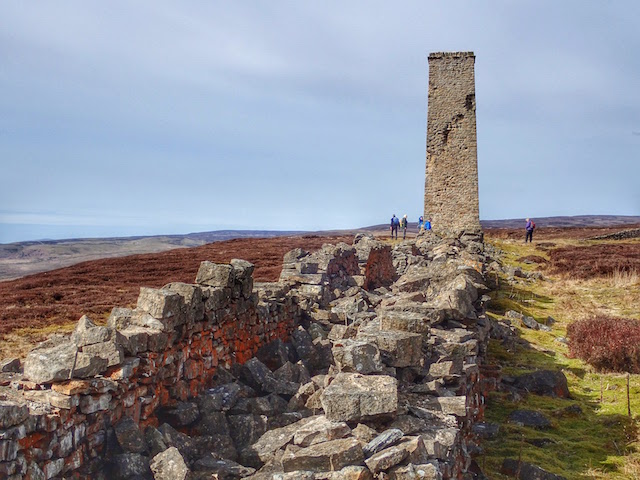
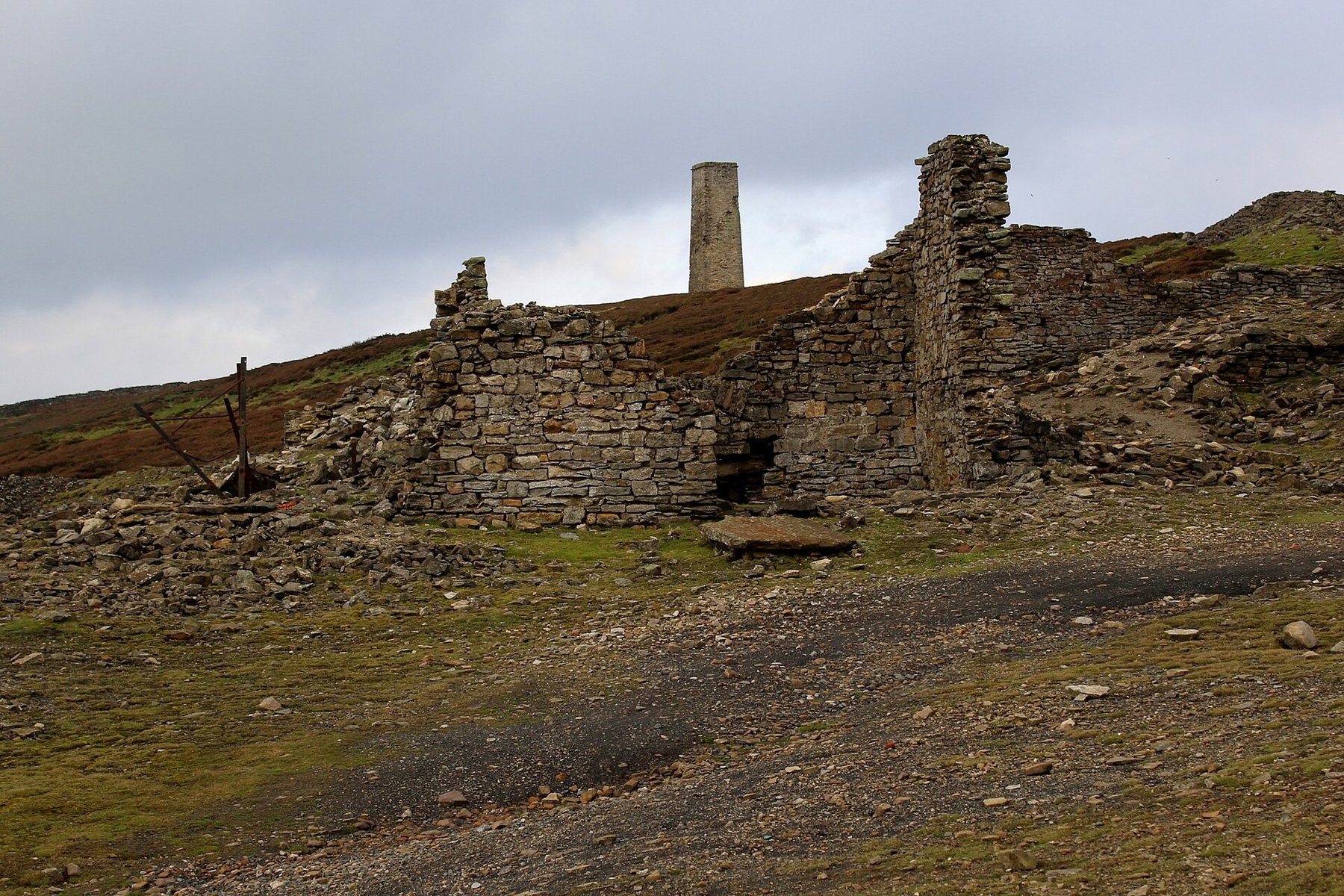
The mill building survives choked with rubble following partial demolition by the army in the late 1940s, with walling up to around four metres high in places; its associated 1848 chimney, some 12 metres tall, survives as a restored Grade II listed structure on the moor above.
Related mines
- Bolton Parks Lead Mine — Bolton Parks worked the Cobscar vein, the same vein on whose rake above Redmire the Cobscar smeltmill stood; the mill was refurbished for Lord Bolton in 1848, the year before the mine's first recorded shareholders.
- Keld Heads Mine — A flue built in 1855 physically connected Keld Heads Mine to Cobscar Mill.
- Redmire Quarry — The Cobscar lead vein and hush lie behind the quarry face; a Redmire quarryman lived in part of Cobscar smelting mill in 1933.
Nearby mines
- Redmire Quarry — 0.7 miles (1.2 km) W
- Wensley Quarry — 0.8 miles (1.3 km) SE
- Keld Heads Mine — 1.7 miles (2.7 km) SE
- Bolton Parks Lead Mine — 1.8 miles (3.0 km) W
- Whiteside Mine — 2.0 miles (3.3 km) NW
Straight-line distance, within 9 miles (15 km). Show on the map.
Recorded claims
Individual factual claims, each attached to the source(s) that support it below. Where sources disagree, both are kept.
- The mill's waterwheel, around six metres in diameter, powered a single set of bellows serving two ore hearths and a slag hearth across the mill's three bays. 1,2
- In 1848 Baron Bolton had the mine and mill refurbished, and in 1855 a long flue was built connecting the neighbouring Keld Heads Mine to the one already running from Cobscar Mill. 1
- The mill's walls survive to around two metres high, and to four metres in one section, with the flue and chimney on the hillside above. 1
- Located at about 54.333 N, 1.910 W. 1
Photographs & further reading
A June 2026 walk along the Cobscar vein and down to Keld Heads, with a marked-up map of which levels were open and which were not. Covers the ruined 'calamine house' where zinc blende was processed, the chimney and flue system linking Cobscar's smelt mill to Keld Heads far downhill, and the surviving iron straps of a hearth at Cobscar Mill itself.
View sourceSources
- (secondary) Cobscar Mill — Wikipedia
- (primary) Cobscar Mill ore hearth lead smeltmill, flue and chimney, Redmire — Historic England (Scheduled Monument record)
Record created: 23 August 2026 · Last researched: 24 September 2026