 MineArchive
Redmire Quarry
| Location | Redmire Scar, above Redmire, Wensleydale, North Yorkshire — 54.3330, -1.9285 (approximate) |
|---|---|
| Commodity | Limestone |
| Type | Quarry |
| Worked | Before 1912–1992 |
| Maximum depth | Unknown. |
| Operators | Thorny Bank Lime Company (?–1912), John Stringer Calvert (1912–1929), Dorman, Long and Company (1929–?), Tarmac (?–1992), British Steel Corporation |
Overview
A limestone quarry on Redmire Scar above Wensleydale that sent stone to the ironworks of Teesside from 1912, by aerial ropeway to Redmire station from 1919. Dorman Long took it over in 1929; British Steel and Tarmac later ran it, and it closed in 1992.
History
Redmire Quarry lies on the edge of Redmire Scar above Redmire, where the Cobscar lead vein was found in 1650 and later worked by the Cobscar Hush, whose remains stood behind the quarry face in 1921. The moor colliery, almost exhausted by the late nineteenth century, still produced just enough coal to burn limestone at the quarry, worked by the Thorny Bank Lime Company until some time between 1908 and 1912, when John Stringer Calvert of Redmire took it over. From 1912 it was sending industrial lime as sinter dust to the ironworks on Teesside. In 1919 Calvert put up an aerial ropeway to carry about 140 tons of limestone a day down to Redmire station, and in 1938 its eleven wooden pylons were replaced by thirteen steel ones, raising its capacity by forty per cent.
Dorman Long of Middlesbrough took the quarry over in 1929 and worked it as the Wensleydale Quarry Co. Ltd, and men came from Weardale to work it. It was mothballed for a while, some of its men going to quarries near Bollihope, and in the Second World War Dorman Long was persuaded to reopen it, with men directed there under the Defence (General) Regulations 1939 as work of national importance. British Steel and Tarmac later ran it on equal shares until Tarmac took it over completely. Daily limestone trains ran from the loading terminal at Redmire station to the steelworks at Redcar, and kept the Wensleydale branch open after the 1960s, until the traffic ended in December 1992. The ropeway's end is dated differently: 1962 in one account, while another has stone going by ropeway to the station sidings until the loading point closed in 1992. In 1992 the plant at Redmire was dismantled and mobile plant put into the old Preston Quarry, and the neighbouring Wensley Quarry increased its output of industrial carbonate.
Geology
Limestone on Redmire Scar, cut into the ground of the Cobscar lead vein and its hush.
Workings
Quarry faces on Redmire Scar, with lime-burning before 1912; an aerial ropeway of 1919 to the loading sidings at Redmire station, rebuilt with thirteen steel pylons in 1938.
Closure
The plant was dismantled in 1992, when the limestone trains from Redmire station ended.
What remains
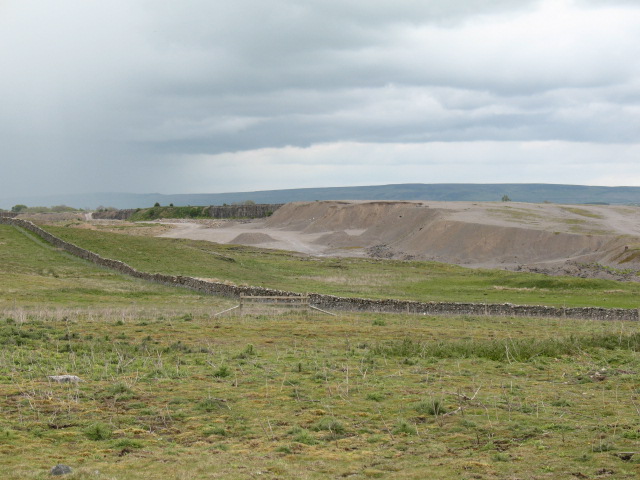
Disused since 1992; the worked ground and pale spoil banks remain on the moor edge.
Redevelopment
Unknown.
Related mines
- Cobscar Mill — The Cobscar lead vein and hush lie behind the quarry face; a Redmire quarryman lived in part of Cobscar smelting mill in 1933.
- Wensley Quarry — Neighbouring Wensleydale limestone quarries; Wensley increased its output when Redmire closed in 1992.
Nearby mines
- Cobscar Mill — 0.7 miles (1.2 km) E
- Bolton Parks Lead Mine — 1.1 miles (1.8 km) W
- Wensley Quarry — 1.3 miles (2.2 km) SE
- Whiteside Mine — 1.9 miles (3.0 km) N
- Grinton Smelt Mill — 2.1 miles (3.4 km) N
Straight-line distance, within 9 miles (15 km). Show on the map.
Culture
- Fred Lawson's Redmire Quarry (1921) (Art)
Fred Lawson painted quarrymen at work at Redmire Quarry in 1921, two years after John Stringer Calvert built its aerial ropeway.
What's uncertain
Points where sources disagree or the record could not be settled; both accounts are kept. All open questions in the archive.
- The aerial ropeway ceased working in 1962. (disputed) 2
- Stone went by aerial ropeway to the Redmire station sidings until the loading point closed in 1992. (disputed) 1
Recorded claims
Individual factual claims, each attached to the source(s) that support it below. Where sources disagree, both are kept.
- Redmire Quarry was sending industrial lime as sinter dust to the ironworks on Teesside from 1912. 1
- An aerial ropeway was built in 1919 to carry about 140 tons of limestone a day to Redmire station. 2,3
- In 1938 the ropeway's eleven wooden pylons were replaced by thirteen steel ones, raising its capacity by 40 per cent. 2
- The aerial ropeway ceased working in 1962. (disputed) 2
- Stone went by aerial ropeway to the Redmire station sidings until the loading point closed in 1992. (disputed) 1
- Dorman Long of Middlesbrough took the quarry over in 1929 and worked it as the Wensleydale Quarry Co. Ltd. 3
- The quarry closed in 1992, when its plant was dismantled and the limestone trains from Redmire ended. 1,3,4
Photographs & further reading
The quarry's owners from the lime company to Tarmac, its ropeway and its men.
View sourceThe neighbouring quarry, with Redmire's Teesside trade and closure.
View sourceThe Redmire ropeway's dates, capacity and pylons.
View sourceSources
- (secondary) Wensley Quarry — Wikipedia
- (secondary) UK Gazetteer: Aerial Ropeways — ropeways.co.uk
- (secondary) Redmire Quarry and Fred Lawson's Painting — Yorkshire Dales History (Ian Spensley)
- (secondary) Redmire railway station — Wikipedia
Record created: 4 October 2026 · Last researched: 4 October 2026