 MineArchive
Grinton Smelt Mill
| Also known as | How Mill, Low Mill, Grinton Mill |
|---|---|
| Location | Cogden Moor, 2 km south of Grinton, Swaledale, at the meeting of Cogden Gill and Smales Gill, North Yorkshire — 54.3633, -1.9264 (exact) |
| Commodity | Lead |
| Type | Metal |
| Worked | c. 1727 (first mill); rebuilt 1820-22–1886-95 (sources differ) |
| Maximum depth | Not applicable; a surface smelt mill. |
| Operators | Grinton Mining and Smelting Company Limited (?–1895) |
Overview
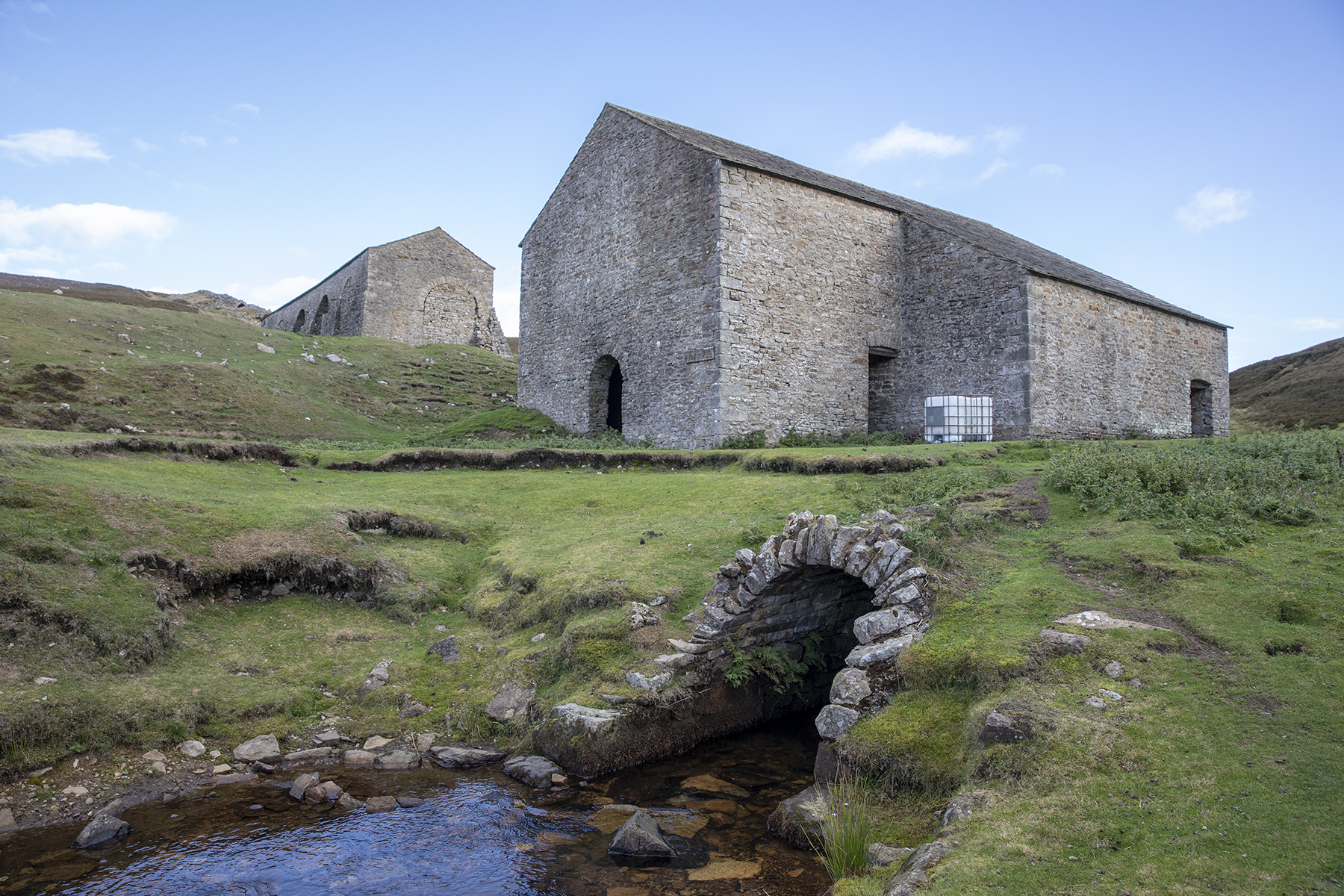
A lead smelt mill on Cogden Moor south of Grinton in Swaledale, which smelted ore from the Grinton How Vein. A mill stood here from the early 18th century; the present buildings, the mill, peat store and a 300-metre flue up Sharrow Hill, date from a rebuilding of 1820-22. Smelting ended between 1886 and 1895, and the site is now scheduled and listed as the best-preserved lead smelting complex in the Yorkshire Dales.
History
Lead was worked around Grinton long before the mill: the first written record is a mandate of 1219 for the king's workmen in the manors of Swaledale and Wensleydale. After the Dissolution the Crown kept the mineral rights. Because lead ore is so heavy, Swaledale's smelt mills were built close to the mines they served, and Grinton's took its ore from the Grinton How Vein just to the south, worked by Grinton How, Whiteside and Fearnought mines. It was also known as How Mill, after the vein, and as Low Mill. Reginald Marriott was granted the right to mine here in 1696, which led to a long lawsuit with Lord Wharton, decided in Marriott's favour after three years. The first mill is credited to William Marriott in about 1727. Historic England says the London Lead Company is believed to have bought the mill and two mines in 1733; more recent research doubts it ever worked in Swaledale. In the 1730s the mill turned out a little over 100 tons of lead a year. It passed to Caleb Readshaw in 1756, and after Readshaw Morley's bankruptcy in 1791 to Fenton and Wilkinson, who sold it in 1803 to the Whitelocks of Cogden Hall. Between 1820 and 1822 the Grinton ore was smelted elsewhere while the mill was rebuilt and the long flue and chimney built. Charlesworth bought the mineral rights and the mill in 1876. The York Herald reported the mine closed in 1886 and a new 21-year lease taken; the mill was repaired in 1888 and 1892, but the Grinton Mining and Smelting Company was dissolved in 1895 and the mill never smelted again. It was later used as a sheep wash and for sheltering cattle.
Geology
Smelted galena from the Grinton How Vein, a lead vein in the Carboniferous rocks of Swaledale.
Workings
A T-shaped furnace house 15 m by 10 m, which held three ore hearths, with a bellows house behind driven by an overshot waterwheel of about 20 ft fed by a launder from a dammed reservoir. An arched flue 1.8 m high runs 290-300 m east up Sharrow Hill to a chimney, with openings for scraping out the condensed lead. A peat store with arched openings stands beside the mill.
Closure
Several sources give 1886, when the York Herald reported the mine closed. The mill was refurbished in 1888 and 1892, and some sources say smelting continued to 1893. The Grinton Mining and Smelting Company was dissolved in 1895, after which the mill never smelted again.
What remains
The mill and peat store stand roofed, re-roofed in 1987 and repaired in 1998 with National Park and EU money. The July 2019 floods swept away the barrel-arched watercourse, and the mill's edge was protected in 2020.
Mill and bellows house, peat store, the flue and the footings of its chimney, the site of a smithy, dams, leats, tracks and slag.
Redevelopment
None; a scheduled monument, with the mill listed Grade II* and the flue and peat store Grade II.
Related mines
- Whiteside Mine — Whiteside was one of the three Grinton How Vein mines whose ore this mill smelted.
Nearby mines
- Whiteside Mine — 0.4 km SW
- Marrick Lead Mines — 2.3 km NE
- Surrender Mine — 3.1 km NW
- Fremington Edge Quarry — 4.9 km N
- Old Gang Mines — 4.9 km NW
Straight-line distance, within 15 km. Show on the map.
People
- Reginald Marriott · lessee, 1696–1727 — Granted the right to mine at Grinton in 1696 and won the lawsuit Lord Wharton brought over it.
- William Marriott · founder, from 1727 — Built the first smelt mill on the site in about 1727.
- Caleb Readshaw · owner, from 1756 — Bought the mill in 1756; later a shareholder in the mines who let the mill out.
What's uncertain
Points where sources disagree or the record could not be settled; both accounts are kept. All open questions in the archive.
- The London Lead Company is believed to have bought the site and two mines in 1733, though modern research doubts it ever operated in Swaledale. (uncertain) 1
- Several sources give a closure in 1886; the York Herald of 1887 reported the mine closed in 1886 and a new 21-year lease taken. (disputed) 1
- Repairs were made in 1888 and 1892, but the Grinton Mining and Smelting Co Ltd was dissolved in 1895 and the mill never smelted again. (disputed) 2
Recorded claims
Individual factual claims, each attached to the source(s) that support it below. Where sources disagree, both are kept.
- The mill smelted lead from the Grinton How Vein, mined at Grinton How, Whiteside and Fearnought mines just to the south. 1
- The first mill was built about 1727 by William Marriott. 1
- Historic England dates the original complex to the early or mid 18th century, probably established by the Marriott family, crown lessees of the Grinton and Harkerside mines. 2
- The London Lead Company is believed to have bought the site and two mines in 1733, though modern research doubts it ever operated in Swaledale. (uncertain) 1
- The mill passed to Caleb Readshaw in 1756; after Readshaw Morley's bankruptcy in 1791 it went to Fenton and Wilkinson, who sold it to the Whitelocks of Cogden Hall in 1803. 2
- The mill was rebuilt, and the flue and chimney constructed, between 1820 and 1822. 2,1
- Several sources give a closure in 1886; the York Herald of 1887 reported the mine closed in 1886 and a new 21-year lease taken. (disputed) 1
- Repairs were made in 1888 and 1892, but the Grinton Mining and Smelting Co Ltd was dissolved in 1895 and the mill never smelted again. (disputed) 2
- The furnace house held three ore hearths; the flue runs 290 m up Sharrow Hill to a chimney, and the complex is one of the best preserved in the Yorkshire Dales. 2,1
- Mine plans for Grinton Moor cover the Cooper's, Devis Hole, Grove Beck and How workings. 3
Photographs & further reading
Full description of the mill, flue, peat store and earthworks, with the ownership history.
View sourceSources
- (secondary) Grinton Smelt Mill — Wikipedia
- (primary) Grinton ore hearth lead smelt mill, flue, fuel store and associated earthworks, Grinton — Historic England (Scheduled Monument record)
- (primary) BGS / Mining Remediation Authority mine plans: GRINTON MOOR COOPER'S DEVIS HOLE GROVE BECK HOW — British Geological Survey / Mining Remediation Authority
Record created: 18 September 2026 · Last researched: 18 September 2026