 MineArchive
Gawton Mine
| Location | Gulworthy, Tamar valley, Devon — 50.4990, -4.1830 (exact) |
|---|---|
| Commodities | Arsenic, Copper |
| Type | Mineral |
| Worked | Before 1846–1902–03 (arsenic works) |
| Maximum depth | worked to at least the 95-fathom level |
Overview
A copper and arsenic mine on the Devon bank of the River Tamar near Gulworthy, worked for copper (and earlier tin) before switching to arsenic production around 1846. Historic England rates it the best-preserved arsenic mine, ore-dressing, calcining and refining complex of its type in the country, with two rare surviving Brunton calciners and the longest, most impressive arsenic flue in England, ending in a distinctively leaning chimney. A fatal rock fall in January 1899 killed two miners.
History
Gawton was worked for copper, and earlier tin, using water power alone in its earliest phase, before switching to arsenic production from about 1846. Interruptions to its water supply led to the surface buildings being completely rebuilt in 1890, when an arsenic refinery was added. The dedicated arsenic works operated from 1887 to 1903, and Devon Great Consols took over the works in 1895 — together the two were the largest arsenic producers in the region, though Gawton was, in Historic England's words, 'not totally successful in its own right.' A fatal rock fall struck the mine on 27 January 1899: roughly 30 tons of overhanging rock collapsed on the mundic lode at the 95-fathom level some fifteen minutes after a blast that had been sounded for safety and appeared sound, killing miners Thomas Stacey and Ernest Coniam and injuring two more. A coroner's inquest, attended by H.M. Inspector of Mines E. E. V. Stokes, returned a verdict of accidental death and recommended more timber and examination ladders be used underground in future. The arsenic works finally closed around 1902-03; the last recorded activity on site was in 1926, when copper was still being precipitated from run-off draining the waste dumps, long after active mining and arsenic production had ceased. The original chimney had to be relocated further up the valley side after arsenic fumes made children at a nearby school ill.
Geology
Arsenopyrite, the miners' 'mundic', with copper alongside it in the Tamar valley; the arsenic was driven off by roasting the crushed ore in Brunton calciners.
Workings
Crushed arsenopyrite ('mundic') ore was roasted in a calciner — Gawton used two Brunton calciners, brick-covered rotating iron plates over a furnace on which crushed ore was mechanically turned — driving off arsenic as vapour. The vapour passed into a long zig-zagging flue or 'labyrinth,' where it cooled and crystallised as arsenical soot on the walls, scraped off by hand at the end of each burn. This soot was re-roasted in a bottle-shaped kiln or reverberatory furnace and re-vaporised into a second labyrinth, recrystallising as near-pure white arsenic trioxide; where water was available, an 8-10ft 'waterfall chamber' packed with brushwood and sprayed with water scrubbed much of the remaining poison from the gases before they reached the chimney. The recovered soot was finally ground between millstones to produce a marketable powder of around 99.5% purity, used as a fixer in dyes and paints, an alloying agent in bronze, and later as a pesticide. Workers were repeatedly exposed to raw arsenic trioxide dust during scraping and grinding, and to acid and arsenical fumes throughout the process; acid vapours killed vegetation for a wide area around the site, which remained stunted well into the 20th century.
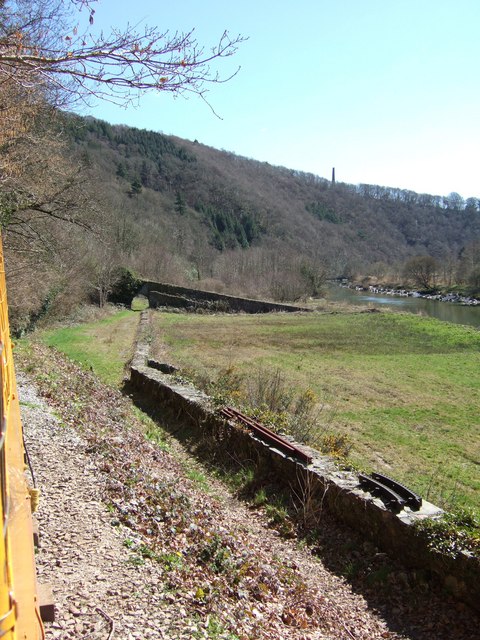
The mine's flue runs for several hundred metres up an extremely steep hillside, over 2 metres high in places with walls more than 0.7 metres thick. Underground, the 1899 inquest describes work on the 'mundic lode' at the 95-fathom level. A quay on the Tamar was used to bring limestone by barge from Plymouth to on-site limekilns, supplying lime for local agriculture as a secondary activity alongside the mining.
Closure
The arsenic works closed around 1902-03; the last recorded activity on site was in 1926, precipitating copper from run-off draining the waste dumps.
What remains
Surviving structures include limekilns, the leaning chimney and its flue, a count house, washing and crushing plant, the two Brunton calciners, a cooperage, dam and reservoir, an engine house, boiler house, smithy, refinery and quay, together with waste tips estimated to hold over 124,000 tons of material. The site is on Historic England's Heritage at Risk Register, with visible arsenic and heavy-metal contamination on surviving structures; drone and photogrammetry surveys from 2021 have documented its condition to inform future conservation.
Related mines
- Devon Great Consols — Devon Great Consols took over Gawton's arsenic works in 1895, and together the two were the region's largest arsenic producers.
Nearby mines
- Okeltor Mine — 0.4 miles (0.7 km) W, Cornwall
- George and Charlotte Copper Mine — 0.7 miles (1.1 km) NW
- Bere Alston Silver-Lead Mines — 1.2 miles (1.9 km) SW
- Danescombe Mine — 1.9 miles (3.0 km) W, Cornwall
- Drakewalls Mine — 2.0 miles (3.3 km) NW, Cornwall
Straight-line distance, within 9 miles (15 km). Show on the map.
Recorded claims
Individual factual claims, each attached to the source(s) that support it below. Where sources disagree, both are kept.
- Gawton was worked for copper and earlier tin using water power alone before switching to arsenic production from about 1846; interruptions to its water supply led to the surface buildings being completely rebuilt in 1890, when an arsenic refinery was added. 1
- The dedicated arsenic works operated from 1887 to 1903; Devon Great Consols took over the works in 1895, and together the two were the largest arsenic producers in the region. 1,2
- The arsenic works closed around 1902-03; the last recorded activity at the site was in 1926, when copper was still being precipitated from run-off draining the waste dumps. 1
- The flue runs for several hundred metres up an extremely steep hillside, over 2 metres high in places with walls more than 0.7 metres thick; two Brunton calciners survive, described by Historic England as the best-preserved example of an arsenic mine, dressing and refining complex of its type in the country. 1
- The BGS/Coal Authority mine plans catalogue holds six records for the site, including 'Gawton United', a 'Gawton' abandonment plan recording copper and arsenic ores, and a joint 'Bedford Consols and Gawton' copper-ore plan abandoned in 1878. 3
- A rock fall on the mundic lode at the 95-fathom level on 27 January 1899 killed miners Thomas Stacey and Ernest Coniam and injured two more; the coroner's inquest returned a verdict of accidental death and recommended more timber and examination ladders underground. 4
Sources
- (primary) Gawton arsenic mine and flue, Gulworthy — Historic England (Scheduled Monument List Entry 1002667)
- (secondary) Ore Processing and Smelting — Arsenic Refineries — Tamar Valley Industrial Archaeology
- (primary) Gawton mine plan records — British Geological Survey / Coal Authority mine plans catalogue
- (primary) Devon Inquests 1899: The Gawton Mine Accident / Gawton Mine Disaster — Western Morning News, 30 Jan & 7 Feb 1899 (via GENUKI)
Record created: 26 August 2026 · Last researched: 26 August 2026