 MineArchive
George and Charlotte Copper Mine
| Also known as | George and Charlotte Mine, Morwellham copper mine |
|---|---|
| Location | Morwellham Quay, on the Tamar near Tavistock, Devon — 50.5064, -4.1929 (approximate) |
| Commodities | Copper, Pyrite |
| Type | Metal |
| Worked | 18th century–1869 |
| Maximum depth | Eight levels, the mine dropping about 850 ft top to bottom |
| Operators | The Dukes of Bedford (1539–1900) |
Overview
Named after the King and Queen on the throne when it was sunk, and worked into the bank of the Tamar above a quay that the Dukes of Bedford turned into the richest copper port in the Empire. Visitors now ride into the Deep Adit on a battery railway.
History
Morwellham was established as a quay by the Benedictine monks of Tavistock Abbey, and at the Dissolution the abbey's lands went in 1539 to John Russell, Earl of Bedford, whose successors became Dukes of Bedford in 1694. Copper ore was being exported from Morwellham by 1712, and the mine that became the George and Charlotte was opened during the 18th century — named for George III and Queen Charlotte, who were on the throne when it was sunk. From 1714 to 1854 the quays were leased to the Gill family, whose relationship with the Bedford agents was often uneasy. The mine's own best years were its last: between 1852 and 1869 it produced 16,595 tons of copper ore and 110 tons of pyrite. What transformed Morwellham was not this mine but the discovery of Devon Great Consols upriver in 1844, which made the quay 'the richest copper port in the Empire' and brought Queen Victoria to visit in 1856; the 7th and 8th Dukes of Bedford took £182,036 in dues, mostly as an eight per cent royalty on that company's ore.
Geology
The mine worked chalcopyrite — copper iron sulphide — in the mineralised ground of the Tamar valley on the Devon side, part of the same great belt of copper and arsenic mineralisation around the granite of Dartmoor that produced Devon Great Consols a few miles upriver. Pyrite came up with the copper and was sold in its own right. The mine is also the classic British locality for childrenite, a rare phosphate collected here by mineralogists.
Geological setting: Veins and Lodes (well documented example)
Workings
Entered by three adits — Shallow, Middle and Deep — with eight levels below, the lowest four now drowned; top to bottom the mine dropped about 850 feet. An underground waterwheel pumped the lower levels, some 350 feet down. Working the rock was slow: it took five or six hours to bore a hole with a borer and sledgehammer before it could be charged with gunpowder.
Closure
The mine closed in 1869, as Devon copper generally gave way to cheaper foreign ore. Morwellham declined with the trade it had been built on.
What remains
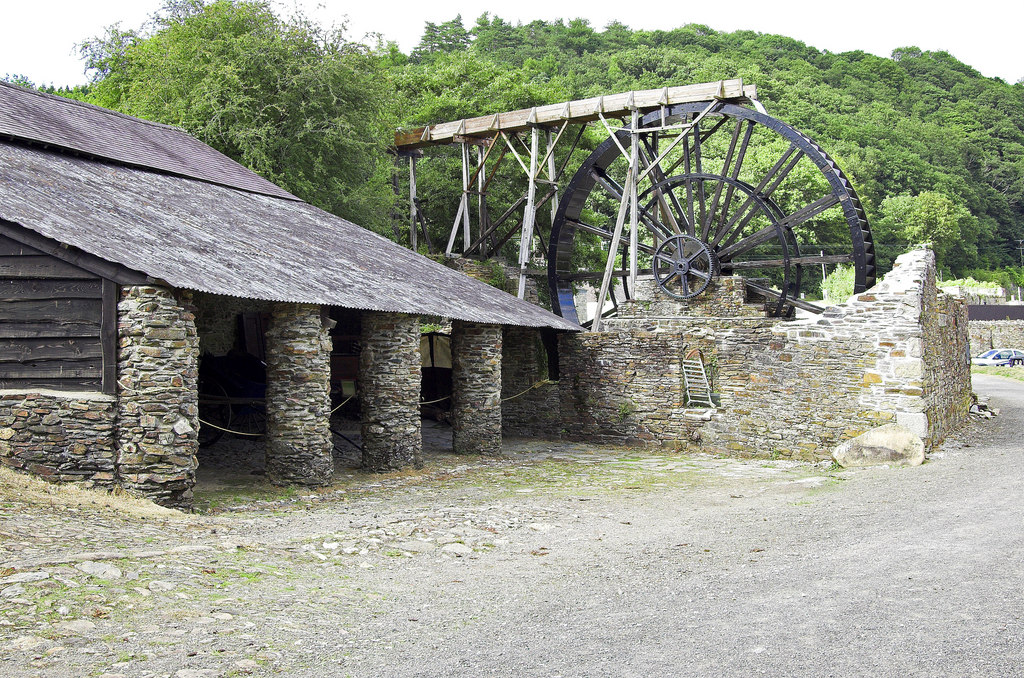
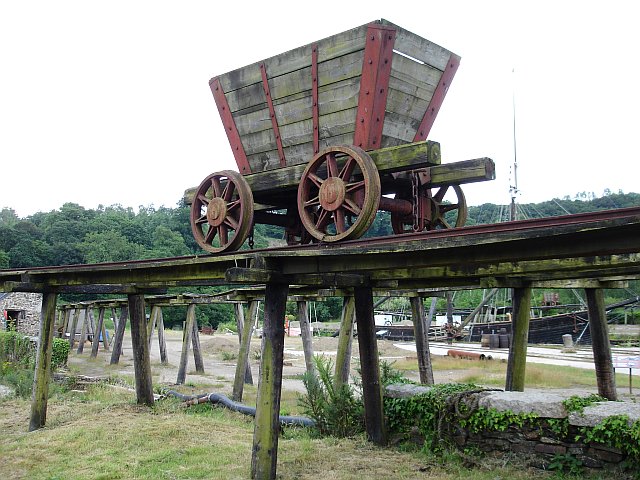
Preserved and open. The Deep Adit carries a narrow-gauge tramway 460 metres into the mine, worked by battery locomotives with purpose-built visitor carriages, passing the site of the underground waterwheel. Subterranea Britannica records the mine's layout and its present use as a visitor attraction.
Morwellham Quay itself — the quays, cottages, lime kilns and inclined railway — preserved as an open-air museum, with the mine entered from it.
Redevelopment
A museum and visitor attraction covering the quay and the mine together.
Related mines
- Devon Great Consols — The 1844 discovery of Devon Great Consols upriver transformed Morwellham Quay, which George and Charlotte mine also used to ship its own ore.
Nearby mines
- Okeltor Mine — 0.5 miles (0.8 km) S, Cornwall
- Gawton Mine — 0.7 miles (1.1 km) SE
- Bere Alston Silver-Lead Mines — 1.4 miles (2.3 km) S
- Drakewalls Mine — 1.4 miles (2.3 km) NW, Cornwall
- Danescombe Mine — 1.5 miles (2.4 km) W, Cornwall
Straight-line distance, within 9 miles (15 km). Show on the map.
Recorded claims
Individual factual claims, each attached to the source(s) that support it below. Where sources disagree, both are kept.
- Copper ore was exported from Morwellham from 1712 and the mine that became the George and Charlotte was opened in the 18th century, named for the King and Queen on the throne when it was sunk. 1,2
- The mine was entered by three adits — Shallow, Middle and Deep — and worked eight levels, the lowest four now drowned, dropping about 850 feet top to bottom; an underground waterwheel pumped the lower levels some 350 feet down. 1,3
- Output between 1852 and 1869 was 16,595 tons of copper ore and 110 tons of pyrite. 3
- Boring a shot hole by hand with a borer and sledgehammer took five to six hours before it could be charged with gunpowder. 1
- The mine is the classic British locality for childrenite. 3
- The discovery of Devon Great Consols upriver in 1844 made Morwellham the richest copper port in the Empire, and Queen Victoria visited in 1856. 1,2
- The Deep Adit now carries a narrow-gauge tramway 460 m into the mine, worked by battery locomotives with visitor carriages. 1,3
Photographs & further reading
The museum's own account of the quay and the mine.
View sourceSources
- (observational) George and Charlotte Copper Mine — Subterranea Britannica
- (secondary) Morwellham Quay and the Devonshire Great Consolidated Copper Mining Company — West Devon History Group
- (secondary) George and Charlotte Mine, Gulworthy, West Devon — Mindat
Record created: 24 August 2026 · Last researched: 24 August 2026