 MineArchive
Owlacombe Beams
| Also known as | Wheal Beam, West Beam Mine, Beam Mine |
|---|---|
| Location | North-east of Ashburton, between Owlacombe Farm and Owlacombe Bridge, Devon — 50.5488, -3.7440 (approximate) |
| Commodities | Tin, Copper |
| Type | Metal |
| Worked | By 1492–1866 |
| Maximum depth | 66 fathoms (West Beam engine shaft, after 1851). |
| Operators | Ashburton United (1857–?) |
Overview
A great medieval tinners' cutting north-east of Ashburton, recorded as 'Owlescomb worke' in 1492, and the Beam and West Beam mines sunk on its lode from 1836 until their abandonment in 1866.
History
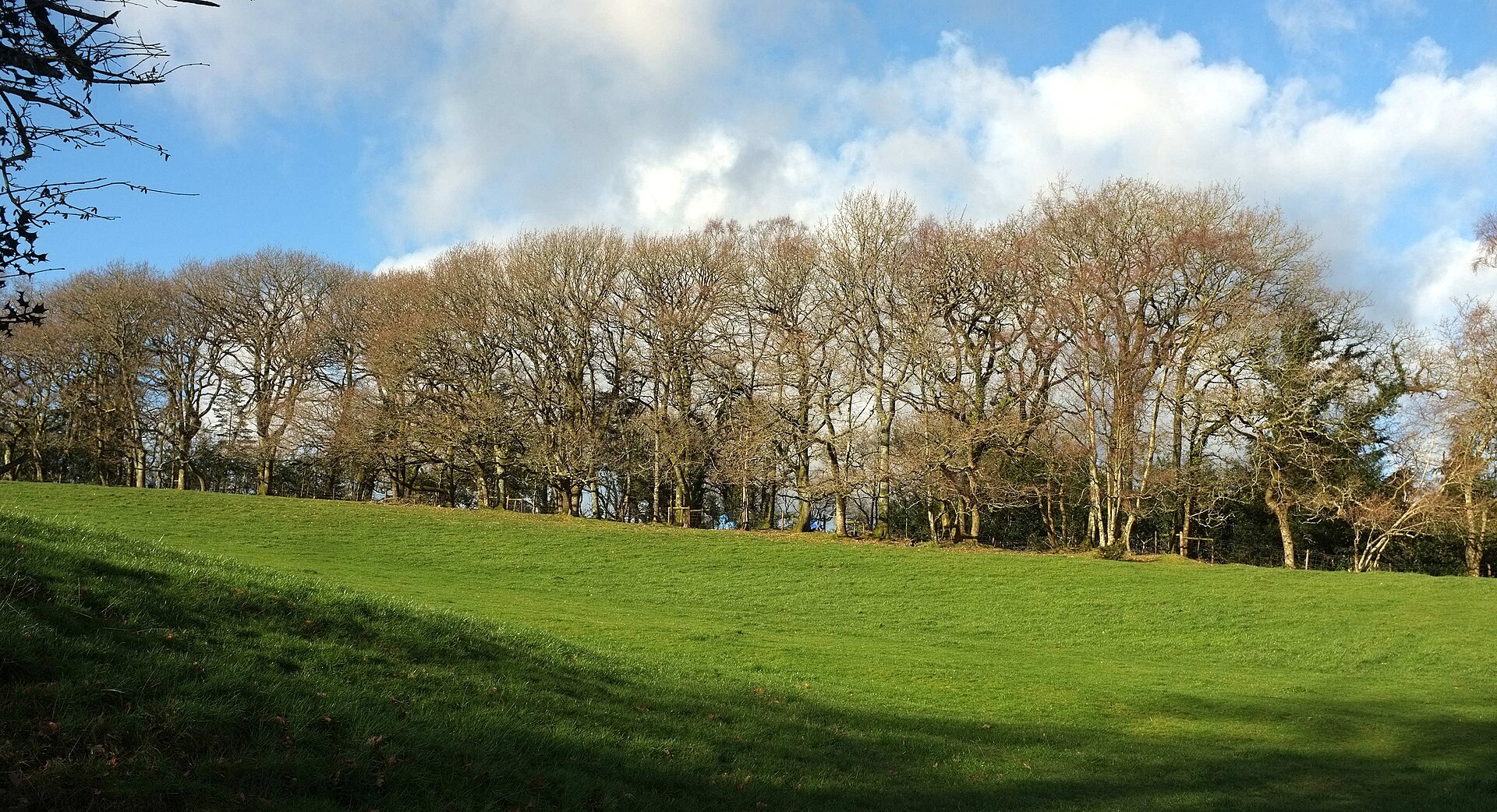
Owlacombe Beams is a great tinners' cutting a few miles north-east of Ashburton, beside the road between Owlacombe Farm and Owlacombe Bridge, dug by hand in the medieval period along a tin lode. It is about 1,200 feet long, 30 to 40 feet deep and 50 to 100 feet wide. It was recorded as a major tinwork, 'Owlescomb worke', in 1492, and in 1688 Richard Strode of Newnham claimed the tinworks called Owlacombe Beam within Ashburton Stannary.
Shaft mining followed on the northern of its two lodes. West Beam Mine began in 1836 with an engine shaft west of the cutting, pumped by a water-wheel said to have been 40 feet across; the wheel could not drain it below 40 fathoms, and in 1848 work was suspended for want of water. In June 1851 a small 21-inch steam engine was put up and the shaft was taken to 66 fathoms. West Beam yielded about £10,600 of black tin. In the 1840s Beam Mine, or Wheal Beam, was sunk within the cutting itself and raised about £6,000 of tin from no more than 31 fathoms below adit. In 1857 a company called Ashburton United took over the Beam setts with Wheal Union and the copper lodes of Brothers Mine to the south-east. The West Beam workings were abandoned in 1866, their last recorded output 30 tons of black tin and 22 tons of copper ore.
Geology
Two tin lodes, the northern worked both by the medieval cutting and by the nineteenth-century shafts; a copper lode, the Brothers or Union lode, to the south-east.
Workings
A medieval openwork cutting about 1,200 ft long and up to 40 ft deep; Wheal Beam's shafts within it to 31 fathoms below adit; West Beam's engine shaft to 66 fathoms, pumped first by water-wheel and from 1851 by a 21-inch steam engine.
Closure
West Beam was suspended in 1848 for want of water and restarted with steam in 1851; the West Beam workings were abandoned in 1866.
What remains
The cutting survives, tree-lined, and is used for clay pigeon shooting; the West Beam remains are on private land.
The great openwork cutting; at West Beam a wheelpit, a probable stamps site, the burning house (a calciner with a surviving chimney) and stone-lined dressing floors running down to the Langworthy Brook; earthworks of Brothers shaft.
Related mines
- Stormsdown Mine — Both lie in the Owlacombe valley north-east of Ashburton; the collective Owlacombe mines closed in 1866, and Stormsdown was worked again in the twentieth century.
Nearby mines
- Stormsdown Mine — 0.5 miles (0.8 km) SE
- Haytor Granite Quarry — 1.8 miles (2.8 km) NE
- Bagtor Mine — 1.8 miles (3.0 km) N
- Hemsworthy Mine — 2.0 miles (3.3 km) NW
- Haytor Iron Mine — 2.2 miles (3.5 km) N
Straight-line distance, within 9 miles (15 km). Show on the map.
Recorded claims
Individual factual claims, each attached to the source(s) that support it below. Where sources disagree, both are kept.
- The tinwork was recorded as 'Owlescomb worke' in 1492, and in 1688 Richard Strode of Newnham claimed the tinworks called Owlacombe Beam. 1
- The cutting is about 1,200 feet long, 30 to 40 feet deep and 50 to 100 feet wide. 1
- West Beam Mine began in 1836, was suspended for want of water in 1848, and was deepened to 66 fathoms after a steam engine was put up in 1851. 1
- In 1857 Ashburton United took over the Beam setts with Wheal Union and the Brothers copper lodes. 1
- The West Beam tin workings were abandoned in 1866. 1,2
Sources
- (secondary) Owlacombe Beams, Wheal Beam, West Beam Mine and Brothers Mine (Dartmoor Explorations) — Dartmoor Explorations
- (primary) BGS mine plan: BEAM WEST, tin ore, abandoned 1866 — British Geological Survey / Mining Remediation Authority
Record created: 25 October 2026 · Last researched: 25 October 2026