 MineArchive
Costean
| Also known as | Costeaning, Costean pit |
|---|---|
| Dialect | Cornish |
| Category | Prospecting & Exploration |
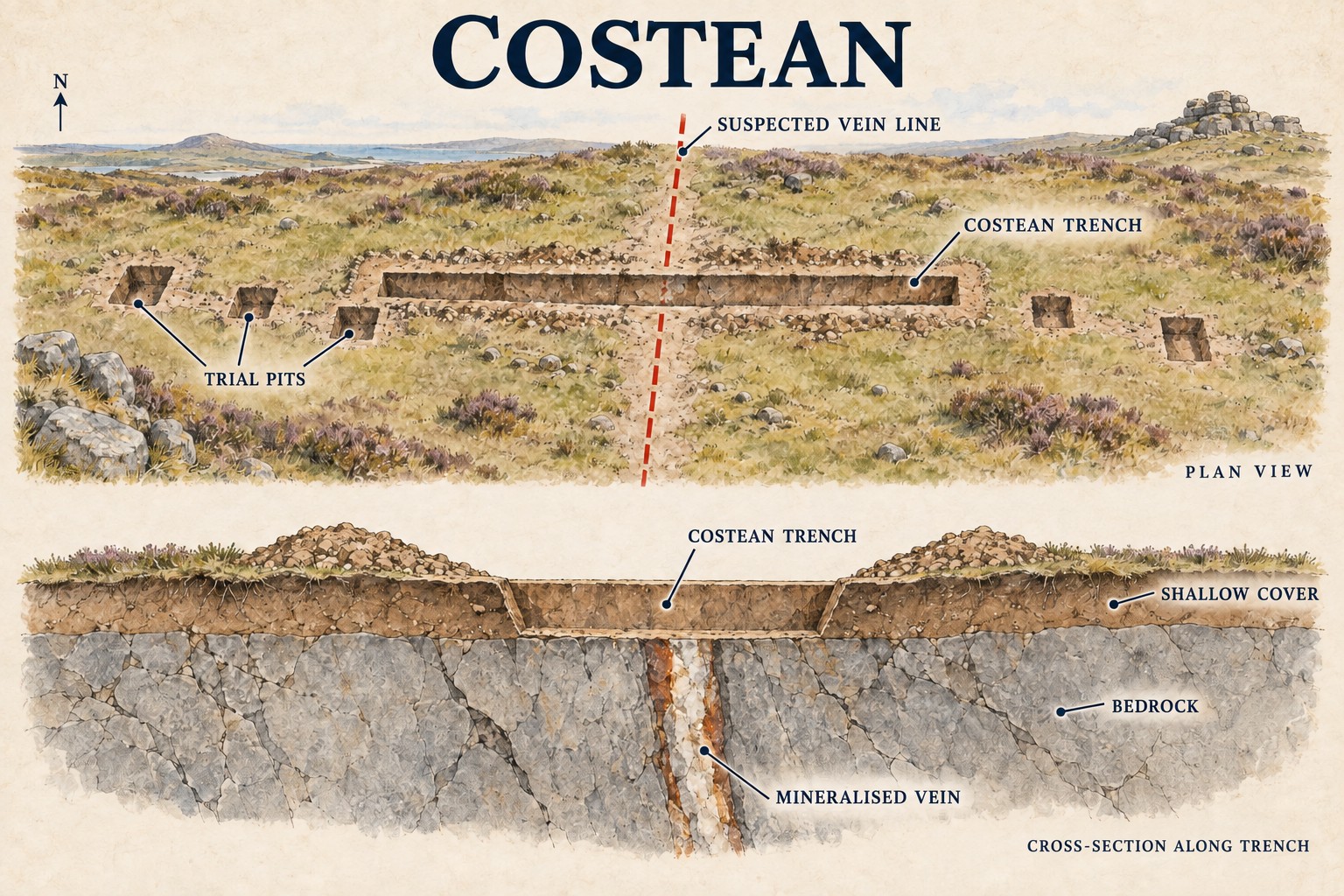
A trial pit or trench, dug down through surface soil and loose debris to solid rock, used to search for and trace the line of a mineral vein before any full-scale mine was sunk.
Historical usage
Costeaning is an old Cornish prospecting method — the word itself is thought to come from Cornish costēn, from codha (to fall/happen) and stēn (tin) — and was in everyday use wherever British miners needed a quick, cheap way to read the geology hidden under a covering of soil, subsoil or scree before committing to sink an actual shaft.
How it worked
A prospector sank a series of small pits down to bedrock across the suspected line of a vein, then dug connecting trenches between them at right angles to that line, cutting across every vein or lode running through the ground in between. Where a trench crossed a mineralised vein, the outcrop would be exposed and its width, direction and apparent richness could be judged directly, without the time and expense of sinking a full shaft on unproven ground.
Why it was used
Costeaning let a mine adventurer test ground cheaply and quickly, gathering real geological information — not just surface float or guesswork — before risking capital on a shaft that might strike nothing worthwhile. It remained a standard early step in exploration wherever shallow cover masked the bedrock beneath.
Risks & limitations
Costeaning only worked where the loose surface cover was shallow enough to dig through by hand; it told a prospector nothing about how a vein behaved once it ran deeper than a pit could easily reach, so promising costean results still had to be followed up with real underground working before a mine's true worth was known.
Regional variation
The same basic method appears well beyond Cornwall under other names — in Australia it survives in modern mineral exploration regulation, where costeaning is still a recognised, regulated technique for exposing shallow bedrock with minimal ground disturbance.
Related terminology
Mines associated with this term
Included only where MineArchive's own research gives a reasonable evidential basis — not every mine where this might plausibly apply.
- Brimpts Tin Mine — Devon (well documented example)
Named in this record’s workings: “…include the Engine Shaft, an Adit/New Engine Shaft, several trial (costean) pits, a collapsed adit and the remains of dressing floors below the…” - Nangiles Mine — Cornwall (well documented example)
Named in this record’s history: “…steam engine; a mine plan surviving from around 1810 shows a line of costean pits worked east-west along the old tin lode, suggesting activity…”
Sources
- (primary) Definition of costean — Mindat
- (secondary) Costean — Wikipedia
- (secondary) Glossary of Mining Terms — Open University Geological Society (South West Branch)
Record created: 20 August 2026 · Last researched: 20 August 2026