 MineArchive
Bonawe Iron Furnace
| Also known as | Lorn Furnace, Bonawe Furnace |
|---|---|
| Location | Bonawe, on the River Awe at Loch Etive, Argyll and Bute — 56.4360, -5.2220 (exact) |
| Commodity | Iron |
| Type | Iron |
| Worked | 1753–1874-76 |
| Operators | Newland Company (1753–1874) |
Overview
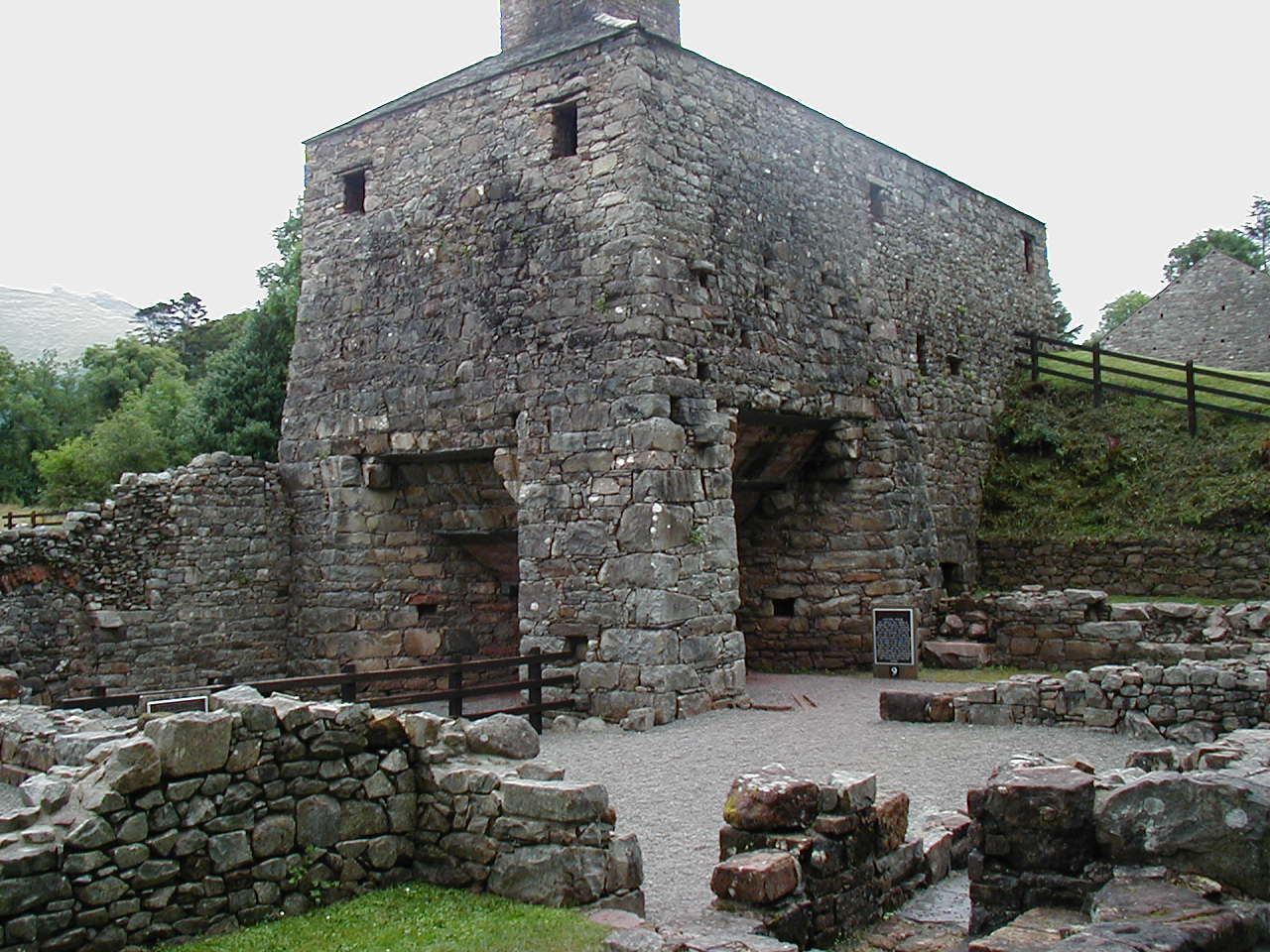
A charcoal-fired blast ironworks on the River Awe at Loch Etive, founded in 1753 by an English partnership, the Newland Company, later the Lorn Furnace Company. It ran for over a century smelting haematite ore shipped in from Cumbria and Lancashire using charcoal produced across Argyll's oak woodland, closing in the mid-1870s as the longest-lived charcoal blast furnace in Scotland. It is now managed by Historic Environment Scotland and described as the most complete surviving charcoal-fired ironworks in Britain.
History
Bonawe was established beside the River Awe where it flows into Loch Etive by the Newland Company, a Cumbrian partnership later known as the Lorn Furnace Company, whose founders included Richard and William Ford, James Backhouse and Michael Knott. The furnace's own cast-iron lintel is inscribed 'BUNAW F 1753', though Canmore's record separately gives the founding year as 1752. The company chose this remote Highland site for two reasons: Argyll's extensive semi-natural oak woodland offered a large, renewable charcoal supply at a time when English woodland, including Cumbria's own, was becoming scarce for charcoal-ironmaking, making it cheaper to ship ore 300 miles to the wood than wood to the ore; and Loch Etive gave sheltered sea access for shipping ore in and pig iron out, with the River Awe supplying enough water to drive a waterwheel. Long 110-year leases for coppice-cutting rights were secured from local landowners Duncan Campbell of Lochnell and the Earl of Breadalbane.
The works was run throughout its life by the same Cumbrian company, managed locally by a resident representative housed at Bonawe House; a new lease was signed as late as 1863, shortly before closure. In 1805, news of Trafalgar reaching Bonawe by ship prompted the workforce to erect what is believed to be the first monument in Britain to Admiral Nelson, on a hillock north of Muckairn churchyard at Taynuilt; the original Cumbrian-slate plaque is now displayed on site at Bonawe. The furnace closed in the mid-1870s — sources differ between 1874 and 1876 — by which point it was the last charcoal ironworks working in Scotland; when it closed, only Backbarrow in Cumbria remained in operation as a charcoal furnace anywhere in Britain.
Geology
Not a mine: the furnace smelted haematite shipped in from Cumbria and Lancashire, and the site was chosen for Argyll's oak woodland, which supplied the charcoal, and for sheltered sea access on Loch Etive.
Workings
Haematite iron ore was shipped in from Cumbria and Lancashire, and limestone flux from Northern Ireland, while charcoal was produced locally across Argyll woodland — including what is now the Glen Nant National Nature Reserve, which preserves the old coppice — by up to 600 charcoal-burners at peak, mostly local, Gaelic-speaking, seasonal workers who cut and stacked wood into pyres and lived in turf or wooden huts through the burning season. A lade brought water from the River Awe to a waterwheel, which powered the furnace bellows; the furnace took about a week to reach temperature and, once alight, ran nearly continuously through around nine months of the year, working hardest in winter, with the furnace men repairing and renewing plant over the summer. The site could only produce pig iron and simple castings; pig iron was the main export, shipped on elsewhere for further working, though cannonballs were cast on site during the Napoleonic Wars.
A small core of around 20 skilled furnace workers relocated from Cumbria, given stone houses, grazing allotments and schooling for their children, forming an English-speaking enclave amid the Gaelic-speaking local majority; up to 600 seasonal local charcoal-burners worked alongside them at peak. Output reached some 600-700 tons of pig iron a year at its height, around 700 tons recorded in 1788, with peak daily output up to around 2,500kg.
Closure
Closed in the mid-1870s — the sources differ between 1874 and 1876 — by which time it was the last charcoal ironworks working in Scotland.
What remains
Managed by Historic Environment Scotland as a Guardianship monument, open to visitors from April to September and described by HES as the most complete charcoal-fired ironworks in Britain. Surviving structures include the furnace itself, a bridgehouse, fragmentary blowing-engine and casting-house walls, two charcoal sheds, an ore and limestone shed, two ranges of workers' housing, Bonawe House (the former manager's residence, now privately occupied) and a stone pier. After closure the buildings were abandoned or put to other uses and fell into disrepair before an extensive government-led restoration programme consolidated the site.
What's uncertain
Points where sources disagree or the record could not be settled; both accounts are kept. All open questions in the archive.
- Historic Environment Scotland and Wikipedia give the closure date as 1876; Canmore's record separately states the furnace was finally closed down in 1874. Both figures are recorded rather than reconciled. (disputed) 1,2
Recorded claims
Individual factual claims, each attached to the source(s) that support it below. Where sources disagree, both are kept.
- The furnace was founded in 1753 by the Cumbrian Newland Company, later the Lorn Furnace Company, whose founders included Richard and William Ford, James Backhouse and Michael Knott; the furnace's own cast-iron lintel is inscribed 'BUNAW F 1753', though Canmore separately gives 1752 as the founding year. 1,2
- The company chose this remote site chiefly for Argyll's extensive oak woodland, a renewable charcoal supply at a time when English woodland was becoming scarce, making it cheaper to ship ore 300 miles to the wood than wood to the ore; sheltered access at Loch Etive and water power from the River Awe were secondary advantages. 1
- Historic Environment Scotland and Wikipedia give the closure date as 1876; Canmore's record separately states the furnace was finally closed down in 1874. Both figures are recorded rather than reconciled. (disputed) 1,2
- News of Trafalgar reaching Bonawe by ship in 1805 prompted the workforce to erect what is believed to be the first monument in Britain to Admiral Nelson, on a hillock north of Muckairn churchyard at Taynuilt. 1
- Output reached around 600-700 tons of pig iron a year at its height, with around 700 tons recorded in 1788 and peak daily output up to around 2,500kg. 3
Sources
- (primary) Bonawe Iron Furnace: History — Historic Environment Scotland
- (primary) Bonawe Ironworks — Canmore / National Record of the Historic Environment
- (secondary) Case Study 14: Bonawe and Inveraray Iron Furnaces — Scottish Archaeological Research Framework (ScARF)
Record created: 26 August 2026 · Last researched: 26 August 2026