 MineArchive
Charcoal Blast Furnace
| Also known as | Wealden Furnace (the Weald) |
|---|---|
| Category | Structures & Machinery |
The furnace that made Britain's iron before coal did: a tall charcoal-fired shaft furnace, blown continuously by water-powered bellows, that could run for months at a time and draw off molten iron rather than the solid lump a smaller bloomery hearth produced.
Historical usage
Iron had been smelted in Britain for centuries in the bloomery, a much smaller charcoal hearth that produced a solid, spongy lump of iron called a bloom rather than liquid metal, and which had to be broken open and rebuilt after every firing. The blast furnace, a taller, continuously-run structure, reached England in the late 15th century — the furnace at Newbridge in Sussex, working from 1496, is usually reckoned the first — and spread through the Weald and other wooded, water-rich ironmaking districts over the following two centuries. A typical early English furnace stood roughly six to seven metres high and could produce four or five tons of iron every six days, running for forty to sixty weeks before it needed rebuilding. The charcoal blast furnace was gradually displaced from 1709, when Abraham Darby successfully smelted iron with coke at Coalbrookdale rather than charcoal; the change spread slowly at first but accelerated from the 1750s, and by 1788 around four-fifths of British pig iron was already coke-smelted, ending the charcoal furnace's long dominance everywhere except a handful of surviving Wealden and Lake District ironworks.
How it worked
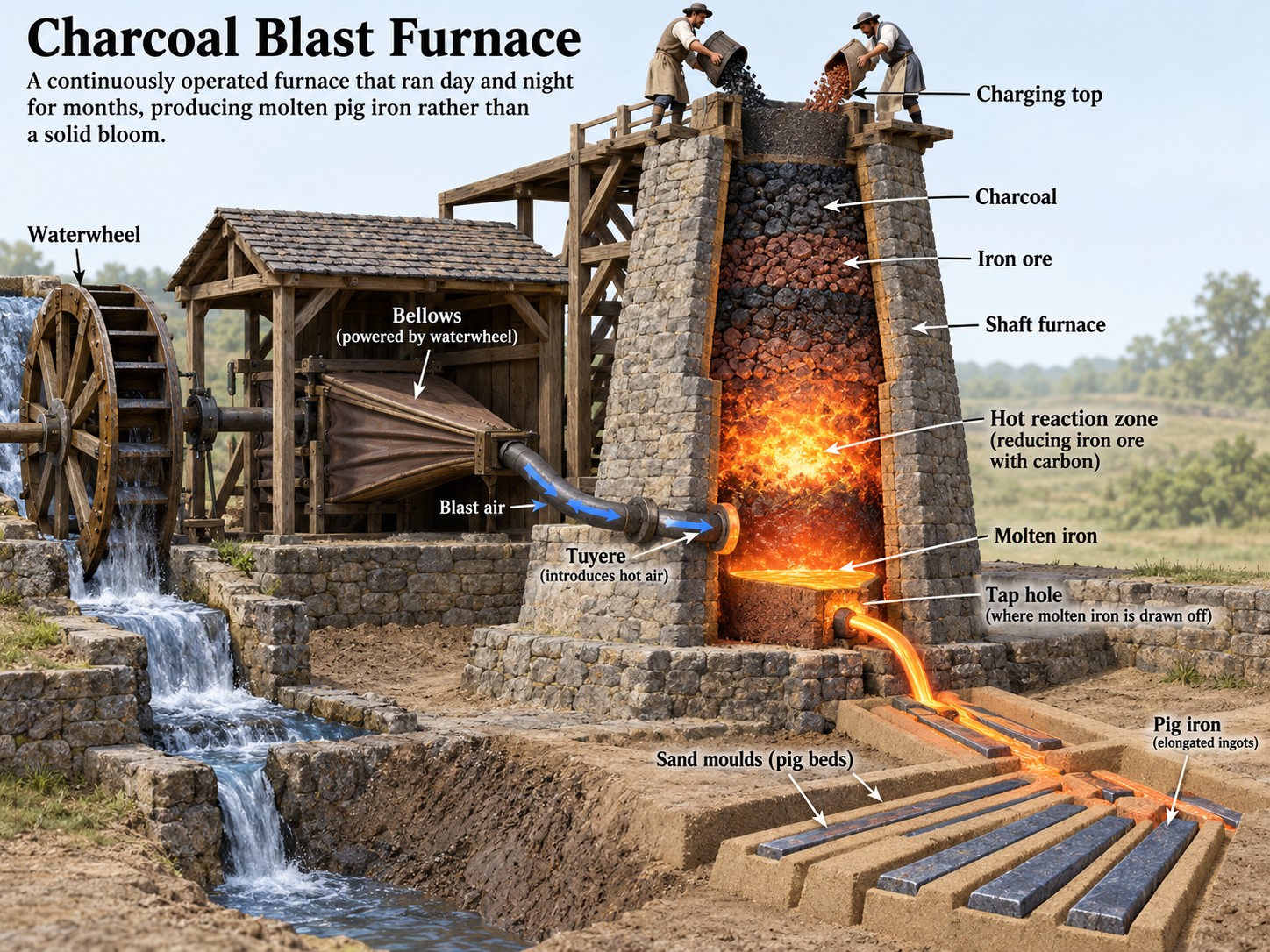
Charcoal and ore were charged into the top of a tall shaft furnace and burned continuously, with air forced in through nozzles called tuyeres near the base — the 'blast' that gives the furnace its name — usually driven by leather bellows powered by a waterwheel. Because the furnace ran hot enough and long enough, the iron produced was fully molten rather than the pasty bloom of the smaller bloomery hearth, and could simply be tapped off from the bottom as liquid pig iron, run into sand moulds to cool into the elongated ingots that gave the product its name. Continuous operation was essential: unlike a bloomery, which could be lit, used and left to cool between firings, a blast furnace held too much heat and material to be run intermittently, and had to be kept going day and night for months at a stretch.
Why it was used
A charcoal blast furnace could produce far more iron, far more reliably, than a bloomery hearth, and could do it as liquid metal that flowed to wherever it was needed — cast directly into finished goods such as cannon or fire-backs, or run into pig iron for a forge to work up into wrought iron later. That combination of scale and flexibility made it the backbone of English ironmaking for over two centuries.
Risks & limitations
The furnace's appetite for fuel was enormous — around four and a half to five tons of charcoal for every ton of iron produced — which tied every furnace to the managed woodland around it and set a hard ceiling on how much iron a given district could ever produce without exhausting its timber. That same dependence on wood, water power and local ore made charcoal furnaces geographically inflexible in a way coke furnaces, tied instead to coalfields, were not, and it was ultimately fuel scarcity as much as any technical failing that ended the charcoal furnace's dominance.
Regional variation
The Weald of Kent and Sussex was England's great charcoal ironmaking district, sustained by its dense woodland and many small streams, but the same technology was used wherever similar conditions existed, including parts of the Forest of Dean, South Wales and the Lake District, the last of which kept small charcoal furnaces running well into the 18th and even 19th centuries in places too remote for coal to reach economically.
Related terminology
Colliery Brickworks, Gunfounding, Lime Kiln
Mines associated with this term
5 examples chosen from 6 linked records — the term page is not an index.
- Bonawe Iron Furnace — Argyll and Bute (well documented example)
Named in this record’s summary: “…Argyll's oak woodland, closing in the mid-1870s as the longest-lived charcoal blast furnace in Scotland. It is now managed by Historic Environment Scotland and…” - Ashburnham Furnace — East Sussex (well documented example)
The last charcoal blast furnace working anywhere in the Weald, closed 1813, its own record describing the process in detail. - Cowden Furnace — Kent (well documented example)
Named in this record’s workings: “A conventional Wealden charcoal blast furnace, with an associated mill building (Furnace Mill) that may have…” - Fernhurst Furnace (North Park Furnace) — West Sussex (well documented example)
Working by 1614 and revived in the 1760s specifically to cast cannon; probably the best-preserved Wealden charcoal blast furnace site. - Gloucester Furnace, Lamberhurst — Kent (well documented example)
Named in this record’s geology: “Not a mine: a Wealden charcoal blast furnace working both good local ore and poorer, brittler ore brought in,…”
Sources
- (primary) Pre-industrial Ironworks — Introductions to Heritage Assets — Historic England
- (secondary) Bloomery process — Encyclopaedia Britannica
- (secondary) The Blast Furnace: 800 Years of Technology Improvement — Construction Physics
Record created: 25 August 2026 · Last researched: 25 August 2026