 MineArchive
Gunfounding
| Category | Ore Processing |
|---|
The specialised trade of casting iron or bronze cannon and other ordnance directly from a blast or air furnace — a distinct, exacting branch of ironfounding in which a single flaw in the casting could burst a gun under fire.
Historical usage
From the 1540s the Weald of Kent and Sussex became England's principal gunfounding district, its number of gun-casting furnaces peaking in the 1570s before settling to around ten at the time of the Armada. Demand fluctuated sharply with the political and military climate: a long peace from 1713 left gunfounding unprofitable for all but a few Wealden furnaces until the War of the Austrian Succession revived it from 1739, and the Seven Years' War (1756-63) drove the trade to its eighteenth-century peak — over that war's full 1750-70 span the Weald supplied about 80% by weight of all the guns purchased by the Board of Ordnance. The trade's decline followed close on the war's end: the Carron Company, near Falkirk, undercut the established English and Wealden gunfounders from the mid-1760s using coke-smelted iron, and the Board of Ordnance's 1775 decision to accept only guns bored from the solid — rather than cast around a core and merely reamed true — favoured founders with modern boring machinery over the Weald's small, charcoal-fired furnaces. Carron itself, after early quality problems were resolved under the partner Charles Gascoigne from 1765, went on to dominate British naval ordnance into the nineteenth century — the Duke of Wellington is said to have insisted on Carron-made cannon for his army in 1812 — and its short, light carronade, introduced in 1778, became a mainstay of naval armament into the 1850s.
How it worked
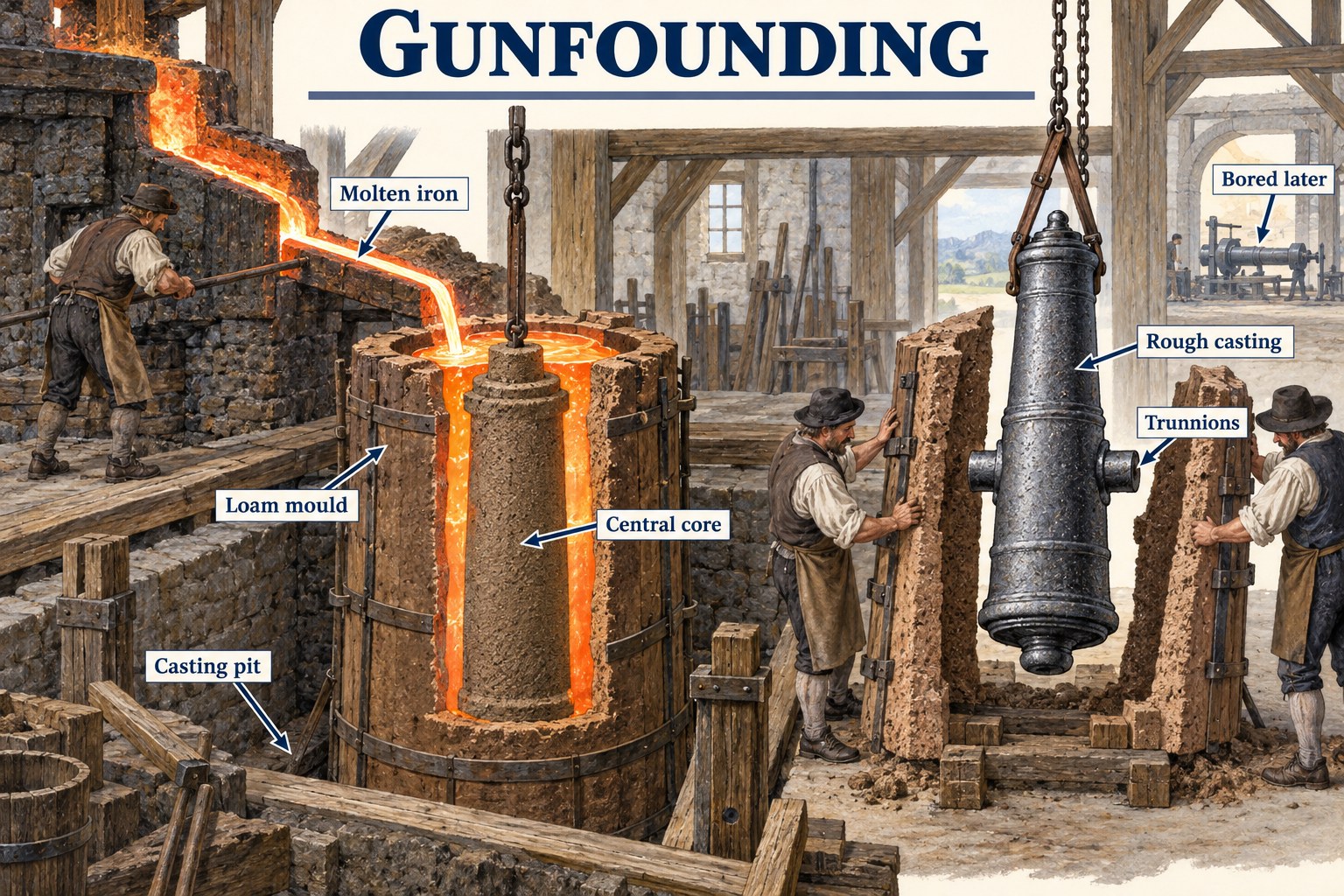
Molten iron from the furnace was run into a vertical loam or clay mould formed around a core, casting the gun with its bore already roughly present. Guns were classified by their 'nature' — the weight of shot they fired, from half-pounder swivel guns up to 42-pounders — and, once cast and cooled, were bored or reamed true at a boring mill before being 'proved': test-fired with a deliberate overcharge of powder to reveal any casting flaw before the Board of Ordnance would accept the gun into service. Founders commonly identified their work with a trunnion mark, a maker's stamp cast or struck into one of the two trunnions (the lugs by which a gun was mounted on its carriage).
Why it was used
Guns cast directly from ore, rather than remelted from scrap and pig iron in an air furnace, were of higher and more consistent quality, and the Board of Ordnance's specifications required exactly that for naval and military service — a requirement that gave the established, ore-casting Wealden founders a real advantage over rivals who worked only remelted metal. Reliability at proof mattered commercially as well as for safety: between 1750 and 1770, guns cast in the Weald passed the Board's proof at a markedly higher rate (around 79.5%) than guns cast elsewhere (around 70.7%).
Risks & limitations
A casting flaw — a blowhole, an internal void, or a wall left too thin by an off-centre core — could cause a gun to burst catastrophically when fired, endangering its crew; proof-firing existed precisely to catch this before a gun reached service, though it could not guarantee to catch every fault. Commercially, the trade lived and died by government demand: peacetime consistently brought falling prices and bankruptcies among ironmasters who depended on Board of Ordnance contracts, while wartime brought its own strains — late payment, impressment of ships' crews, and warrant deadlines gunfounders often struggled to meet given the state of Wealden roads and the hazards of wartime coastal shipping. In the long run, the small scale and short campaigns of the charcoal-fired Wealden furnaces left them unable to compete with larger, coke-fired, mechanised rivals once the postwar peace removed the government contracts that had sustained them.
Regional variation
Overwhelmingly concentrated in the Weald of Kent and Sussex from the sixteenth to the later eighteenth century. From the 1760s the Carron Company near Falkirk, Scotland, became the dominant rival and eventual successor to Wealden gunfounding, its coke-smelted iron ultimately displacing it; other, smaller centres included the Wilkinson family's works at Bersham and New Willey in Shropshire, and Robert Morgan's furnace at Carmarthen in south Wales.
Related terminology
Boring Mill, Charcoal Blast Furnace, Trunnion Mark
Mines associated with this term
Included only where MineArchive's own research gives a reasonable evidential basis — not every mine where this might plausibly apply.
- Ashburnham Furnace — East Sussex (well documented example)
A major Wealden gunfounding site under the Crowley family through the mid-18th century, supplying the Board of Ordnance. - Cowden Furnace — Kent (well documented example)
William Bowen supplied cast-iron ordnance to the Board of Ordnance from Cowden through the 1750s-60s, one of very few Wealden founders still able to do so after 1764. - Fernhurst Furnace (North Park Furnace) — West Sussex (well documented example)
Established amid the 16th-17th century Wealden ordnance boom and later revived for gunfounding by John Butler. - Gloucester Furnace, Lamberhurst — Kent (well documented example)
Named in this record’s closure notes: “…furnace was still standing in 1787, later than most other Wealden gunfounding furnaces, several of which had already been idled by Richard…”
Sources
- (secondary) Carron Company — Wikipedia
- (secondary) The Iron Industry in the Weald in the Period of the Seven Years' War, 1750-1770 (M.A. dissertation) — Jeremy Spencer Hodgkinson, University of Brighton (1993), via the Wealden Iron Research Group
Record created: 26 August 2026 · Last researched: 26 August 2026