 MineArchive
Boring Mill
| Also known as | Boring House (Wealden usage, e.g. the boring house at Horsmonden) |
|---|---|
| Category | Ore Processing |
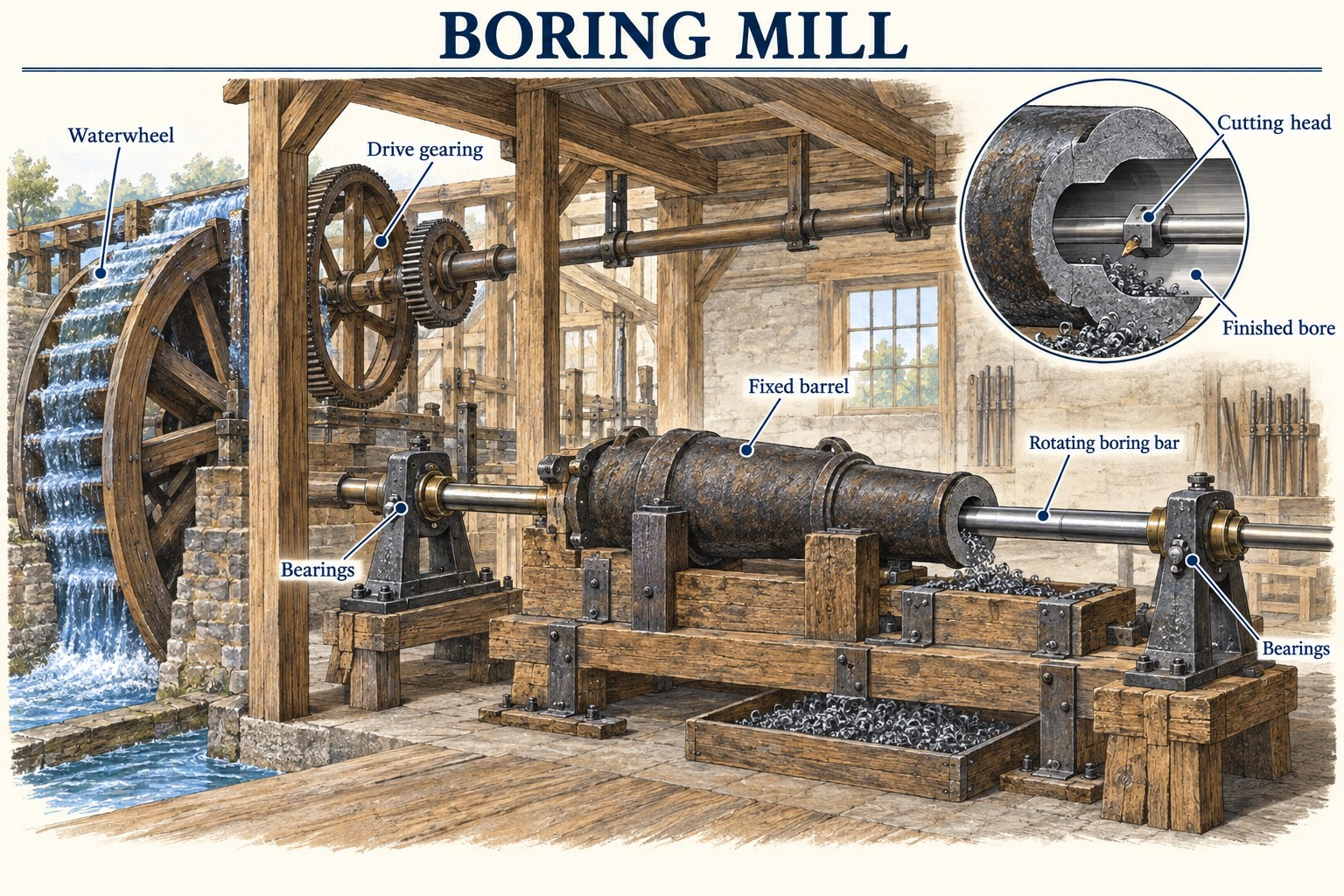
A mill or workshop equipped with machinery to bore, or ream, a newly cast gun barrel's rough bore true and smooth — an essential finishing step in gunfounding before a gun could be proved and accepted into service.
Historical usage
Wealden gunfounders maintained dedicated boring mills or boring houses at several sites, including a boring house at Horsmonden associated with the Harrison-Legas partnership's group of furnaces, and a second boring mill built at Ashburnham furnace in 1766 that specialised in boring and testing cannon. Before around 1775, cannon were typically bored by a method credited to the Swiss engineer Jean Maritz from 1715, in which the gun itself was rotated against a fixed boring and turning tool. John Smeaton built an early cylinder boring mill for the Carron Company in 1769, but it proved unsatisfactory; it was John Wilkinson's water-powered horizontal boring machine of around 1775 — which instead held the gun stationary while a supported boring bar rotated through its axis — that became the new industry standard, and which Wilkinson went on to adapt for boring the far more demanding, precisely-toleranced cylinders of James Watt's steam engines.
How it worked
In the older method, the rough-cast gun, still mounted on its casting core, was rotated — often by waterwheel — against a fixed boring bar and cutting tool to true and smooth its bore to the correct diameter. In Wilkinson's later design, the gun was instead held still while a long boring bar, supported in bearings and passed through the axis of the intended bore, rotated and advanced through it; holding the workpiece still let the bar bear down harder without deflecting off-centre, producing a straighter, more accurately bored barrel — and, later, a far more precisely bored engine cylinder.
Why it was used
A gun's bore had to be round, straight and of the exact stated diameter: an uneven or off-centre bore risked shot that fitted badly, an unevenly thin barrel wall that could burst under firing, and outright rejection at the Board of Ordnance's proof test.
Risks & limitations
Early boring methods struggled to keep a long bore straight and centred, especially in larger-calibre guns, and the workpiece-rotating method limited how hard a cutting tool could bear without deflecting. The Board of Ordnance's 1775 decision to accept only guns bored from the solid — cast without a core at all, and bored out entirely, rather than merely reamed smooth — raised the bar further still, favouring founders with access to Wilkinson's newer machinery over those still working the older way.
Regional variation
Documented Wealden examples include Horsmonden and Ashburnham; outside the Weald, John Smeaton's 1769 machine at the Carron Company, Falkirk, and John Wilkinson's works at Bersham and New Willey in Shropshire from around 1775 mark the technology's later, more accurate development.
Related terminology
Mines associated with this term
Included only where MineArchive's own research gives a reasonable evidential basis — not every mine where this might plausibly apply.
- Ashburnham Furnace — East Sussex (well documented example)
An upper furnace added in 1766 specialised in boring and testing cannon. - Calcutts Colliery — Shropshire (well documented example)
Named in this record’s history: “…by 1796, bored eleven at a time on one of only three steam-powered boring mills in the country, and shipped to Bristol for the navy. William…” - Gloucester Furnace, Lamberhurst — Kent (well documented example)
Named in this record’s history: “…to Joseph Wright and Thomas Prickett. A 1795 map of the site shows a boring mill in addition to the furnace itself, and the furnace was still…” - Cowden Furnace — Kent (historical documentary reference)
Furnace Mill may have doubled as a boring mill for cannon; a 1748 estate map marks a 'boring house' on the site, though this is not stated with full certainty.
Sources
- (secondary) Early Boring Mills — Grace's Guide to British Industrial History
- (secondary) The Iron Industry in the Weald in the Period of the Seven Years' War, 1750-1770 (M.A. dissertation) — Jeremy Spencer Hodgkinson, University of Brighton (1993), via the Wealden Iron Research Group
Record created: 26 August 2026 · Last researched: 26 August 2026