 MineArchive
Trunnion Mark
| Category | Ore Processing |
|---|
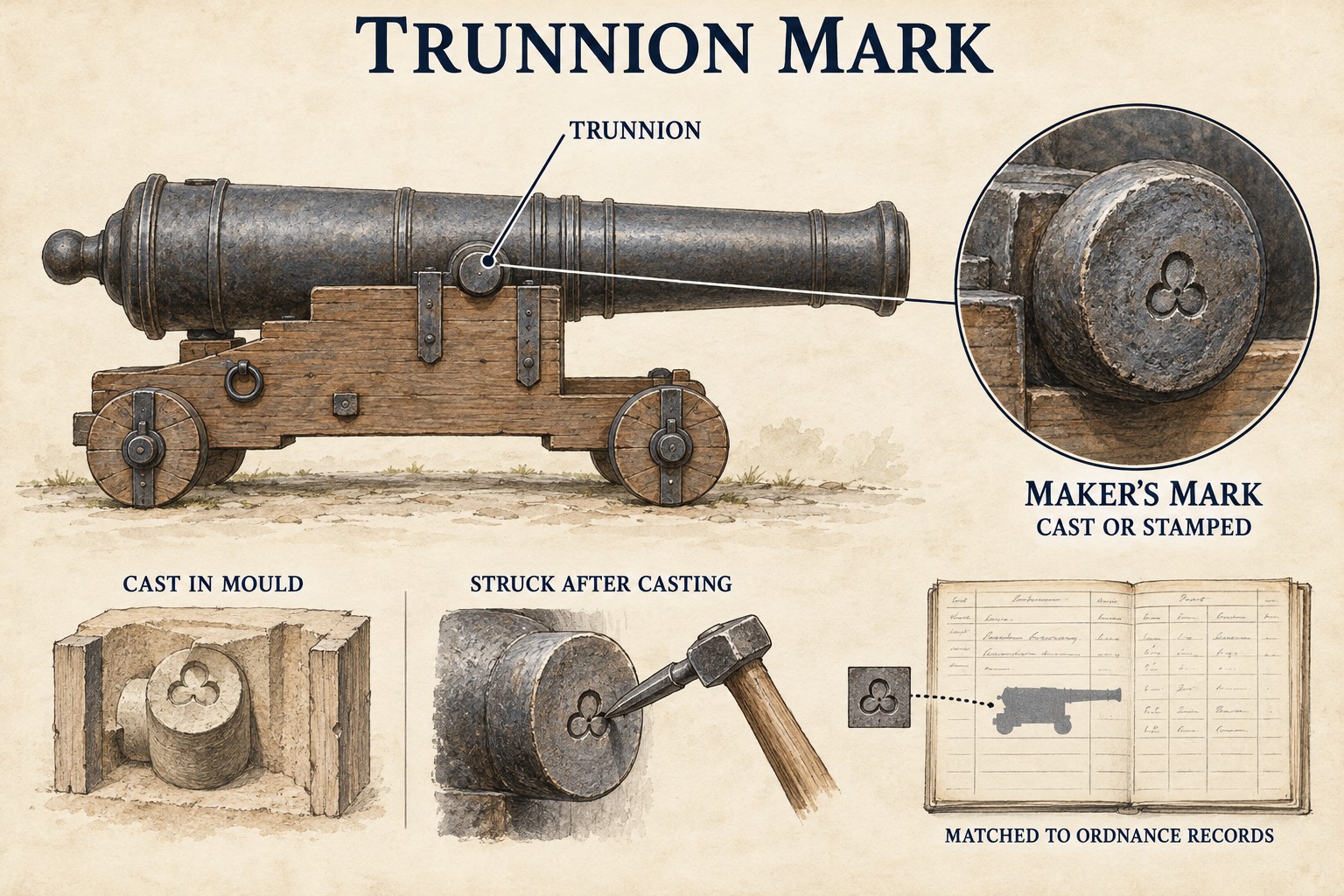
A maker's identifying mark, cast or stamped into one of a cannon's trunnions — the two cylindrical pivots projecting from its sides, by which the gun was mounted on its carriage — recording who cast the gun and often when.
Historical usage
British cast-iron ordnance of the seventeenth and eighteenth centuries commonly carried, alongside a founder's own trunnion mark, other cast or stamped information: a reigning monarch's cypher (such as 'GR' for George Rex) confirming the gun's reign, and often the coat of arms of the Master General of the Ordnance then in office, which narrows a gun's casting date to that individual's tenure. Founders sometimes cast their name and the casting year directly onto a gun — guns marked 'W. BOWEN FECIT 1756' identify William Bowen of Cowden and Barden furnaces as founder — and individual guns within a production batch were often further numbered on a trunnion (e.g. 'NO. 3') to track a specific casting run. Surviving guns and archival trunnion-mark lists, matched against Board of Ordnance Bill Books and Surveyor General's Minutes, remain one of the main ways an individual iron gun can still be traced back to the specific founder, furnace and campaign that cast it.
How it worked
A mark was either formed as raised lettering or a device built into the casting mould itself, or struck or chased into the finished metal afterward. Because a founder was paid by the weight of iron delivered, and the Board of Ordnance's own records track individual furnace campaigns and warrants in fine detail, a securely identified trunnion mark can often be matched to a specific founder, furnace and even year through those surviving official records.
Why it was used
Distinguishing one founder's work from another's mattered for payment, since founders were paid by the ton of iron delivered; for quality accountability, since a burst or rejected gun could be traced back to its maker; and, incidentally, for the historical record generally, since a gun's own casting has often outlived any paper record of where it came from.
Risks & limitations
Not every mark found on a gun is contemporary with its casting — some markings, particularly on bronze guns, were etched or chiselled on later, after the gun had left the foundry — so a mark alone does not always prove when or by whom a gun was made without corroborating documentary evidence. Interpretation can also be genuinely ambiguous on worn, partial or corroded iron guns.
Regional variation
Marking conventions varied by nation: British Board of Ordnance guns typically carried the monarch's cypher and Master General's arms described above, while, for example, Spanish cannon of the period instead marked the gun's weight on the left trunnion.
Related terminology
Mines associated with this term
Included only where MineArchive's own research gives a reasonable evidential basis — not every mine where this might plausibly apply.
- Cowden Furnace — Kent (well documented example)
William Bowen's guns from Cowden and Barden furnaces are specifically documented as marked 'W. BOWEN FECIT 1756', a directly attributable, dated trunnion mark.
Sources
- (secondary) Deciphering “The Cannon Code” — Times of the Islands
- (secondary) The Iron Industry in the Weald in the Period of the Seven Years' War, 1750-1770 (M.A. dissertation) — Jeremy Spencer Hodgkinson, University of Brighton (1993), via the Wealden Iron Research Group
Record created: 26 August 2026 · Last researched: 26 August 2026