 MineArchive
Mine Tremors
| Category | Ground Conditions & Hazards |
|---|
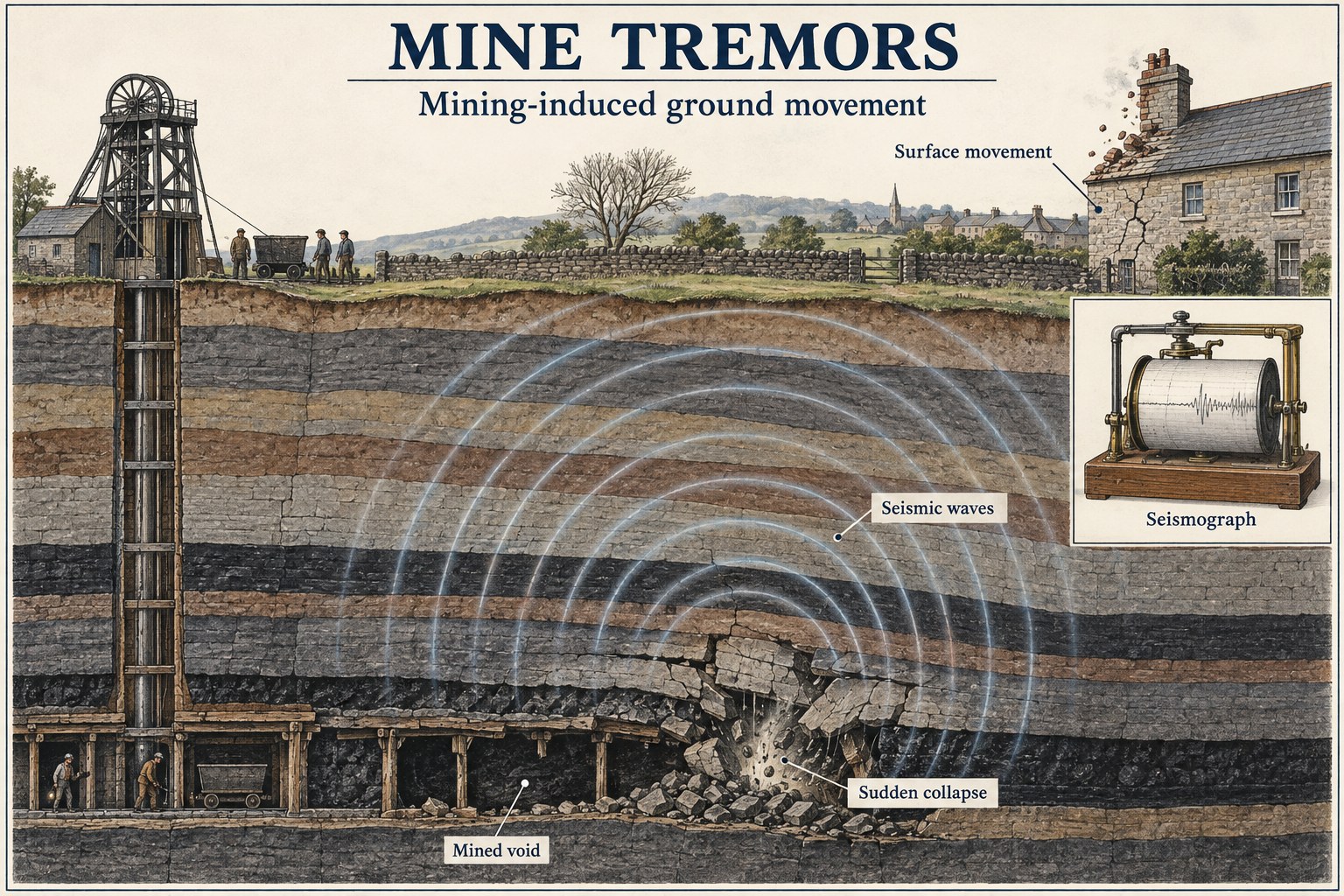
A small earthquake caused by mining itself — usually the sudden collapse of old workings or the movement of rock into a void left by extraction — distinct from, but occasionally overlapping with, the rare natural earthquake that happens to be felt underground.
Historical usage
Genuine mining-induced tremors have a long British history. At Balleswidden Mine, St Just, on 29 January 1847, the collapse of soft, kaolinised granite underground created a surface depression some 270 feet long and 60 feet wide — contemporary accounts described the surface effects as resembling 'a minor earthquake'; the collapse had been foreseen and the area evacuated in advance, so there were no casualties. In 1999, two small seismic events near Redruth, Cornwall — a 19th-century copper-mining town — were traced to the shallow collapse of old copper mine workings rather than tectonic activity. Coal mining has its own long, separately documented history of induced tremors tied to underground gallery collapse and fault reactivation, going back at least 150 years. The best-instrumented modern British case came at Thoresby Colliery, Nottinghamshire, where over 40 tremors (the largest ML 1.7) were recorded by the national seismometer network between December 2013 and January 2014, briefly earning nearby New Ollerton the nickname 'the UK's earthquake capital'; a dedicated local monitoring array run from February to October 2014 went on to record 305 separate events. A genuinely different, older case is worth distinguishing from all of this: an account sent to the Royal Society in 1755 by the Reverend William Bullock described a natural earthquake — actually the great Lisbon earthquake of 1 November 1755 — being distinctly felt by miners working underground at the lead mines on Eyam Edge, Derbyshire, a rare eyewitness record of a genuinely external, tectonic earthquake reaching workings far from its source rather than one caused by the mining itself.
How it worked
Extracting ore or coal leaves a void underground that the surrounding rock is no longer there to support; where the ground above sags and the ground below rebounds to close that void gradually, nothing much happens, but where a large section moves suddenly instead, the released energy travels outward as a small earthquake. In longwall coal mining specifically, monitored tremors have been shown to track closely with the position of the advancing coal face — at Thoresby, most recorded events occurred within 300 metres of the working face — and typically involve movement along near-vertical fracture planes running parallel to the face itself, matching the expected deformation as the panel advances and the ground above and below moves to fill the space left behind. In hard-rock metal mines, the same basic principle applies to sudden roof or pillar failure into old, unsupported workings, sometimes long after those workings were abandoned. Seismicity can also continue for years or even decades after a mine has closed entirely, as pumping stops, workings flood, and the ground settles into its new equilibrium at a much slower pace.
Why it was used
Distinguishing a mining-induced tremor from a natural earthquake mattered for reasons well beyond scientific curiosity: felt tremors near a working or former mine could prompt real public alarm, insurance and subsidence claims, and questions about whether it was safe to keep working a particular seam or panel. Modern instrumented monitoring, of the kind installed at Thoresby, exists specifically to answer that question in real time — tracking events precisely enough to confirm they're following the mining face rather than an unrelated geological fault, and to inform how a panel is planned and worked to limit the disturbance it causes at the surface.
Risks & limitations
Even where a mining-induced tremor causes no direct injury, as at Balleswidden and Thoresby, it can still cause real surface damage — cracked walls, disturbed foundations — and repeated felt seismicity in a populated area, as at New Ollerton, is disruptive and alarming in its own right regardless of magnitude. Post-closure seismicity is a particular long-tail risk: an area can go on producing occasional small tremors for years after the mine responsible has shut and its owners moved on, complicating who bears responsibility for any resulting damage.
Related terminology
Sources
- (primary) Anthropogenic earthquakes in the UK: A national baseline prior to shale exploitation — Science of the Total Environment / ScienceDirect
- (primary) LIX. An account of the earthquake, Novem. 1, 1755, as felt in the lead mines in Derbyshire — Philosophical Transactions of the Royal Society
- (primary) Seismicity induced by longwall coal mining at the Thoresby Colliery, Nottinghamshire, U.K. — Geophysical Journal International / Oxford Academic
- (secondary) The Balleswidden Earthquake - mine collapse in St Just — Penwith Local History Group
Record created: 22 August 2026 · Last researched: 22 August 2026