 MineArchive
Neston Colliery
| Location | Ness / Little Neston, Wirral, Cheshire — 53.2758, -3.0669 (approximate) |
|---|---|
| Commodity | Coal |
| Type | Coal |
| Worked | 1759/60–1855 |
| Operators | Sir John Stanley (1759–1822), Thomas Cottingham (1820–1822) |
Overview
An obscure Wirral peninsula coalfield worked in two separate eras, 1759-1855 and 1875-1927, where a bitter rivalry between neighbouring pit owners in the 1820s saw one deliberately flood the other's workings and blow up his tunnels — and where coal was, remarkably, moved underground by boat along canals dug beneath the Dee Estuary.
History
Coal had been dug in small quantities around Neston, on the Cheshire side of the Wirral peninsula, since at least the 17th century, but organised deep mining began in earnest in 1759-60 when Sir John Stanley opened a colliery at Denhall, on the Dee Estuary, complete with limekilns and a quay built in 1791 to ship coal out to North Wales and Ireland. The works reached genuine industrial scale for their time and place, said locally to have hosted the first steam engine anywhere in Wirral or west Cheshire; conditions for the workforce, which by the mines' later 1920s peak exceeded 300 men, were harsh even by the standards of the day, with shifts of over ninety hours a week, children as young as nine employed underground, and housing described by contemporaries as 'the most miserable mass of hovels' on the peninsula.
A second mine opened on adjoining land around 1820, and the rivalry between the two operations turned genuinely vicious. Thomas Cottingham's Little Neston Colliery and Sir John Stanley's Ness Colliery each dug workings that threatened to undercut the other, and Stanley's men resorted to outright sabotage — deliberately flooding Cottingham's pit and dynamiting his tunnels. Cottingham brought two court cases against Stanley at Chester in 1821-22; in the first, Stanley's own agent, Robert Johnson, did not deny his men had destroyed Cottingham's tunnel, but justified it as managing Ness Colliery's own ventilation and stopping Cottingham's men from damaging the canal. Cottingham sued for £10,000 in damages in the second case and was awarded £2,000. Perhaps the mines' most remarkable engineering feature, from 1791, were underground 'Navigations' — canals dug 55-86 metres below sea level, beneath the Dee Estuary itself, along which coal was carried in small wooden boats known as 'starvationers', propelled by workers 'legging' them along by pushing against the tunnel roof with their feet, before horse-drawn wagons eventually took over the job.
This first era of Neston mining wound down through the 1850s as flooding and technical difficulty took their toll, ending by 1855. A revival came in 1875 under the new Neston Colliery Company, later renamed the Wirral Colliery Company, which brought in powered steam drainage and, from 1866, a rail connection via the Hooton-Parkgate branch line. The revived colliery employed over 300 men at its 1920s peak, the largest single industrial concern in the district, and continued raising coal alongside a sideline in lime- and brick-making, but flooding struck again in 1878, and increasing competition from larger, more modern coalfields elsewhere eventually made the pit uneconomic. It finally closed in 1927-28, hastened by continuing silting of the River Dee, which undermined the colliery's old advantage of direct water-borne coal shipment.
Geology
The Neston coalfield forms the northernmost, and geologically most isolated, outlier of the wider North Wales and Cheshire Coal Measures, its seams worked out beneath the Dee Estuary itself in the mine's underground canal workings — an unusually direct exploitation of coal running under tidal water for a British coalfield of this size.
Workings
A deep shaft colliery whose most distinctive feature was its underground canal system, 'Navigations' dug 55-86m below sea level from 1791, along which small wooden boats called 'starvationers' carried coal from distant working faces back to the pit bottom — at first propelled by workers 'legging' along the tunnel roof, later by horse-drawn wagons once that system was superseded.
Closure
The first era of Neston mining ended around 1855 amid flooding and technical difficulty; a revived colliery, worked from 1875 under steam-powered drainage and rail transport, finally closed in 1927-28 as competition from larger coalfields and continuing silting of the River Dee made the pit uneconomic.
What remains
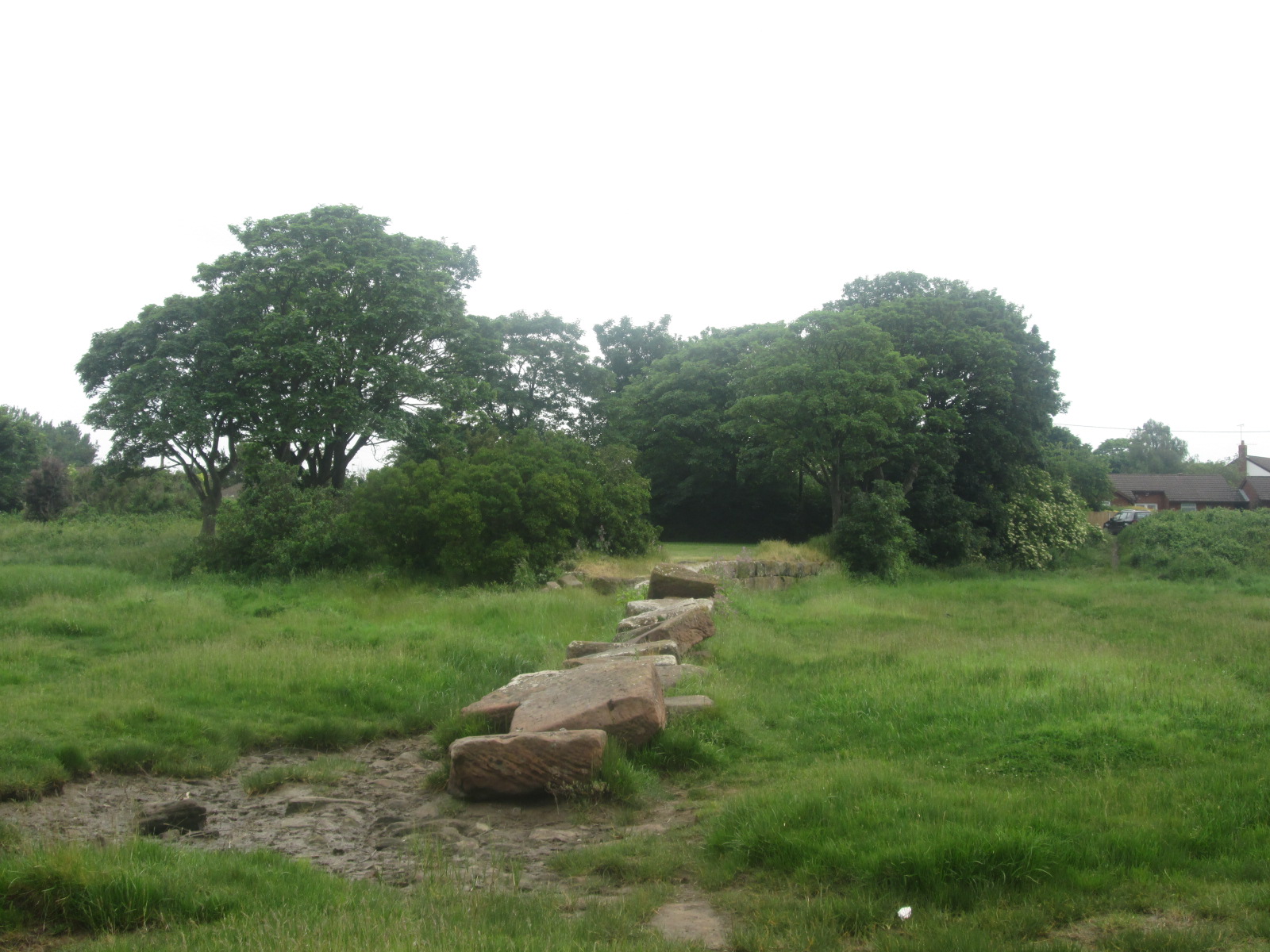
The main colliery site is now entirely occupied by a modern housing estate, its shafts buried beneath residential properties, though one shaft survives behind a brick wall on Riverside Walk. Denhall Quay, built in 1791 to serve the earliest workings, still projects into the Dee Estuary; spoil tips remain visible near Marshlands Road, and the Harp public house, recorded serving miners since at least 1813, still stands nearby.
Denhall Quay, spoil tips near Marshlands Road, a surviving shaft on Riverside Walk, and the historic Harp public house all survive as visible traces of the colliery.
Nearby mines
- Bettisfield Colliery — 4.5 miles (7.3 km) W, Flintshire
- Milwr Tunnel — 5.9 miles (9.5 km) SW, Flintshire
- Halkyn Mountain — 6.3 miles (10.1 km) SW, Flintshire
- Pen-y-Bryn Mine — 6.3 miles (10.1 km) SW, Flintshire
- Elm Colliery — 6.9 miles (11.0 km) S, Flintshire
Straight-line distance, within 9 miles (15 km). Show on the map.
The surviving shaft and old workings are unstable and largely built over — this entry describes history and general location only, not an access guide.
Disasters & major incidents
-
Neston Colliery explosion, 1777
17 May 1777 · Explosion · 4 fatalities
An explosion at Neston Colliery killed four colliers, among the earliest recorded fatal mining accidents on the Wirral peninsula.
Recorded claims
Individual factual claims, each attached to the source(s) that support it below. Where sources disagree, both are kept.
- Sir John Stanley opened a colliery at Denhall in 1759-60, with a quay built in 1791; the revived colliery of 1875 onward employed over 300 men at its 1920s peak, the largest industrial concern in the district. 1,2
- Sir John Stanley's Ness Colliery and Thomas Cottingham's Little Neston Colliery clashed bitterly in the early 1820s; Stanley's men flooded and dynamited Cottingham's tunnels, leading to two Chester court cases in which Cottingham was ultimately awarded £2,000 in damages against the £10,000 he sought. 1,2
- From 1791 underground 'Navigation' canals were dug 55-86m below sea level beneath the Dee Estuary, along which small wooden boats called 'starvationers' were propelled by workers 'legging' against the tunnel roof, later superseded by horse-drawn wagons. 2,3
- The first era of mining ended around 1855; a revived colliery worked from 1875 finally closed in 1927-28 amid competition from larger coalfields and continuing silting of the River Dee. 1,2
Sources
- (secondary) The Neston Collieries — Neston Town Council
- (secondary) Neston Colliery (Gayton) — Old Wirral
- (secondary) The Neston Collieries — The Neston Collieries (research project, backed by Annakin-Smith's published history)
Record created: 27 August 2026 · Last researched: 27 August 2026