 MineArchive
Aberthaw Limestone Quarry
| Also known as | Aberthaw Quarry, Aberthaw Blue Lias Quarry |
|---|---|
| Location | East Aberthaw, near Rhoose, Vale of Glamorgan — 51.3911, -3.3885 (exact) |
| Commodity | Limestone |
| Type | Quarry |
| Worked | By 1750s–Still active |
| Maximum depth | An open quarry worked in benches; no shaft depth applies. |
| Operators | David Owen (1888–1926), Aberthaw and Bristol Channel Portland Cement Company (1913–1983), British Portland Cement Manufacturers (1983–2001) |
Overview
A Blue Lias limestone quarry on the Glamorgan coast, worked beside the cement works it feeds. Aberthaw stone was burnt for lime for centuries, and by the 1750s the lime was known to set under water — the property that made it valuable for harbours and sea walls and drew John Smeaton to it while he was designing the Eddystone lighthouse. The present quarry was opened out from 1913 for the Aberthaw and Bristol Channel Portland Cement Company, and it was here that the method of crushing the mixed limestone and shale together and scalping out the softer clay was worked out, in place of the hand separation every other Blue Lias plant then used. The quarry is still worked.
History
The limestone along this coast lies in relatively thin beds — the remains of prehistoric mud — and for centuries it was quarried from the cliffs and burnt for lime. By the 1750s cement made with Aberthaw lime was known to set under water, which made it useful for sea walls and harbours. In 1756 the engineer John Smeaton, preparing his designs for the Eddystone lighthouse, was "very anxious to procure" a sample, and his tests proved cement made with Aberthaw lime "considerably harder" than cement made with common lime. He used a similar lime from the Somerset coast for the lighthouse itself, but Aberthaw’s reputation spread: one quarry in Flintshire was named "Aberdo" because it produced the same kind of lime. Much Aberthaw stone went as pebbles from the shore, shipped across the Bristol Channel for burning at Watchet; geologically the same limestone runs under the channel and comes up again there. A lime works and kilns were built beside Pleasant Harbour at East Aberthaw in 1888 by David Owen, owner of the Western Mail, rail-served by 1892 and closed in 1926. The modern quarry belongs to the cement works. The Aberthaw and Bristol Channel Portland Cement Company was floated in June 1912 by the Beynon family, the site was still green-field at the start of 1913, and the first two kilns were running by May 1914. The Engineer, describing the new plant in 1915, noted that a quarry was "in course of being opened out immediately adjoining the works" and that the deposit was so hard that quarrying it by hand would have cost more than the cement was worth. The company bought a Ruston Proctor steam digger instead — the largest of that maker’s range and, at the time, the largest machine in the British cement industry — able to lift a hundred tons an hour. The company took over the neighbouring Aberthaw and Rhoose Point Portland and Lime Company in 1919. Blue Circle bought both sites in 1983 and closed Rhoose in 1987; Lafarge followed in 2001, Lafarge Tarmac in 2013 and CRH in 2015. Clinker has been made here without a break since May 1914 — some 36 million tonnes by 2022 — and of the few cement plants still working in Britain in 2025, only Rugby is older.
Geology
Blue Lias — limestone and shale of the Porthkerry Formation, members B and C, laid down about 198 to 200 million years ago and lying in the thin alternating beds that outcrop along the Glamorgan coast. The limestone is argillaceous: it carries enough clay in it to be, as The Engineer put it in 1915, "practically ideal" for Portland cement straight out of the ground. The bed here runs about 75 per cent limestone to 25 per cent shale, and the same seam continues beneath the Bristol Channel to reappear at Watchet in Somerset. It is the clay content that gives Aberthaw lime its hydraulic property — the ability to set under water — and so the reputation the stone had two centuries before anybody made Portland cement from it.
Workings
An open quarry immediately adjoining the works, worked from 1913 and extended south of Port Road in 2007. The rock proved too hard to win by hand economically, so from the outset it was dug by a Ruston Proctor steam excavator of a hundred tons an hour. Blasting was introduced soon after and made the digging much easier: vertical shot holes were driven thirty to forty feet down from the surface near the face by a drop drill from the Cyclone Drill Company of Orrville, Ohio, and fired so that the rock fell forward towards the excavator already broken small enough for the digger to pick up. In 1915 the drilling and blasting cost about 4.8 pence per ton of cement made, and the whole business of blasting, excavating and delivering to the crushers about one shilling and one penny a ton. Stone and marl came from the face in six-and-a-half-yard side-tip wagons on standard-gauge track behind a tank locomotive, hauled up a short incline to a platform above two jaw crushers. The surplus clay was separated mechanically rather than by hand: the wagons discharged onto a fan-shaped grid of steel rails set wider apart at the top than the bottom, so that softer marl fell through the wedge-shaped gaps and was carried away. Every other Blue Lias plant of the period was still quarrying by hand and separating the layers manually, and in time all the surviving Lias works changed to the Aberthaw method. From 1947 the whole unsorted Lias was used, sweetened with higher-calcium Carboniferous limestone brought in from elsewhere — Ruthin quarry from 1947 to 1986, Garwa Farm from 1986 to 2006, and Pant quarry since.
Closure
The quarry has not closed. Clinker manufacture at Aberthaw has been continuous since May 1914, and the works were still operating under CRH in 2025. The older lime works on the shore at East Aberthaw, a separate concern established in 1888, is the part that ended: it ceased working in 1926 and by the fourth-edition Ordnance Survey of 1943 it is shown disused with all its railway connections removed.
What remains
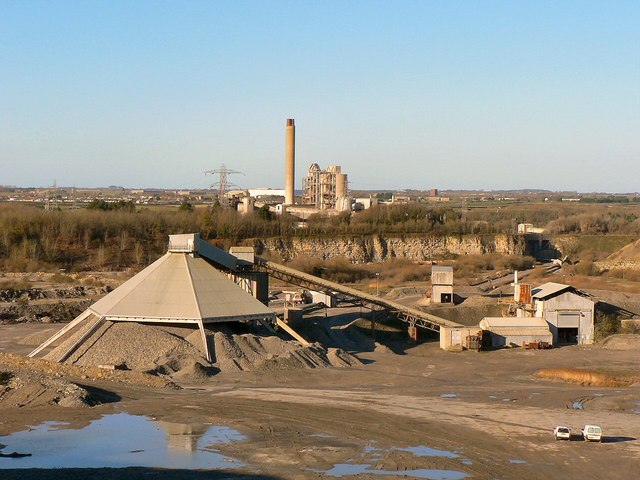
A working quarry. The face, the stockpiles and the conveyor plant that feeds the crushers stand in the quarry bowl with the cement works and its chimney beyond. The 1888 lime works on the shore is a ruin and survives well: roofless stone buildings that held the crushing plant, the kilns and the boilers, two tall shaft kilns and a square brick chimney, reachable from the Wales Coast Path.
At the shore site, the roofless stone buildings of the 1888 lime works, two tall shaft kilns and a square brick chimney. The tramway that once ran some 670 metres east to a shingle bank, and the short branch west to the Taff Vale Railway’s Aberthaw branch, are gone.
Related mines
- Rhoose Quarry — Three miles apart on the same Blue Lias beds and under the same owner from 1919, when the Aberthaw and Bristol Channel company bought Rhoose. Rhoose thereafter ran as make-up capacity for Aberthaw, used the same Ruthin limestone sweetener from 1947, and its power plant was sized to supply back-up electricity to Aberthaw as well as itself.
Nearby mines
- Rhoose Quarry — 2.0 miles (3.3 km) E
- Wenvoe Quarry — 7.7 miles (12.3 km) NE
- Wenvoe Iron Mine — 7.7 miles (12.4 km) NE
- Llanharry Iron Mine — 8.7 miles (14.1 km) N, Rhondda Cynon Taf
Straight-line distance, within 9 miles (15 km). Show on the map.
Recorded claims
Individual factual claims, each attached to the source(s) that support it below. Where sources disagree, both are kept.
- By the 1750s cement made with Aberthaw lime was known to be able to set underwater, useful for constructing sea walls and harbours; John Smeaton was "very anxious to procure" a sample in 1756 as he prepared his designs for the Eddystone lighthouse, and his tests proved cement made with Aberthaw lime "considerably harder" than cement using common lime. He used a similar lime from the Somerset coast for the lighthouse itself. 1
- The quarry adjacent to the plant works Blue Lias limestone and shale of the Porthkerry Formation, members B and C, dated to 198–200 million years ago; the Blue Lias here has a limestone to shale ratio of 75:25. 2
- Aberthaw Lime Works were established in 1888 by David Owen, owner of the Western Mail. They do not appear on the first-edition 25-inch Ordnance Survey of 1897 but are shown on the editions of 1900 and 1919; having ceased working in 1926, they are shown disused with all railway connections removed by the fourth edition of 1943. 3
- The Aberthaw and Bristol Channel Portland Cement Company was established in 1912 by the Beynon family, the site being chosen for its proximity to limestone and to South Wales coal; the works started in 1914 with two small wet-process kilns of 120 tonnes a day each, and the first consignment of cement left by rail in 1914. 2,4
- The Engineer reported in 1915 that the deposit was "exceedingly hard and by no means easy to quarry by hand labour", so that hand working would have been prohibitively costly; a Ruston Proctor steam digger with a capacity of 100 tons an hour or more was adopted instead. Blasting was introduced shortly afterwards, using 30 to 40 foot vertical shot holes drilled by a Cyclone Drill Company drop drill. 2
- All other Blue Lias cement plants of the period quarried by hand and separated the layers manually. Aberthaw instead crushed the mixed rock and scalped out the softer clay fractions mechanically, and eventually all the surviving Lias plants changed to the Aberthaw method. 2
- Initially the limestone alone was used and the shale removed by selective crushing; as higher-C3S clinker became necessary the company purchased Ruthin quarry in 1947 to supply limestone of 92 to 96 per cent calcium carbonate, after which the entire unsorted Lias was used. The sweetener came from Ruthin to 1986, Garwa Farm to 2006 and Pant quarry since. 2
- Clinker manufacture at Aberthaw has been operational from May 1914 to date, with approximately 36 million tonnes produced to 2022; among the few British cement plants remaining in 2025, only Rugby is older. 2
- Surviving remains of the 1888 lime works include roofless stone buildings housing the crushing plant, kilns and boilers, two tall shaft kilns and a square brick chimney. 3
Photographs & further reading
The definitive technical account of the works and its quarry — raw materials and their geology, the ownership chain from 1914 to CRH, kiln-by-kiln histories, and the full text of The Engineer’s 1915 description of the steam digger, the blasting and the fan-grid that scalped the marl.
View sourceThe national monuments record for the 1888 shore lime works: who built it, the tramway and railway connections, its appearance and disappearance across four Ordnance Survey editions, and the kilns and chimney still standing.
View sourceA short walking guide to finding the ruins from the Wales Coast Path, with the story of why Aberthaw lime mattered: setting under water, Smeaton and the Eddystone, and a Flintshire quarry that named itself after it.
View sourceSources
- (secondary) Remains of lime and cement works, Aberthaw — History Points
- (secondary) Cement Kilns: Aberthaw — Dylan Moore, cementkilns.co.uk
- (primary) Aberthaw Lime Works and Cement Works, Aberthaw (NPRN 40673) — Royal Commission on the Ancient and Historical Monuments of Wales
- (secondary) Aberthaw Cement Works — Wikipedia
Record created: 7 September 2026 · Last researched: 7 September 2026