 MineArchive
Rhoose Quarry
| Also known as | Rhoose Cement Works Quarry, Rhoose Point Quarry |
|---|---|
| Location | Rhoose, Porthkerry parish, near Barry, Vale of Glamorgan — 51.3850, -3.3425 (approximate) |
| Commodity | Limestone |
| Type | Quarry |
| Worked | 1913–1979 |
| Maximum depth | An open quarry worked in benches; no shaft depth applies. |
| Operators | Aberthaw and Rhoose Point Portland Cement and Lime Co. (1913–1919), Aberthaw and Bristol Channel Portland Cement Company (1919–1979) |
Overview
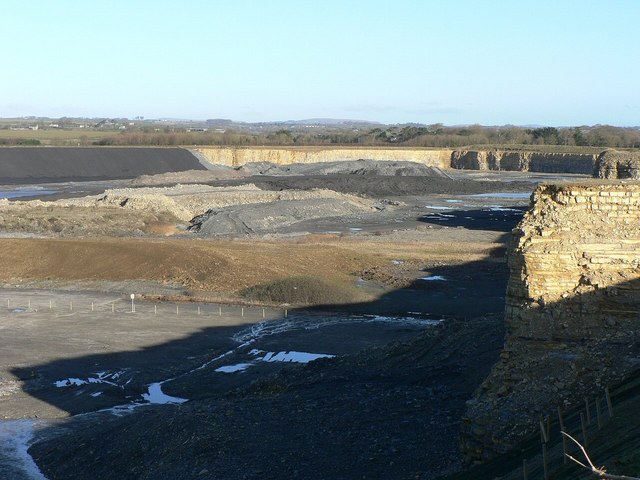
A Blue Lias limestone quarry and cement works on the Glamorgan coast, three miles east of Aberthaw and worked on the same beds. It opened in 1913 as a private venture by the Aberthaw and Rhoose Point Portland Cement and Lime Company, was bought by its larger neighbour in 1919 and thereafter ran as make-up capacity for it, working only in short periods through the depression. It made about 8.2 million tonnes of clinker before the last kiln stopped in 1979. The cement plant and quarry are now largely under housing, with the coastal part of the quarry made into parkland.
History
Rhoose was built to do what Aberthaw was already doing, on the same rock, and never escaped the comparison. Clinker manufacture began on 29 April 1913, a private venture by the Aberthaw and Rhoose Point Portland Cement and Lime Company with what was then a fairly large rotary kiln — but it was overshadowed from the outset by the larger and more advanced works at Aberthaw. Aberthaw took it over in 1919, and the decision to install a second kiln of similar inefficiency to the first confirmed what Rhoose was for: make-up capacity. Through the depression years it ran only for short periods, and only began working to capacity in 1936. The kilns shut down altogether from 17 August 1944 to 19 January 1946, during which Vickers desiccators and van der Werf coolers were installed. It was not without distinction. Rhoose pioneered the production of low-heat clinker from 8 April 1947, making 60,000 tonnes for the Claerwen Dam in small batches over four years — the naturally high silica ratio of the raw materials made the process straightforward. It made sulfate-resisting clinker alongside ordinary clinker from 1953 to 1980. Its reduction of slurry water content using deflocculants was uniquely successful, taking slurry moisture from 38 per cent to below 25 for a while, until the resulting high sodium levels became a problem. A third kiln improved efficiency in the 1960s, but after the energy crisis kilns 1 and 2 were stopped and kiln 3 ceased making clinker in 1979. Under Blue Circle ownership from 1983 to 1989 the plant was used for slag drying and grinding. The company had started its own asbestos-cement plant immediately west of the works in the early 1930s and sold it to Turner & Newall in 1935; that continued until 1992, after which the whole site was cleared.
Geology
Blue Lias limestone and clay of the Porthkerry Formation, members A, B and C, 198 to 200 million years old, from the quarry adjacent to the plant — essentially identical to Aberthaw’s raw materials and used in the same way. Initially the Blue Lias alone was used, the clay removed by selective crushing and screening; as higher-C3S clinker became necessary, Ruthin quarry supplied high-calcium Carboniferous limestone from 1947 to sweeten the mix, after which screening was abandoned and the entire unsorted Lias was used. The naturally high silica ratio of these materials is what made the low-heat clinker straightforward to produce.
Workings
An open quarry immediately beside the works, worked on the Aberthaw pattern: crush the mixed Lias and separate the clay mechanically rather than by hand. Transport was by rail. Power was generated on site — initially electricity only for lighting and the kiln, the rest driven directly by steam engine, then full electrification in 1923 with turbo-generators sized to provide back-up power to Aberthaw as well. Grid power came in from 1939, with the plant’s own generation kept as back-up into the 1970s.
Closure
Kilns 1 and 2 were stopped after the energy crisis and kiln 3 ceased making clinker in 1979, ending sixty-six years of production. The site had an afterlife — slag grinding under Blue Circle from 1983 to 1989, and the neighbouring asbestos-cement works until 1992 — and was then cleared entirely.
What remains
The cement plant and quarry are now largely under housing. The coastal part of the quarry has been developed as parkland, and waste from Aberthaw power station has been tipped at the north-east end.
Little. The whole site was cleared after 1992; the quarry survives as landform under housing and coastal parkland rather than as workings.
Related mines
- Aberthaw Limestone Quarry — Three miles apart on the same Blue Lias beds and under the same owner from 1919, when the Aberthaw and Bristol Channel company bought Rhoose. Rhoose thereafter ran as make-up capacity for Aberthaw, used the same Ruthin limestone sweetener from 1947, and its power plant was sized to supply back-up electricity to Aberthaw as well as itself.
Nearby mines
- Aberthaw Limestone Quarry — 2.0 miles (3.3 km) W
- Wenvoe Quarry — 6.5 miles (10.5 km) NE
- Wenvoe Iron Mine — 6.6 miles (10.6 km) NE
Straight-line distance, within 9 miles (15 km). Show on the map.
Recorded claims
Individual factual claims, each attached to the source(s) that support it below. Where sources disagree, both are kept.
- Clinker manufacture at Rhoose ran from 29 April 1913 to 1979, under the Aberthaw and Rhoose Point Portland Cement and Lime Co. from 1913 to 1919 and the Aberthaw and Bristol Channel Cement Co. Ltd from 1919 to 1979. Approximate total clinker production was 8.2 million tonnes. 1
- The plant commenced as a private venture with what was at the time a fairly large rotary kiln, but was overshadowed from the outset by the larger and more advanced Aberthaw nearby; after the 1919 takeover, the decision to install a second kiln of similar inefficiency to the first confirmed its role as make-up capacity for Aberthaw. 1
- Blue Lias limestone and clay of the Porthkerry Formation, members A, B and C, 198–200 million years old, came from the quarry adjacent to the plant; the raw materials are essentially identical to those of Aberthaw and were used in a similar manner. 1
- The plant pioneered the production of low-heat clinker, commencing 8 April 1947 and making 60,000 tonnes for the Claerwen Dam in small batches over a four-year period; the naturally high silica ratio of the raw materials made this a straightforward process. 1
- The reduction of slurry water content using deflocculants was uniquely successful here, with slurry moisture reduced from 38 per cent to below 25 per cent for a while, until the resulting high sodium levels became a problem. 1
- The kilns shut down altogether from 17 August 1944 to 19 January 1946, during which time Vickers desiccators and van der Werf coolers were installed. 1
- Following the energy crisis kilns 1 and 2 were stopped and kiln 3 ceased making clinker in 1979; during Blue Circle ownership from 1983 to 1989 the plant was used for slag drying and grinding. The company’s own asbestos-cement plant, started in the early 1930s and sold to Turner & Newall in 1935, continued until 1992, after which the whole site was cleared. The cement plant and quarry are now largely under housing, the coastal part of the quarry developed as parkland. 1
- Further development of the Rhoose Point housing on the quarry ground was halted in 2008 over concern that the drainage would not cope. 2
- By 2009 the flooded quarry workings lay beside the new housing estate at Rhoose Point. 3
Photographs & further reading
The technical record of the works and its quarry: ownership, the raw materials shared with Aberthaw, the kiln-by-kiln history, the low-heat clinker made for the Claerwen Dam, and the clearance of the site after 1992.
View sourceSources
- (secondary) Cement Kilns: Rhoose — Dylan Moore, cementkilns.co.uk
- (secondary) Rhoose (Wikipedia) — Wikipedia
- (observational) Flooded quarry workings and housing estate, Rhoose Point (Geograph, Mick Lobb, 2009) — Geograph Britain and Ireland
- (secondary) Cement Kilns: Aberthaw — Dylan Moore, cementkilns.co.uk
Record created: 8 September 2026 · Last researched: 24 September 2026