 MineArchive
Stemming
| Category | Mine Workings & Access |
|---|
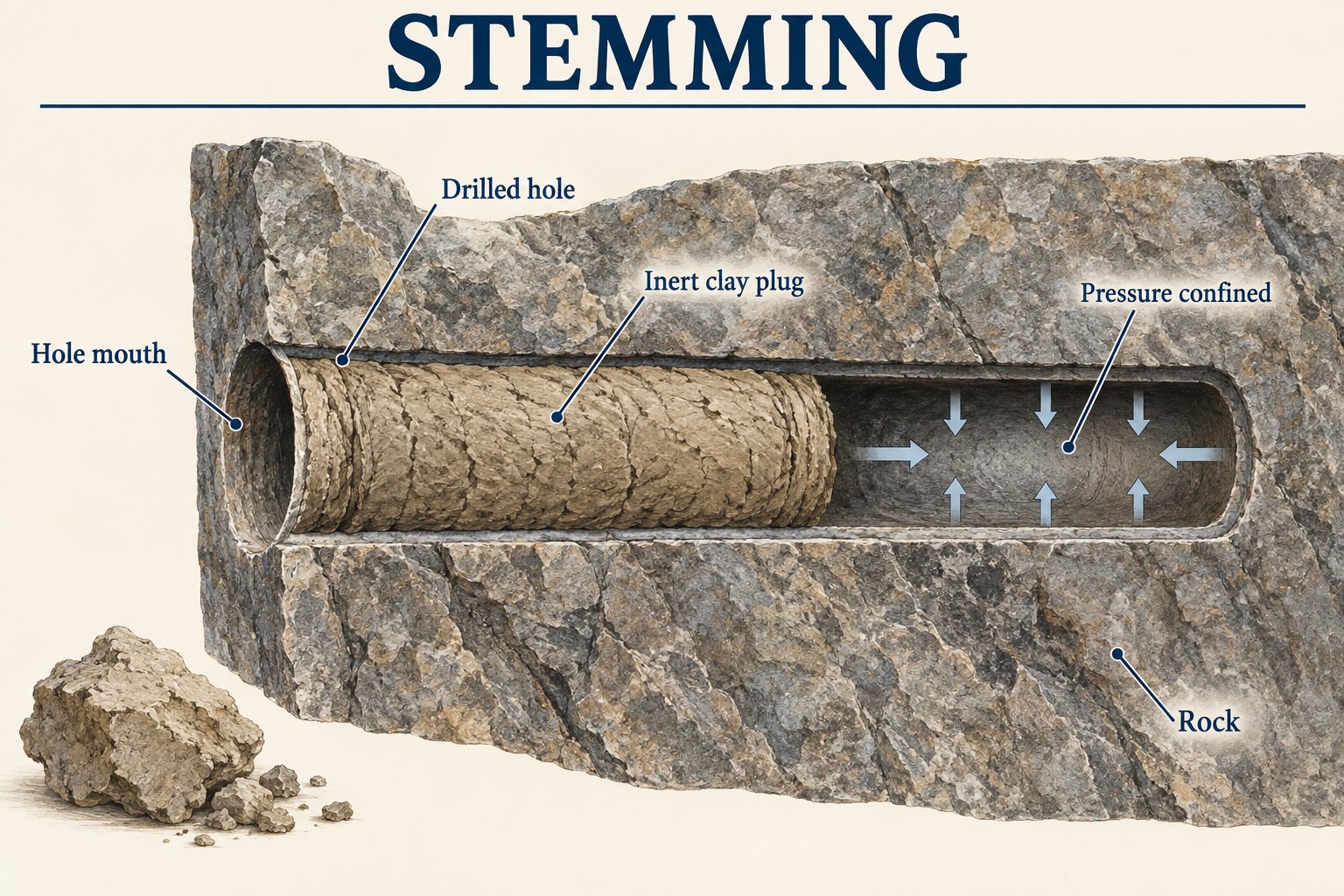
The inert material — clay, sand, drill cuttings or similar — packed into a drilled shot-hole on top of an explosive charge, and the act of packing it, done to confine the blast within the rock rather than let it vent uselessly out of the hole.
Historical usage
Stemming has been part of ordinary blasting practice for as long as gunpowder and later explosives have been used to break rock underground, and remains a standard, regulated step in shot-firing today.
How it worked
A hole is drilled and charged with explosive, then the remaining length of the hole is packed with stemming material before the charge is fired. Without stemming, as much as half the explosive's energy can escape uselessly out of the hole as venting gas; a well-packed stemming plug — clay is particularly effective — can cut that loss to as little as 15%, directing far more of the blast's force into breaking the surrounding rock.
Why it was used
Stemming makes each shot more efficient, breaking more rock for the same charge, and reduces the fumes, flying debris and noise that an unstemmed or poorly stemmed shot produces.
Risks & limitations
The material used to stem a hole matters for safety as well as efficiency: an inert material such as clay or sand is safe, but stemming a shot with coal dust — as was standard practice at some collieries, including Kames — was specifically criticised after the 1957 Kames Colliery disaster as dangerously explosive in its own right, since a shot's flame could ignite the stemming material itself and help raise the very coal-dust cloud that turned a firedamp ignition into a much larger explosion.
Related terminology
Mines associated with this term
Included only where MineArchive's own research gives a reasonable evidential basis — not every mine where this might plausibly apply.
- Lovers Lane Colliery — Greater Manchester (well documented example)
Named twice in this record, first in the summary: “…largest of their early collieries, where a shot that blew out its stemming killed 27 in 1872; it was abandoned in 1898.”
Disasters associated with this term
5 examples chosen from 12 linked records, most direct relationship first.
- Kames Colliery Explosion, 1957 (contributing factor)
Expert evidence at the official inquiry specifically criticised the colliery's practice of stemming blasting shots with coal dust as dangerously explosive. - Pendleton Colliery explosion, 1870 (contributing factor)
The jury considered how powder came to be on the stemming. - Agecroft Colliery shot-firing accident, 1859 (contextual relationship)
Named 3 times in this record, first in the summary: “…in Lancashire, by a heavily charged shot that blew out its stemming.” - Apedale Colliery Sladderhill No. 3 Pit explosion, 1891 (contextual relationship)
Named twice in this record, first in the contributing factors: “Poor stemming of shots; a lamp relighting station too near the face; dust from…” - Llay Main Colliery Explosion (contextual relationship)
Named twice in this record, first in the contributing factors: “…a haulage engine as part of the ventilation of working places. On stemming clay, which the jury wanted supplied to every district, he pointed…”
Sources
- (primary) Kames Colliery Disaster — culled from the files of The Muirkirk Advertiser, by James Taylor — Ayrshire History / The Muirkirk Advertiser
- (secondary) Underground Shot Firer study guide — Virginia Department of Energy
Record created: 2 September 2026 · Last researched: 2 September 2026