 MineArchive
Llay Main Colliery Explosion
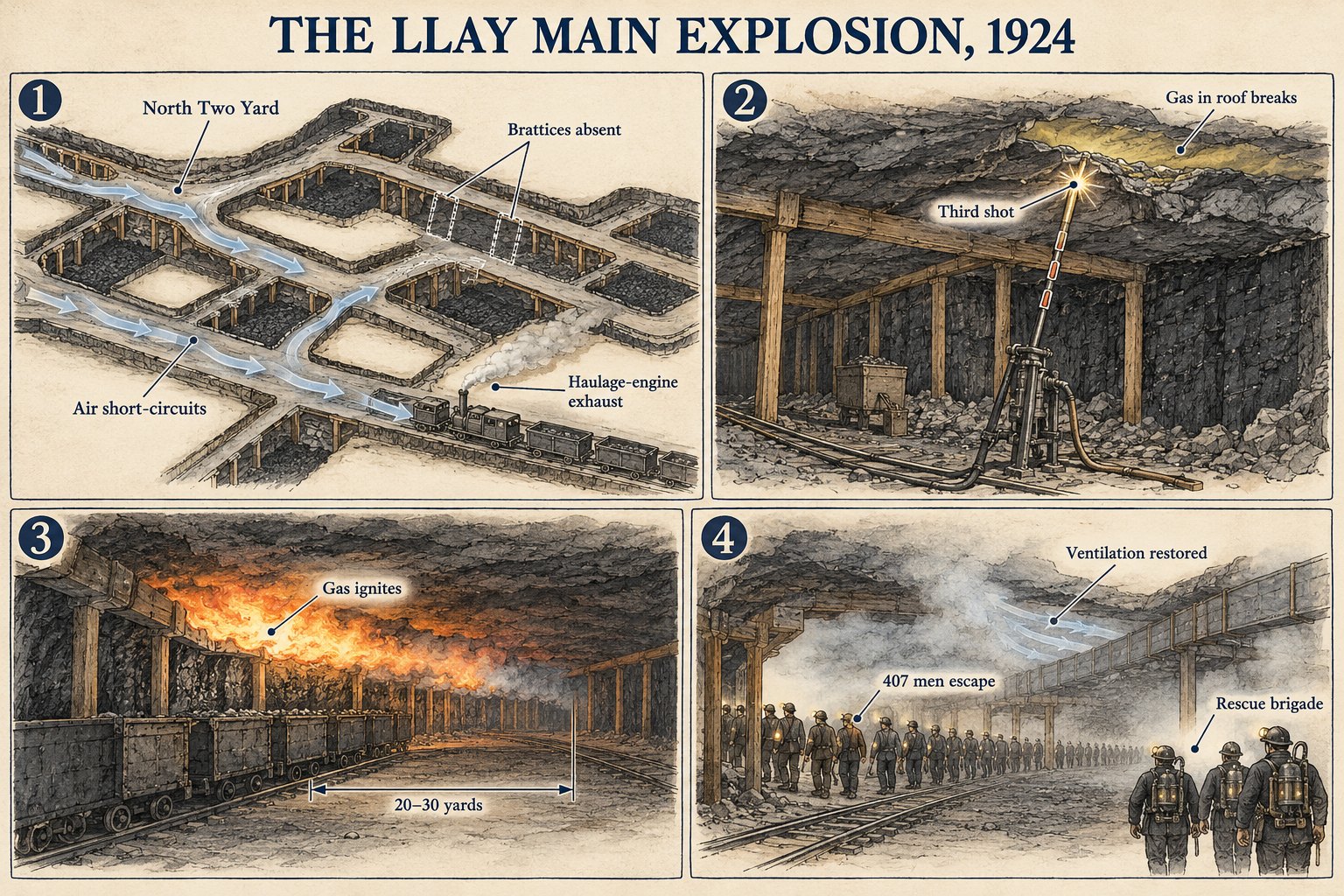
At about a quarter past one on the morning of Friday 5 December 1924, gas ignited in the North Two Yard district of Llay Main Colliery, near Wrexham. The flame travelled only twenty or thirty yards, but nine men and boys died in it — including the fireman who had fired the shot that set it off. The other 407 men underground got out. The divisional inspector’s report to Parliament found the district’s ventilation inadequate and criticised the practice of relying on exhaust air from a haulage engine to ventilate working places.
| Date | 5 December 1924 |
|---|---|
| Mine | Llay Main Colliery |
| Region | Wrexham |
| Primary type | Explosion |
| Associated types | Rescue |
| Fatalities | 9 (Nine dead, ranging in age from 15 to 53. The youngest were Edward German, 15, found at his haulage engine, and Isaac Evans, 19. The fireman William Ernest Williams, 41, who had fired the shots, was among them.) |
| Context | During active mining (The night shift, in a colliery barely a year into full production.) |
Cause
Fireman William Ernest Williams took a pound of Penrhyn Powder underground and fired three shots in the roof. The third ignited gas which, on the inspector’s reading of the evidence, was sitting in breaks in the roof rather than having accumulated after the earlier shots. No gas had been reported in the district since 26 November, though it had previously been found on the high side of No. 17 near the shaft pillar. The jury attributed the deaths to carbon monoxide poisoning and to the shock of the explosion.
Contributing factors
Inspector Nicholson’s report turned on ventilation. The high side of the district was poorly swept because brattice cloths that would have directed the air were not in place — he noted specifically that "if a brattice sheet had been erected at No.6 gate and another at No.17 gate, the ventilation of the high side... would have been much more adequate." Air was short-circuiting instead of reaching the face. He also criticised the colliery for using exhaust air from a haulage engine as part of the ventilation of working places. On stemming clay, which the jury wanted supplied to every district, he pointed out that clay had been sent to within a hundred yards of the site two days earlier — making it a question of enforcement rather than supply.
What happened
Llay Main was one of the largest and most modern collieries in Britain, employing some 2,600 men and raising 10,000 tons a week. On the night of 4–5 December, 416 men were underground. The ignition came at about 1.15 a.m. in the North Two Yard district. It was, in explosion terms, small — the flame reached only twenty or thirty yards from the shot — but everyone within that distance was caught. Most of the bodies were severely burned. Edward German, fifteen years old, was found at his haulage engine. The remaining 407 men underground came out unhurt.
Rescue & recovery
Three colliery officials went straight in and recovered bodies without respirators before the rescue teams arrived. The North Wales Rescue Station at Wrexham sent a brigade under Sergeant-Major Herbert. Ventilation was restored quickly enough to clear the afterdamp before it became a second danger — the reason the toll stopped at nine. The last body was recovered on the Saturday morning from beneath a heavy roof fall.
Investigation & inquiry
Arthur D. Nicholson, H.M. Divisional Inspector of Mines, reported to Parliament as Command Paper 2365 of 1925: "Report on the Causes and of the Circumstances attending the Explosion which occurred at the Llay Main Colliery, Wrexham, Denbighshire on the 5th December 1924". The inquest jury returned deaths from carbon monoxide poisoning and explosion shock, and made three recommendations: adequate stemming clay in every district, a standard ventilation system with proper brattice cloths, and a named foreman responsible for explosives each shift.
Changes to practice & legislation
Nicholson accepted the jury’s recommendations on ventilation and on clay, while noting that the clay had in fact been available. The lasting point of the report was its attack on ventilating working places with the exhaust from a haulage engine — a shortcut that saved installing proper ducting and that Llay Main’s nine deaths made indefensible.
Recorded claims
Individual factual claims, each attached to the source(s) that support it below. Where sources disagree, both are kept.
- Nine men and boys were killed, aged from 15 to 53; the other 407 of the 416 men underground escaped. 1,2
- Fireman William Ernest Williams fired three shots in the roof with Penrhyn Powder; the third ignited gas apparently lying in breaks in the roof. 2
- The jury attributed the deaths to carbon monoxide poisoning and to the shock of the explosion. 2
- The flame travelled only twenty to thirty yards from the point of ignition. 2
- Arthur D. Nicholson, H.M. Divisional Inspector of Mines, reported to Parliament as Command Paper 2365 of 1925, criticising the use of exhaust air from a haulage engine to ventilate working places and the absence of brattice cloths at Nos. 6 and 17 gates. 2
- A brigade from the North Wales Rescue Station at Wrexham attended under Sergeant-Major Herbert; three colliery officials had already recovered bodies without respirators. 2
Related terminology
Mining terms this disaster is structurally linked to, with the nature of the relationship.
- Brattice (contributing factor)
Nicholson’s central finding was that brattice sheets at Nos. 6 and 17 gates would have swept the high side of the district properly; without them the air short-circuited and gas stayed in the roof breaks. - Firedamp (direct cause)
Gas lying in breaks in the roof, not reported in the district since 26 November, was what the shot found. - Mines Rescue Station (rescue/recovery concept)
The North Wales Rescue Station at Wrexham sent a brigade under Sergeant-Major Herbert, after three colliery officials had already gone in without respirators. - Shot-firing (direct cause)
The third of three shots fired in the roof ignited the gas — the fireman who fired them was among the nine killed. - Stemming (contextual relationship)
Named twice in this record, first in the contributing factors: “…a haulage engine as part of the ventilation of working places. On stemming clay, which the jury wanted supplied to every district, he pointed…”
Photographs & further reading
This page doesn't try to reproduce everything — these are the best original sources found for this disaster.
The national heritage body’s account, setting the explosion alongside the building of the village and the memorial winding wheel installed in 2012.
View sourceThe detailed account following Nicholson’s report, with the inspector’s own wording on the brattice cloths and the jury’s three recommendations.
View sourceSources
- (secondary) Llay Main and Llay Hall collieries, Wrexham — Welsh Coal Mines
- (secondary) Llay Main Colliery Explosion, Wrexham, 1924 — Northern Mine Research Society
- (primary) 1924 — a significant year in Llay village history — Royal Commission on the Ancient and Historical Monuments of Wales
Record created: 26 August 2026 · Last researched: 26 August 2026