 MineArchive
Kames Colliery Explosion, 1957
An explosion in the West Mine's Six Feet Section at Kames Colliery, Muirkirk, killed seventeen men after a match struck to light a cigarette ignited firedamp in an unventilated heading — the worst Scottish mining disaster in six years, in a pit that had been considered so safe it was used for experimental blasting work.
| Date | 19 November 1957 |
|---|---|
| Mine | Kames Colliery |
| Region | East Ayrshire |
| Type | Explosion |
| Fatalities | 17 (Seventeen men killed, all of Muirkirk: Thomas Burnside, Thomas Casey, Alexander Crawford, John Dalziel, Timothy Dillon, Andrew Findlay, Ronald Grant, William Hendry, Robert Lowe, James Marshall, Donald McGarry, William McKay, John McKean, James Samson, Robert Smith, William Smith and John Walker. Twelve more men were injured.) |
| Context | During active mining |
Cause
The Chief Inspector of Mines, Sir Harold Roberts, concluded that a mixture of firedamp and air near the face of an unventilated heading in the Six Feet Section of the West Mine had been ignited by a match, struck by a workman intending to smoke — something he was, at the time, entitled to do in what had always been regarded as a 'safe', naked-light pit. The resulting explosion was violent enough to raise an inflammable cloud of coal dust, and continued thereafter as a coal dust explosion.
Contributing factors
The primary cause identified by the inquiry was a failure to ventilate and thoroughly inspect for gas in the heading where the explosion originated (the north-westerly extension of Casagranda's Level), which had gone four days without ventilation or a proper inspection. Deputies frankly admitted they rarely carried flame safety lamps — the standard tool for detecting firedamp — during general inspections, and by no means regularly during pre-shift checks; the inquiry found this reflected a wider failure by management to enforce good ventilation practice and effective measures against coal dust, despite the coal's high volatile content. The pit's long-standing reputation for safety, reinforced by its use for experimental blasting work, had bred a false sense of immunity: workmen were permitted to smoke underground, and 'nobody had ever contemplated the possibility of an explosion.'
What happened
On the night of 19 November 1957, twenty-eight men were working in the Six Feet Section of Kames Colliery's West Mine when an explosion tore through the workings. Ten men working at the coalface and seven more working further along the section were killed outright or died from the blast; the rest were blown off their feet and suffered mainly from shock. Survivors described a shattering blast and a tremendous rush of air; all lights went out and the area filled with dense, choking fumes. The colliery had just emerged from around three years of major modernisation and reconstruction — new pithead towers, a new administrative office, a new medical centre and canteen — that was nearing completion when the disaster struck. The mine had long been considered exceptionally safe, to the point of being used as an experimental ground for blasting techniques with the Mines Inspectorate's permission, and workmen were permitted to carry naked lights and smoke underground. According to the subsequent official inquiry, the explosion began when two workmen went into an unventilated heading — the north-westerly extension of Casagranda's Level, which had gone four days without ventilation or inspection — to see what work might be needed there, and one of them struck a match to smoke, as he was entitled to do. This ignited a pocket of firedamp that had accumulated in the heading, and the resulting blast was violent enough to raise an explosive cloud of coal dust, which carried the explosion on through the section.
Rescue & recovery
News of the explosion reached the surface by 7:50pm, but the first rescue brigade did not leave the fresh air base to explore the affected area until 11:15pm — a delay the subsequent inquiry noted, though it concluded the delay had made no difference to the possibility of saving life on this occasion. Emergency rescue squads were organised at the colliery, and official mine rescue parties were summoned from Coatbridge, Alloa, Whitehill, Highhouse, Auchinleck and Kilmarnock; more than one hundred men, working in teams of five, took part in the operation, hampered by roof falls, carbon monoxide gas and wrecked plant and equipment, at times dragging stretchers through workings with less than three feet of headroom. Two bodies were found soon after the search began; by around 1am the National Coal Board confirmed all seventeen missing men were dead, and all bodies had been recovered and taken to Ballochmyle Hospital by early afternoon the following day. Three injured survivors were also taken to Ballochmyle Hospital.
Investigation & inquiry
A public inquiry, chaired by the Chief Inspector of Mines, Sir Harold Roberts, opened at Ayr in February 1958 and heard from around fifty witnesses over several sittings. Evidence established that deputies at the colliery rarely carried flame safety lamps, that a heading where gas was later detected had gone unventilated and uninspected for days, and that at least one earlier incident of gas igniting in a shot-hole had gone unreported. Expert witnesses disagreed on some technical points — a Durham University mining professor argued naked-light collieries should not exist at all, while a Glasgow University mining professor considered the colliery's ventilation adequate and doubted coal dust had played a significant role — but the Chief Inspector's final report concluded the explosion began with firedamp ignited by a match and was then carried on by coal dust. He found that safety standards regarding explosion risk had not been of a high order, though he accepted that most mining men would genuinely have believed the pit immune to such a risk, given its general dampness and the absence of any prior firedamp incident of consequence.
Legal & regulatory aftermath
The National Coal Board did not dispute the Chief Inspector's findings; his report's central recommendation — banning naked lights underground and converting all collieries to safety-lamp working — was accepted as national policy.
Changes to practice & legislation
Sir Harold Roberts recommended the National Coal Board forthwith prohibit the presence of naked flame of any kind underground, and convert every remaining 'mixed light' colliery to safety-lamp working by 31 December 1960, the date already set nationally for that transition; he also recommended extending permanent, centrally based rescue corps to reduce response times in future incidents.
Memorials & commemoration
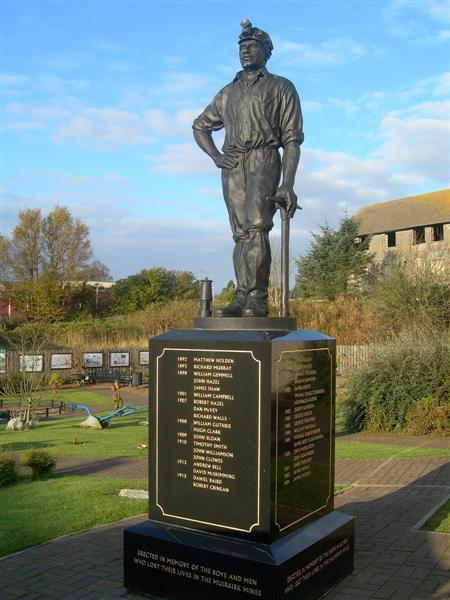
The seventeen victims are commemorated on the general Muirkirk miners' memorial, which records a total of eighty men killed in mining accidents at the local collieries between 1892 and 1966. A public Disaster Relief Fund raised £39,173 for the bereaved families, funding lifetime annuities for the widows and additional provision for their children.
Recorded claims
Individual factual claims, each attached to the source(s) that support it below. Where sources disagree, both are kept.
- Seventeen men, all of Muirkirk, were killed: Thomas Burnside, Thomas Casey, Alexander Crawford, John Dalziel, Timothy Dillon, Andrew Findlay, Ronald Grant, William Hendry, Robert Lowe, James Marshall, Donald McGarry, William McKay, John McKean, James Samson, Robert Smith, William Smith and John Walker. 1
- The Chief Inspector of Mines concluded the explosion began when a workman struck a match to smoke in an unventilated heading, igniting firedamp, which then raised an explosive cloud of coal dust that carried the blast further. 1,2
- The heading where the explosion originated, the north-westerly extension of Casagranda's Level, had gone four days without ventilation or a thorough inspection for gas. 1
- Deputies at the colliery frankly admitted in evidence that they rarely carried flame safety lamps, the standard means of detecting firedamp, during general inspections, and did so no more than irregularly during pre-shift checks. 1
- Although the explosion was known at the surface by 7:50pm, the first rescue brigade did not leave the fresh air base until 11:15pm; the inquiry found this delay had not affected the outcome on this occasion, but recommended extending permanent rescue corps to reduce response times generally. 1
- The Chief Inspector recommended the National Coal Board prohibit naked flame of any kind underground and convert all remaining collieries to safety-lamp working by 31 December 1960. 1
- A public Disaster Relief Fund raised £39,173 for the bereaved families, funding lifetime annuities for the widows and further provision for their children, with contributions received from as far afield as America, Canada, Venezuela and Australia. 1
Related terminology
Mining terms this disaster is structurally linked to, with the nature of the relationship.
- Deputy (contextual relationship)
Named twice in this record, first in the contributing factors: “…which had gone four days without ventilation or a proper inspection. Deputies frankly admitted they rarely carried flame safety lamps — the…” - Naked Light (contextual relationship)
Named 5 times in this record, first in the cause: “…time, entitled to do in what had always been regarded as a 'safe', naked-light pit. The resulting explosion was violent enough to raise an…” - Rescue Brigade (contextual relationship)
Named in this record’s rescue and recovery: “News of the explosion reached the surface by 7:50pm, but the first rescue brigade did not leave the fresh air base to explore the affected area until…” - Safety Lamp (contributing factor)
Deputies at the colliery rarely carried flame safety lamps, the standard tool for detecting firedamp, during their inspections — a central failing identified by the official inquiry. - Shot-firing (contextual relationship)
The colliery had been used for experimental shot-firing and blasting work with the Mines Inspectorate's permission, and expert evidence at the inquiry examined shot-firing practice, though the explosion itself was found to have been caused by a match, not a shot. - Stemming (contributing factor)
Expert evidence at the official inquiry specifically criticised the colliery's practice of stemming blasting shots with coal dust as dangerously explosive.
Sources
- (primary) Kames Colliery Disaster — culled from the files of The Muirkirk Advertiser, by James Taylor — Ayrshire History / The Muirkirk Advertiser
- (secondary) Kames Colliery Explosion — Muirkirk — 1957 — Northern Mine Research Society
Record created: 2 September 2026 · Last researched: 2 September 2026