 MineArchive
B Winning Colliery
| Location | Hilcote, near Alfreton, Derbyshire — 53.1148, -1.3233 (exact) |
|---|---|
| Commodity | Coal |
| Type | Coal |
| Worked | 1873–1874 (sinking)–November 1964 |
| Maximum depth | 345 yards |
| Operators | Blackwell Colliery Company (1873–1944), N. H. and B. Collieries Ltd (1944–1947), National Coal Board (1947–1964) |
Overview
The Blackwell Colliery Company's second pit, sunk at Hilcote in 1873–74 and worked for ninety years until November 1964. The village that grew up beside it was itself known as B Winning.
History
B Winning Colliery stood at the south end of Hilcote, on the east side of Berristow Lane and north of South Normanton. The Blackwell Colliery Company, which had begun its A Winning at Blackwell in 1871, opened this second winning in 1873–74 with two shafts 14 feet in diameter: No. 3 to the Deep Hard seam at 228 yards and No. 4 to the Tupton, or Low Main, at 287 yards. A list of the collieries taken over in 1947 gives it an opening year of 1880. Coal had been got at Hilcote long before: a directory of 1846 called the place "noted for its collieries, at present not worked", and an old shaft stood beside the new pit.
In 1894 the two pits employed 640 people, No. 3 raising manufacturing coal from the Deep Hard and No. 4 household coal from the Tupton. The Waterloo seam was tried from No. 3 several times before 1916 and found very wet and unprofitable, though it was worked again from 1919 to 1960. The Deep Hard was given up in 1919, when the Blackshale was opened; the Low Main lasted until 1937 and the Yard until 1960. Beside the pit were a smithy, a coke oven and a brickworks with four Newcastle kilns. The colliery was connected underground to A Winning and shared its Institute. From 1923 to 1940 it is returned with 727 people, 564 of them below ground.
On the night of 11 January 1922 a descending cage came off its rope in the upcast shaft and fell to the bottom, killing two deputies, Henry Wood of Hucknall and Joseph Moore of Pinxton. The enginewright and a shaftsman were lowered on a rope and worked for five hours to free them. The inquest, held at the B Winning Institute, returned a verdict of accidental death.
In 1944 the Blackwell and New Hucknall companies were joined as N. H. and B. Collieries Ltd, which ran the pit until nationalisation. In 1947 it employed 355 people and raised 115,000 tons. Under the National Coal Board the Threequarter seam was worked from 1951, output reached 371,102 tons in 1956 and the workforce stood at 626 in 1958. It was known as a frugal pit, practised at drawing old roadway supports for use again. The connection to A Winning was closed in April 1964 and the colliery shut that November, ninety years after it opened.
The company built much of Hilcote for its men: brick terraces along Berristow Lane with the Hilcote Arms at the corner, and New Street, running down to the Normanton Brook, with a miners' welfare hall, a Primitive Methodist chapel and a school. The village itself was known as B Winning, and two of its rows were called Top Row and Side Row.
Geology
Coal Measures of the Derbyshire and Nottinghamshire coalfield. The shafts passed the Deep Hard seam at 228 yards and the Tupton, or Low Main, at 287 yards; the Waterloo, Yard, Threequarter and Blackshale (Silkstone) seams were also worked. The Waterloo was very wet.
Geological setting: Sedimentary Beds and Seams (well documented example)
Workings
Two shafts 14 feet in diameter, No. 3 to the Deep Hard at 228 yards and No. 4 to the Low Main at 287 yards, the deepest point 345 yards. The upcast shaft was covered in at the top, with lifting hoods, and the pit was ventilated by a Guibal fan 36 feet in diameter and 12 feet wide. The winding engine had two cylinders of 32 inches by 6 feet stroke, with a flat drum for the Deep Hard pit and a conical drum for the Low Main, and double-deck cages taking two tubs on each deck. Haulage was by a single rope driven by two engines at the surface, by main-and-tail rope and by ponies.
Closure
Closed in November 1964 as a loss-making pit, the underground connection to A Winning having been shut that April. The last seam worked was the Threequarter.
What remains
The colliery land was reclaimed after closure and classed as Grade 4 agricultural land.
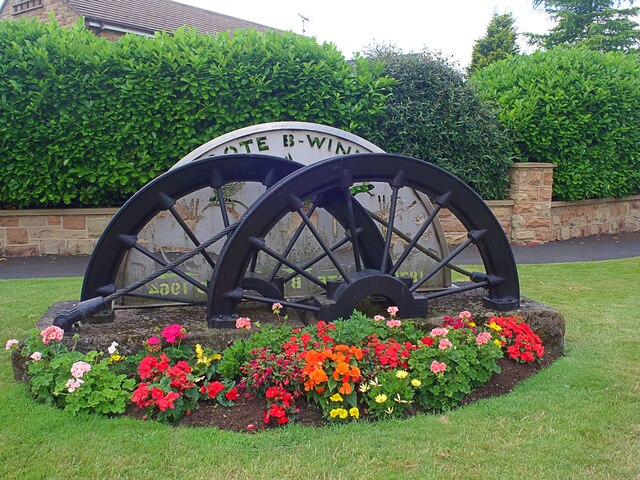
A halved winding wheel from the colliery is set up in Hilcote as a memorial, in front of a stone lettered for the B Winning. The Hilcote Arms and the company's terraces on Berristow Lane, New Street and Pasture Lane survive; the miners' welfare hall burnt down in the 1990s and was rebuilt.
Related mines
- Blackwell Colliery — The Blackwell Colliery Company's A and B Winnings, connected underground until April 1964 and sharing an Institute.
Nearby mines
- South Normanton Colliery — 0.7 miles (1.2 km) SE
- Blackwell Colliery — 1.1 miles (1.8 km) W
- Brookhill Colliery — 2.0 miles (3.2 km) S
- Tibshelf Colliery — 2.0 miles (3.2 km) N
- Langton Colliery — 2.1 miles (3.4 km) SE, Nottinghamshire
Straight-line distance, within 9 miles (15 km). Show on the map.
What's uncertain
Points where sources disagree or the record could not be settled; both accounts are kept. All open questions in the archive.
- Opened in 1880. (disputed) 3
Recorded claims
Individual factual claims, each attached to the source(s) that support it below. Where sources disagree, both are kept.
- Nos. 3 and 4 shafts were sunk in 1873–74 by the Blackwell Colliery Company, 14 feet in diameter, to the Deep Hard at 228 yards and the Tupton at 287 yards. 1,2
- Opened in 1880. (disputed) 3
- In 1894 No. 3 pit employed 380 people in the Deep Hard seam and No. 4 pit 260 in the Tupton. 4
- From 1923 to 1940 the colliery is returned with 727 people, 564 below ground and 163 at the surface. 4
- Two deputies, Henry Wood and Joseph Moore, were killed on 11 January 1922 when a cage came off the rope in the upcast shaft; the inquest verdict was accidental death. 5
- In 1947 the colliery employed 355 people and raised 115,000 tons. 4
- Output was 371,102 tons in 1956 and manpower 626 in 1958. 1
- The underground connection to Blackwell A Winning was closed in April 1964. 1
- The colliery closed in November 1964. 3,1
- Hilcote was previously called B Winning, and many of its houses were built for the mineworkers by the Blackwell Colliery Company. 6,2
- After closure the land was reclaimed and classed as Grade 4 agricultural land. 6
- A plan of the Deep Hard seam at Blackwell A and B Winning records abandonment on 1 June 1946. 7
- A winding wheel from the colliery stands in Hilcote as a memorial, dated 1874 to 1964. 8
Photographs & further reading
Bob Bradley's account of the pit at its closure in 1964: shafts, seams, plant and yearly manpower.
View sourceA transcript of the newspaper report of the inquest on the two deputies killed in the shaft in January 1922.
View sourceA walk round Hilcote's colliery housing, chapel, school and welfare, with the history of the hamlet before the pit.
View sourceA 2021 photograph of the memorial winding wheel in Hilcote, opposite the Hilcote Arms.
View sourceSources
- (secondary) Bob Bradley: 1964, page 3 (Blackwell B Winning Colliery Closed After 90 Years) — Healey Hero
- (secondary) Places Pevsner Forgot - Hilcote — Country Images Magazine
- (secondary) Derbyshire Coalfield - Derby Area (collieries after nationalisation in 1947) — Northern Mine Research Society
- (primary) Blackwell Colliery — Durham Mining Museum
- (secondary) Colliery Accidents, Including Blackwell 'B' Winning Colliery Accident (Alfreton and Belper Journal, 19 January 1922) — Healey Hero
- (secondary) Hilcote — Wikipedia
- (primary) Mine plan: BLACKWELL A&B WINNING, Deep Hard seam, abandoned 1 June 1946 (feature 21937157) — British Geological Survey / Mining Remediation Authority mine plans catalogue
- (observational) Winding wheel from Blackwell Colliery (Graham Hogg, 2021) — Geograph Britain and Ireland
Record created: 2 October 2026 · Last researched: 2 October 2026