 MineArchive
Blackwell Colliery
| Also known as | A Winning Colliery, Blackwell A Winning Colliery |
|---|---|
| Location | Blackwell, east of Alfreton, Derbyshire — 53.1161, -1.3508 (exact) |
| Commodity | Coal |
| Type | Coal |
| Worked | 1871 (sinking)–1969 |
| Maximum depth | 307 yards |
| Operators | Blackwell Colliery Company (1871–?), N. H. and B. Collieries Ltd (?–1947), National Coal Board (1947–1969) |
Overview
The Blackwell Colliery Company's A Winning pit at Blackwell, east of Alfreton, sunk from 1871 with a village built beside it. It raised up to 2,000 tons a day in the 1890s, lost seven men to a coal-dust explosion in 1895, made coke, benzol and town gas, and closed under the National Coal Board in 1969.
History
Blackwell Colliery, known as A Winning, was sunk from 1871 by the Blackwell Colliery Company on open ground at Blackwell, east of Alfreton, under a lease from a Mrs H. B. Whitworth. Coal had been worked at Blackwell before: plans of Top Hard and Dunsil workings there are dated between 1840 and 1852. The two shafts, each 14 feet in diameter, reached the Deep Hard seam at 180 yards and the Low Main at 237, and went on to the Silkstone, which was worked until 1881. Sinking was still going on in September 1874, when a sinker was thrown from a tub in the shaft. The company built a village as it went: houses by the pit, then Primrose Hill with its shops, school, chapel, hospital and reading room, all in brick from the company's own kilns, between 1871 and 1885.
In 1895 A Winning had about 400 men and boys in the Deep Hard and 390 in the Low Main, raising 1,500 to 2,000 tons a day by longwall working with horses and rope haulage. A 45-foot Guibal fan ventilated both seams, and naked lights were in general use. Early on 11 November that year a shot fired in the Low Main haulage road raised and fired the coal dust and killed seven men (see Disasters, below). The Lists of Mines return A Winning as the company's Nos. 1 and 2 mines, with 1,029 people in 1894, and its B Winning at Hilcote as Nos. 3 and 4.
Ponies drew the tubs to the pit bottom throughout the colliery's life, the contorted seams limiting the machinery brought in from the early 1930s. Coke ovens at the pit made coke from Low Main coal, with benzol and gas as by-products, and surplus gas was piped eleven miles to the Derby Corporation gasworks. A Winning employed 1,340 people in 1923. It passed to N. H. and B. Collieries Ltd and, in 1947, to the National Coal Board, raising 385,000 tons that year with 1,136 people.
Manpower peaked at 1,342 in 1952 and output at 578,059 tons in 1957. In 1967 about 1,000 men were producing around 500,000 tons a year from the Yard and Black Shale seams, with every face mechanised. The colliery closed in 1969. The Durham Mining Museum names 71 people killed at the Blackwell pits.
Geology
Derbyshire Coal Measures. The shafts passed the Deep Hard seam, 3 feet 6 inches thick, at 180 yards and the Low Main, 4 feet thick, at 237 yards, and reached the Silkstone, 3 feet 7 inches thick, below. The seams lay almost flat in 1895 but are described as contorted in the later workings. The Lists of Mines name the Tupton and Deep Hard as the seams at work from 1894, and in 1967 the colliery was working the Yard and Black Shale.
Geological setting: Sedimentary Beds and Seams (well documented example)
Workings
Two shafts 14 feet in diameter: coal from the Low Main was wound at the downcast and from the Deep Hard at the upcast. The colliery was 307 yards deep in 1967. The seams were worked longwall, all the coal being taken out as the faces advanced, with horses and rope haulage running at 12 miles an hour on the main roads. A Guibal fan 45 feet in diameter and 12 feet wide gave 140,000 cubic feet of air a minute. Shots were fired with gunpowder and naked lights were used until 1895. Machinery came in during the early 1930s, though ponies worked there to the end, and by 1967 every face was mechanised. Coke ovens with benzol and gas plant stood at the surface.
Closure
Closed in 1969; the surface plan of the colliery is dated as abandoned that year.
What remains
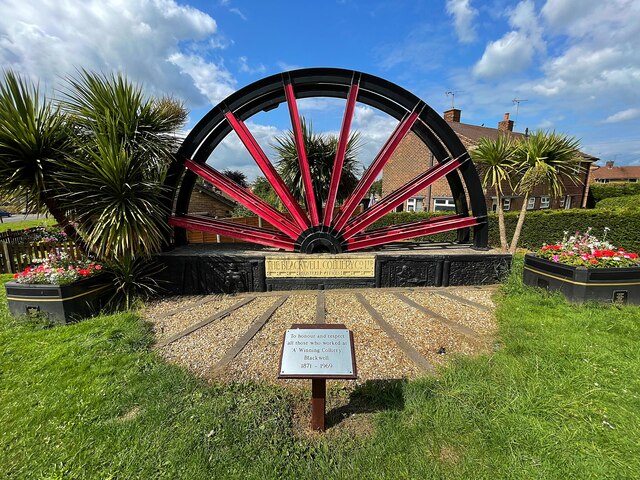
A winding wheel from the colliery stands as a memorial, with a sign 'to honour and respect all those who worked at A Winning Colliery, Blackwell 1871-1969' (2021).
Related mines
- Alfreton Colliery — Both Blackwell Colliery Company pits.
Nearby mines
- Alfreton Colliery — 1.5 miles (2.4 km) SW
- Tibshelf Colliery — 2.2 miles (3.5 km) NE
- Swanwick Colliery — 2.5 miles (4.0 km) SW
- Langton Colliery — 3.0 miles (4.8 km) SE, Nottinghamshire
- Silverhill Colliery — 3.5 miles (5.6 km) NE, Nottinghamshire
Straight-line distance, within 9 miles (15 km). Show on the map.
Disasters & major incidents
-
Blackwell A Winning Colliery explosion, 1895
11 November 1895 · Explosion · 7 fatalities
At about four o'clock on the morning of Monday 11 November 1895 an explosion ran through the main haulage road of the Low Main seam at Blackwell A Winning Colliery, near Alfreton. Seven of the 23 men on the Sunday night repair shift were killed. A shot of gunpowder fired to remove a projection in the roadway had raised and ignited the coal dust.
What's uncertain
Points where sources disagree or the record could not be settled; both accounts are kept. All open questions in the archive.
- Sinking started in 1872. (disputed) 3
Recorded claims
Individual factual claims, each attached to the source(s) that support it below. Where sources disagree, both are kept.
- The pit was first sunk in 1871 by the Blackwell Colliery Company. 1,2
- Sinking started in 1872. (disputed) 3
- Two 14-foot shafts reached the Deep Hard at 180 yards and the Low Main at 237 yards; the Silkstone was worked until 1881. 1,2
- Plans of Top Hard and Dunsil workings at Blackwell are dated between 1840 and 1852. 4
- Between 1871 and 1885 the company built housing, shops, a school, chapel, hospital and reading room for its workforce, in brick from its own kilns. 1
- In 1895 about 400 worked in the Deep Hard and 390 in the Low Main, producing 1,500 to 2,000 tons a day. 2
- A Winning employed 1,029 people in 1894, 1,340 in 1923 and 1,136 in 1947. 3
- The colliery made coke from Low Main coal, with benzol and gas; surplus gas was pumped eleven miles to the Derby Corporation Gas Works. 1
- The highest recorded output was 578,059 tons in 1957 and the highest manpower 1,342 in 1952. 1
- In 1967 A Winning was 307 yards deep and fully mechanised, with 1,000 men producing around 500,000 tons from the Yard and Black Shale. 3
- The pit closed in 1969. 1,5,6
Photographs & further reading
A 2021 photograph of the memorial wheel and its dedication to the people who worked at A Winning.
View sourceA parish history page on the pit, its by-products and the village the company built, with a gallery of photographs.
View sourceOwners, employment and seams for the A and B Winning pits from 1894 to 1947, and 71 recorded deaths.
View sourceSources
- (secondary) Blackwell A Winning — Blackwell Parish History
- (secondary) Blackwell "A" Winning Colliery Explosion - Alfreton - 1895 — Northern Mine Research Society
- (primary) Blackwell Colliery — Durham Mining Museum
- (primary) Mine plan: BLACKWELL, Top Hard seam, abandoned 1840 (feature 21883972) — British Geological Survey / Mining Remediation Authority mine plans catalogue
- (observational) Winding wheel from Blackwell Colliery (photograph and description, 2021) — Geograph (Graham Hogg)
- (primary) Mine plan: BLACKWELL A WINNING COLLIERY, surface plan, abandoned 1969 (feature 21858637) — British Geological Survey / Mining Remediation Authority mine plans catalogue
Record created: 1 October 2026 · Last researched: 2 October 2026