 MineArchive
Glamorgan Colliery
| Also known as | Llwynypia Colliery, Scotch Mines |
|---|---|
| Location | Llwynypia, Rhondda Valley, Rhondda Cynon Taf — 51.6293, -3.4554 (exact) |
| Commodities | Coal, Fireclay |
| Type | Coal |
| Worked | 1861–1945 |
| Maximum depth | Unknown. |
| Operators | Glamorgan Coal Company (1861–1908), Welsh Associated Collieries Limited (1929–1945) |
Overview
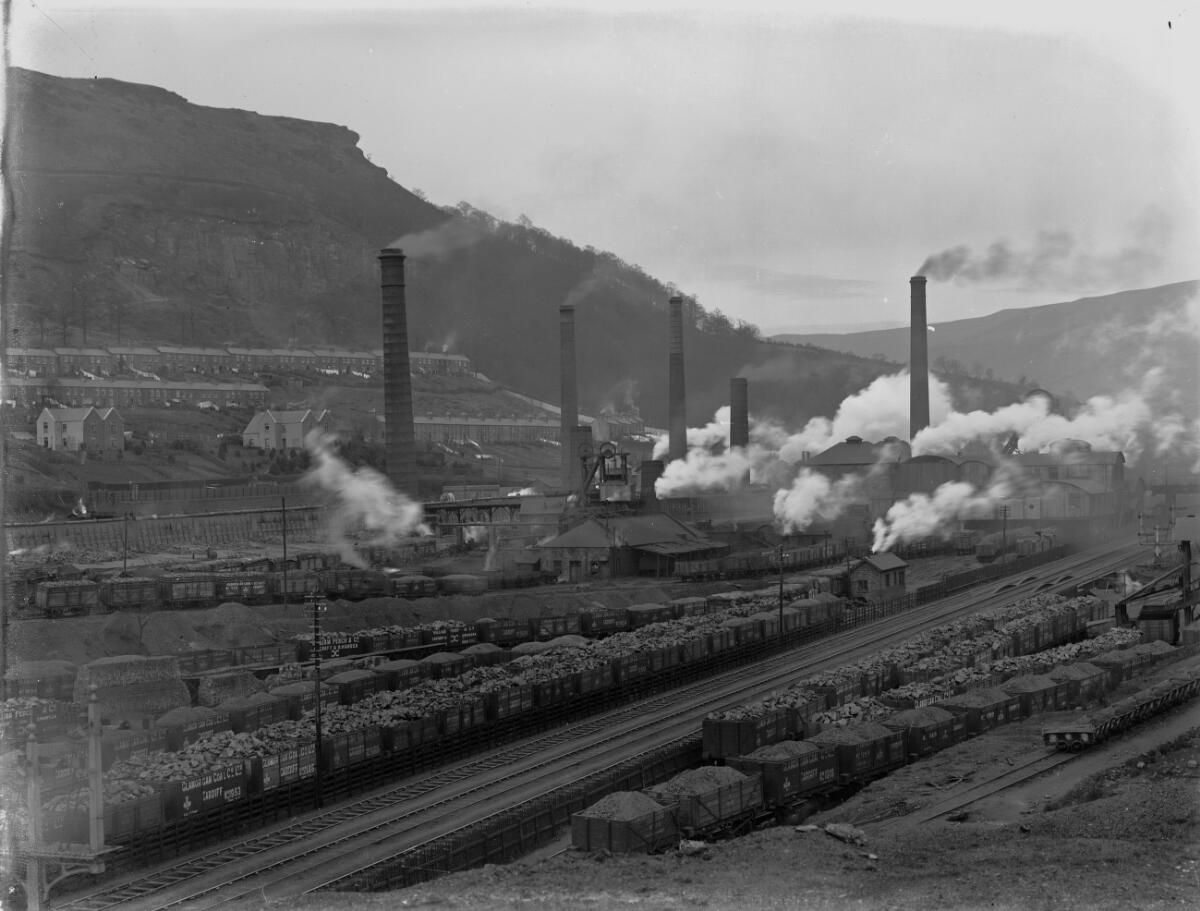
A Rhondda Valley colliery at Llwynypia, known locally as the Scotch Colliery after its Scottish founder, sunk in 1862 and worked until 1945; its 1905 engine house is one of the few substantial colliery buildings still standing anywhere in the Rhondda.
History
The Scottish mining engineer Archibald Hood formed the Glamorgan Coal Company and sank the colliery's first two pits at Llwynypia in 1861-62 under his agent, Mr Begg -- earning it the local nickname the 'Scotch Colliery'. A further four shafts followed by 1873, giving a six-shaft complex in which Nos. 2 and 3 handled winding and No. 1 served as the upcast. The colliery worked the Rhondda Nos. 2 and 3 seams and, later, the district's full sequence of steam-coal measures -- the Two Feet Nine, Four Feet, New Six Feet, Five Feet, Lower Five Feet, Bute and Pentre seams by 1923 -- producing both steam coal and, from its own coking plant, the well-regarded 'Hoods Coke'. Employment peaked at 3,907 in 1913, up from 2,331 in 1896, before falling to 560 by 1938 as the colliery's working life wound down. The Glamorgan Coal Company was absorbed into the Cambrian Combine in 1908, and the Cambrian group's 1929 liquidation folded it into the newly formed Welsh Associated Collieries Limited. On 25 January 1932 a gas explosion in the Pentre seam killed eleven men (see Disasters, below). Coal winding ended in August 1945, though the colliery was kept open for pumping until 1966.
Geology
Coal and fireclay of the South Wales field in the Rhondda: the No. 2 and No. 3 Rhondda seams and later the district's full sequence of steam-coal measures — the Two Feet Nine, Four Feet, New Six Feet, Five Feet, Lower Five Feet, Bute and Pentre among them.
Workings
A six-shaft complex: Nos. 2 and 3 handled winding, No. 1 served as the upcast, and three further shafts were added for pumping and ventilation; worked by longwall faces, some mechanised with conveyors, and others as traditional stalls.
Closure
Coal winding ended in August 1945 following Welsh Associated Collieries' ownership; the site was retained for pumping until 1966, after which it was cleared.
What remains
The colliery's large 1905 engine house survives as a rare example of a substantial standing colliery building in the Rhondda -- a two-storey, eight-bay yellow and red brick structure with stone and concrete dressings, now Grade II listed.
The 1905 engine house (Grade II listed).
Related mines
- Cambrian Colliery — Both were pits of the Cambrian Combine, which absorbed the Glamorgan Coal Company in 1908, and both were at the centre of the strike of 1910 and 1911 and the Tonypandy riots that came out of it.
- Naval Colliery — Another of the Cambrian Combine's mid-Rhondda pits and part of the same 1910 dispute, the combine-wide quarrel that put the Glamorgan men outside their own gates.
Nearby mines
- Blaenclydach Colliery — 0.9 miles (1.5 km) SW
- Gelli Colliery — 1.2 miles (1.9 km) NW
- Dinas Colliery — 1.2 miles (2.0 km) SE
- Naval Colliery — 1.3 miles (2.0 km) S
- Cambrian Colliery — 1.4 miles (2.3 km) W
Straight-line distance, within 9 miles (15 km). Show on the map.
Disasters & major incidents
-
Glamorgan Colliery roof fall, 1881
30 April 1881 · Collapse / Roof Fall · 3 fatalities
A fall killed three repairers ripping the roof of an incline road in the Glamorgan Colliery, Llwynypia, around midnight on 30 April 1881, minutes after they were warned. -
Glamorgan Colliery cage accident, 1903
22 January 1903 · Winding / Shaft Accident · 2 fatalities
Two men fell to their deaths in the No. 2 shaft at Llwynypia on 22 January 1903 when the crowded double-deck cage struck a water garland in the shaft and tipped; three more clung to the frame all the way down. -
Glamorgan Colliery roof fall, 1912
14 October 1912 · Collapse / Roof Fall · 2 fatalities
Two brothers, Charles and George Lemon, were killed on 14 October 1912 by a fall of roof near the face at the Glamorgan Colliery, Llwynypia, that knocked out seven pairs of timber. -
Glamorgan Colliery explosion, 1932
25 January 1932 · Explosion · 11 fatalities
A gas explosion in the Pentre seam at Glamorgan Colliery, Llwynypia, killed eleven men, including two members of the rescue party.
Recorded claims
Individual factual claims, each attached to the source(s) that support it below. Where sources disagree, both are kept.
- Employment rose from 2,331 in 1896 to a peak of 3,907 in 1913, before falling to 560 by 1938. 1
- The colliery's 1905 engine house -- a two-storey, eight-bay building in yellow and red brick with stone and concrete dressings -- survives as a Grade II listed building, a rare surviving example in the Rhondda. 2
- By 1923 the colliery worked the Two Feet Nine, Four Feet, New Six Feet, Five Feet, Lower Five Feet, Bute and Pentre seams, producing both steam coal and coke branded 'Hoods Coke' from its own coking plant. 1
- The Royal Commission's record of the colliery's large brick power house, built in 1905, places it at the centre of the Tonypandy riots in November 1910, when strikers stormed the building during the Cambrian Collieries dispute. It is the same building that survives Grade II listed. 3
- The first rioting of the Tonypandy disturbances took place at Llwynypia on 7 November 1910, when police dispersed strikers demonstrating outside the Glamorgan Collieries. The following night strikers stoned the power house and tore down part of the wooden fence, hand-to-hand fighting followed, and repeated baton charges drove them back towards Tonypandy Square after midnight. Eighty policemen were injured. 4
- Archibald Hood died in 1902 and was widely mourned by his workforce. In 1906 the Rhondda MP William Abraham unveiled a statue of him outside the Llwynypia miners' institute, much of the cost met by donations from the miners of his own pits. 5,4
- The pits raised excellent coking coal, and by the First World War the village housed around a hundred and forty coke ovens. The by-products of the coke distillation were used to light the mines and the narrow streets of miners' terraces, some of which are still too tight for two cars to pass. 4
- Hood's pits were known as the Scotch mines, after Hood himself and the number of Scottish miners who followed him to live and work in Llwynypia. The upper Rhondda's first mine had been sunk at Treherbert in 1850, and Isaac Smith, manager of the Church Colliery, opened a small level beneath Llwynypia Farm in 1859 and abandoned it before Hood took the ground. 4
- The Durham Mining Museum's transcription of the Lists of Mines returns the colliery under the Glamorgan Coal Company, then Welsh Associated Collieries and then Powell Duffryn Associated Collieries, with Nos. 1, 2 and 6 as steam-coal pits and No. 3 the house-coal pit producing coking and household coal and fireclay. 6
Photographs & further reading
Observational-tier photos and site information for the colliery.
View sourceThe Royal Commission's record of the 1905 power house, the building at the centre of the Tonypandy riots and the one substantial colliery structure still standing here.
View sourceThe village and its colliery from Isaac Smith's abandoned level of 1859 to the closure in 1945, including Hood's statue, the coke ovens and the riots.
View sourceThe official returns pit by pit, the 1932 explosion, and the roll of those killed at the colliery.
View sourceThe Ayrshire mining engineer who sank these pits and gave them their Scottish character.
View sourceSources
- (secondary) Glamorgan Colliery Llwynpia — Welsh Coal Mines
- (secondary) Llwynypia — Wikipedia
- (primary) Glamorgan Colliery Engine House, Llwynypia (NPRN 33713) — Royal Commission on the Ancient and Historical Monuments of Wales
- (secondary) Llwynypia — Wikishire
- (secondary) Archibald Hood — Wikipedia
- (primary) Llwynypia Colliery — Durham Mining Museum
Record created: 31 August 2026 · Last researched: 31 August 2026