 MineArchive
Cambrian Colliery explosion, 1965
A firedamp explosion at Cambrian Colliery, caused by an electrical arc igniting gas that had built up after a ventilation structure was left open for over two hours, killed 30 men on 17 May 1965 — the last major mining disaster in South Wales history.
| Date | 17 May 1965 |
|---|---|
| Mine | Cambrian Colliery |
| Region | Rhondda Cynon Taf |
| Type | Explosion |
| Fatalities | 30 (The Northern Mine Research Society's detailed casualty list gives 30 dead and one man, 62-year-old rider Thomas Rees, seriously injured; other, less detailed summaries round the toll to 31. The colliery's own manager, Ernest John Breeze, and undermanager, Leslie James Williams, were both among the dead.) |
| Injuries | One man, Thomas Rees (62), a rider, was seriously injured. |
| Context | During active mining |
Cause
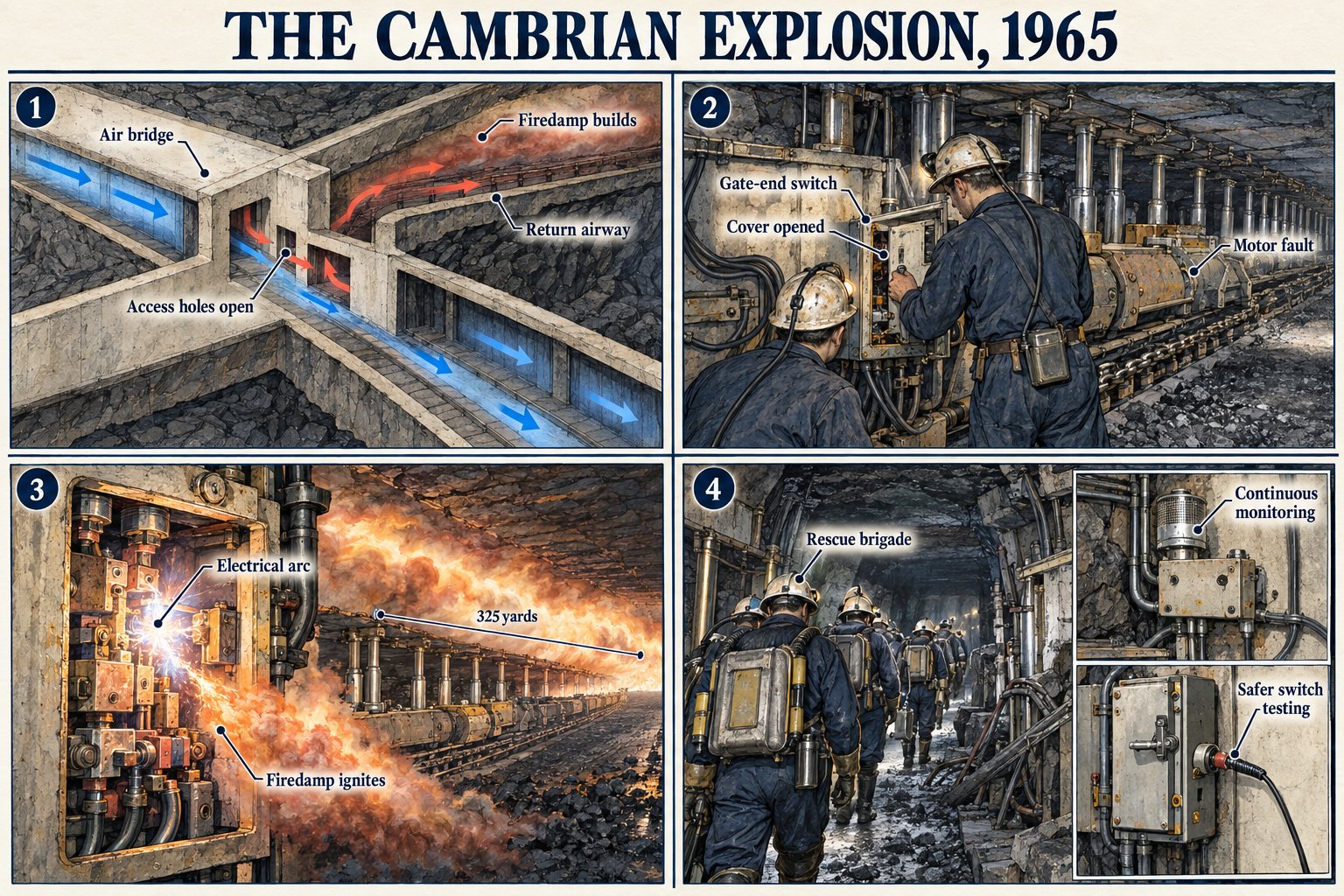
Investigators concluded that access holes in an underground air bridge had been left open for roughly two and a half hours, disrupting ventilation to a return airway and allowing firedamp to accumulate there; two electricians investigating a motor fault then opened the hinged cover of a gate-end switch, and tests afterward showed this could produce enough arcing to ignite gas at that concentration.
Contributing factors
Inspector H.S. Stephenson's report described the air bridge's construction and the length of time its access holes had been left open as 'deplorably bad practice'; no continuous firedamp monitoring or integral testing facility existed at the gate-end switch to catch the danger before the fault was investigated.
What happened
A plough chain broke and the coal face telephone failed around 9am; by 12:15pm an electrical fault had developed at the return plough motor. The colliery manager and undermanager met a deputy at 12:40pm while an overman attended to the fault, and at 12:55pm the explosion occurred, its blast travelling 325 yards along the face.
Rescue & recovery
Porth Central Rescue Station was alerted at 1:05pm; a brigade arrived at 1:17pm and descended by 1:25pm, reaching the affected district by 2:10pm. The bodies of the dead were recovered once the atmosphere had cleared sufficiently.
Investigation & inquiry
Inspector H.S. Stephenson's inquiry identified poor ventilation practice around the air bridge and the absence of adequate gas-monitoring and switch-testing arrangements as the immediate causes, and recommended statutory firedamp checks at face return roadways, priority development of continuous firedamp monitoring, integral testing facilities for gate-end switches in gassy areas, and better instruments for tracing electrical faults underground.
Changes to practice & legislation
Stephenson's specific recommendations — continuous firedamp monitoring, safer gate-end switch testing, and improved fault-tracing instruments — fed directly into wider National Coal Board safety practice in the disaster's aftermath.
Memorials & commemoration
The Cambrian Colliery memorial near Clydach Vale commemorates the dead of both this disaster and the 1905 explosion (see the mine's own record).
Recorded claims
Individual factual claims, each attached to the source(s) that support it below. Where sources disagree, both are kept.
- Access holes in an underground air bridge were left open for roughly two and a half hours, letting firedamp accumulate in a return airway; two electricians opening a gate-end switch cover while investigating an unrelated motor fault then produced an electrical arc that ignited the gas. 1
- The explosion killed 30 men, including colliery manager Ernest John Breeze and undermanager Leslie James Williams, and seriously injured one further man. 1
- Inspector H.S. Stephenson's inquiry recommended statutory firedamp checks at face return roadways, continuous firedamp monitoring, integral gate-end switch testing facilities, and improved instruments for tracing electrical faults underground. 1
Related terminology
Mining terms this disaster is structurally linked to, with the nature of the relationship.
- Deputy (contextual relationship)
Named in this record’s narrative: “…the return plough motor. The colliery manager and undermanager met a deputy at 12:40pm while an overman attended to the fault, and at 12:55pm…” - Firedamp (contextual relationship)
Named 5 times in this record, first in the summary: “A firedamp explosion at Cambrian Colliery, caused by an electrical arc igniting…” - National Coal Board (contextual relationship)
Named in this record’s changes to practice: “…and improved fault-tracing instruments — fed directly into wider National Coal Board safety practice in the disaster's aftermath.” - Overman (contextual relationship)
Named in this record’s narrative: “…colliery manager and undermanager met a deputy at 12:40pm while an overman attended to the fault, and at 12:55pm the explosion occurred, its…” - Return Airway (contextual relationship)
Named in this record’s cause: “…open for roughly two and a half hours, disrupting ventilation to a return airway and allowing firedamp to accumulate there; two electricians…”
Sources
- (secondary) Cambrian Colliery Explosion - Rhondda - 1965 — Northern Mine Research Society
- (secondary) Cambrian Colliery — Wikipedia
- (secondary) Remembering the Cambrian Colliery disaster 50 years on — ITV News Wales
Record created: 27 August 2026 · Last researched: 27 August 2026