 MineArchive
Berthlwyd Colliery
| Also known as | Berthllwyd Colliery |
|---|---|
| Location | Near Gowerton, on the Gower peninsula, Swansea — 51.6322, -4.0799 (exact) |
| Commodity | Coal |
| Type | Coal |
| Worked | 1903–1937 |
| Maximum depth | The Penlan seam was struck at 427 yards and the Penclawdd seam 162 yards below that, reached by a cross-measures drift rather than by shaft. |
| Operators | Berthllwyd Colliery Company Limited (1913–1937) |
Overview
A colliery near Gowerton on the Gower side of Swansea, opened in 1903 by David Williams of Mayfield, Gowerton, and worked until 1937. It began on the Hughes seam, and about 1910 drove a cross-measures drift a mile long to reach other seams — striking the Penlan at 427 yards and the Penclawdd 162 yards deeper. It employed a little over a hundred people at first and around four hundred at its peak in 1920, and abandoned its seams one by one from 1916 until the last five went together in 1937. Its engine house at Caer Eithin still stands.
History
Berthlwyd was opened in 1903 by David Williams of Mayfield, Gowerton, and worked the Hughes seam to begin with. It sat between two neighbours a mile off in either direction — Penclawdd Colliery to the west and Cefn Golau to the east. In 1908 it employed 108 underground and 35 on the surface. About 1910 a cross-measures drift was driven for a mile from the Hughes Vein to explore the other seams of the district: the Penlan was struck at a depth of 427 yards and the Penclawdd another 162 yards below that. The workforce reached 171 in 1912. The Berthllwyd Colliery Company Limited took the colliery over in 1913, when it employed 130 men under the management of M. Williams; by 1915–16 J. Phillips was manager and it employed between 160 and 260. In 1918–19 it had 300 underground and 80 on the surface, by 1920 four hundred men, and in 1923 it employed 312 underground and 94 at the surface and produced 100,000 tons of coal. Through 1924–29 it employed between 300 and 400 men, and in 1930 was down to 152 underground and 57 on the surface. Berthlwyd did not work alone. Cadw’s listing of the Caer Eithin engine house records it as one of a group of early twentieth-century coal works operated in conjunction with Wernbwll, Penlan and Berthlwyd, on a hilltop where the coal outcrops and dips north at about thirty degrees. The engine house is believed to have drawn coal up from the Penlan and Main seams to be transferred underground to a tramway running in a tunnel to Berthlwyd, about 1.5 km to the north — a tunnel known to have existed by 1909, with the earliest reference to the engine house itself in 1914. The abandonment record traces its retreat seam by seam: the Glylid in 1916, the Penclawdd in 1927, the Penlan in 1930, and in 1937 the Glylid, Voylart, Walby’s, Layton’s and Rees’ seams all together, which is where the colliery ends.
Geology
The western end of the South Wales coalfield on the Gower peninsula, where the seams carry local names — Hughes, Penlan, Penclawdd, Glylid, Voylart, Walby’s, Layton’s and Rees’. The colliery began on the Hughes and reached the others by driving across the measures rather than by sinking to them, striking the Penlan at 427 yards and the Penclawdd 162 yards deeper.
Workings
A pit working the Hughes seam from 1903, and from about 1910 a cross-measures drift driven a mile from it to reach the deeper seams — an alternative to sinking a second shaft, and the defining piece of engineering here. Seams were abandoned progressively from 1916 onwards as each was worked out.
Closure
The colliery worked between 1903 and 1937. Its seams were abandoned in sequence — the Glylid in 1916, the Penclawdd in 1927, the Penlan in 1930 — and the last five, the Glylid, Voylart, Walby’s, Layton’s and Rees’, were abandoned together in 1937.
What remains
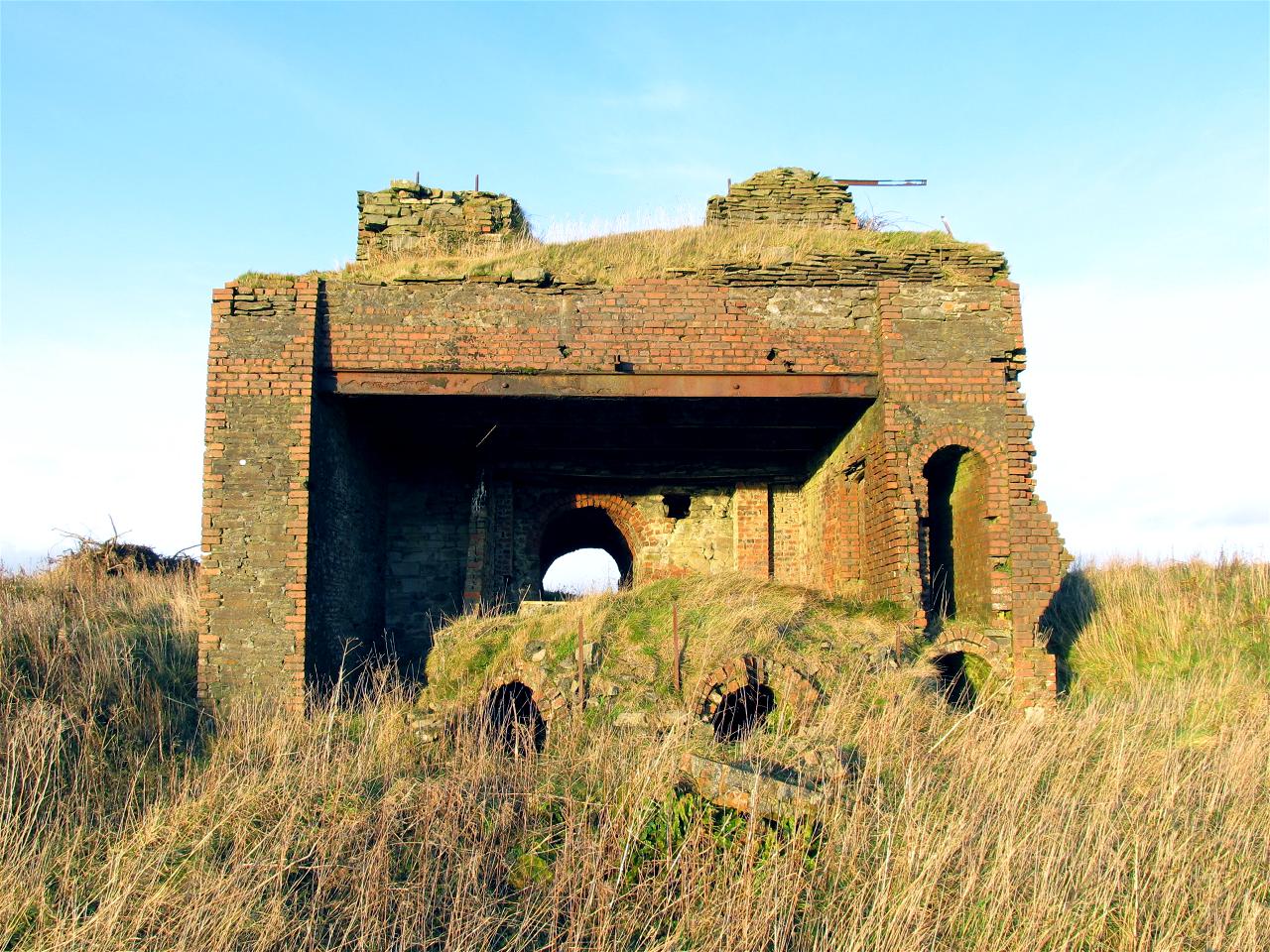
The Caer Eithin engine house survives on the hilltop above Three Crosses, 500 m west of Poundffald Farm, listed grade II by Cadw on 5 June 2000 as "a complex colliery engine structure, and an important relic of the Gower coalmining industry". It is believed to have fallen into ruin shortly after the works ceased in 1937. The rest of the colliery’s ground has gone back to fields and scrub on the Gower slopes.
The Caer Eithin engine house: local sandstone rubble with red-brick features, its main mass about 10 m by 8 m and 5 m high, pierced north to south by a large brick-vaulted tunnel with a smaller sloping tunnel running down from it to the east, and two substantial brick and stone wings to the south with two small blind tunnels between them. Its top storey, reinforced with cantilevered steel joists and tied brick arches, and the buildings that once abutted it to south and east, are gone — though the roof lines of the lost buildings are still legible on the surviving faces.
Related mines
- Cefn Golau Colliery — A single abandonment plan covers Cefnstylle (Cefngolau) with the Berthlwyd slants and levels.
- Wernbwll Colliery — Shared the same owner (D.D. Williams) and certificated manager (J. Phillips) at the time of Wernbwll's 1929 disaster, working the same seams about a mile apart, and were linked by an underground tramway tunnel per Cadw's listing for the Caer Eithin engine house.
Nearby mines
- Wernbwll Colliery — 0.0 miles (0.1 km) SW
- Cefn Golau Colliery — 1.0 miles (1.6 km) NE
- Elba Colliery — 1.5 miles (2.4 km) NE
- Killan Colliery — 1.6 miles (2.5 km) E
- Bishwell Colliery — 2.0 miles (3.2 km) E
Straight-line distance, within 9 miles (15 km). Show on the map.
Recorded claims
Individual factual claims, each attached to the source(s) that support it below. Where sources disagree, both are kept.
- The colliery was opened in 1903 by David Williams of Mayfield, Gowerton, and initially worked the Hughes seam; it worked between 1903 and 1937. 1
- Around 1910 a cross-measures drift was driven for a mile to explore other seams from the Hughes Vein; the Penlan seam was struck at a depth of 427 yards and the Penclawdd seam another 162 yards further down. 1
- The colliery employed 108 underground and 35 on the surface in 1908, 171 by 1912, 400 men by 1920, and 312 underground with 94 at the surface in 1923, when it produced 100,000 tons of coal. 1
- The Glylid seam was abandoned in 1916, the Penclawdd in 1927, the Penlan in 1930, and in 1937 the Glylid, Voylart, Walby’s, Layton’s and Rees’ seams together. 1
- Berthlwyd was sandwiched between Penclawdd Colliery about a mile to the west and Cefn Golau Colliery just under a mile to the east. 1
- Cadw records Caer Eithin as one of a group of early twentieth-century coal works operated in conjunction with Wernbwll, Penlan and Berthlwyd; its engine house is believed to have drawn coal up from the Penlan and Main seams to be transferred underground to a tramway running in a tunnel to Berthlwyd about 1.5 km to the north, a tunnel known to have existed by 1909. 2
- The Caer Eithin engine house is listed grade II (5 June 2000): local sandstone rubble with red brick, its main mass about 10 m by 8 m and 5 m high with a large brick-vaulted tunnel through it north to south, a steam engine at ground level and an electrically powered engine believed to have stood on the reinforced top storey. It is believed to have fallen into ruin shortly after the works ceased in 1937. 2
- The BGS mine-plans catalogue holds a Mining Remediation Authority abandonment plan titled 'Berthlwyd' (catalogue 12144, Glylid, Voylart, Walby'S, Leyshon'S & Rees', dated 1937). 3
Photographs & further reading
The statutory description of the surviving engine house, its tunnels and its two engines, with what is known and what is still guessed about how it worked.
View sourceThe colliery’s owners, managers and workforce year by year, the mile-long cross-measures drift and the dates each seam was abandoned.
View sourceSources
- (secondary) Berthlwyd Colliery — Welsh Coal Mines
- (primary) Caer Eithin Engine House, Berthlwyd Colliery — Cadw list entry 23484 — Cadw, via British Listed Buildings
- (primary) BGS / Mining Remediation Authority mine plans: BERTHLWYD — British Geological Survey / Mining Remediation Authority
- (primary) Berthlwyd Colliery (NPRN 80414) — Royal Commission on the Ancient and Historical Monuments of Wales
Record created: 7 September 2026 · Last researched: 7 September 2026