 MineArchive
Baum Washer
| Also known as | Baum Jig (The North Staffordshire glossary's alternative wording.), Baum-type washer (The form used in the National Coal Board colliery reports.) |
|---|---|
| Category | Ore Processing |
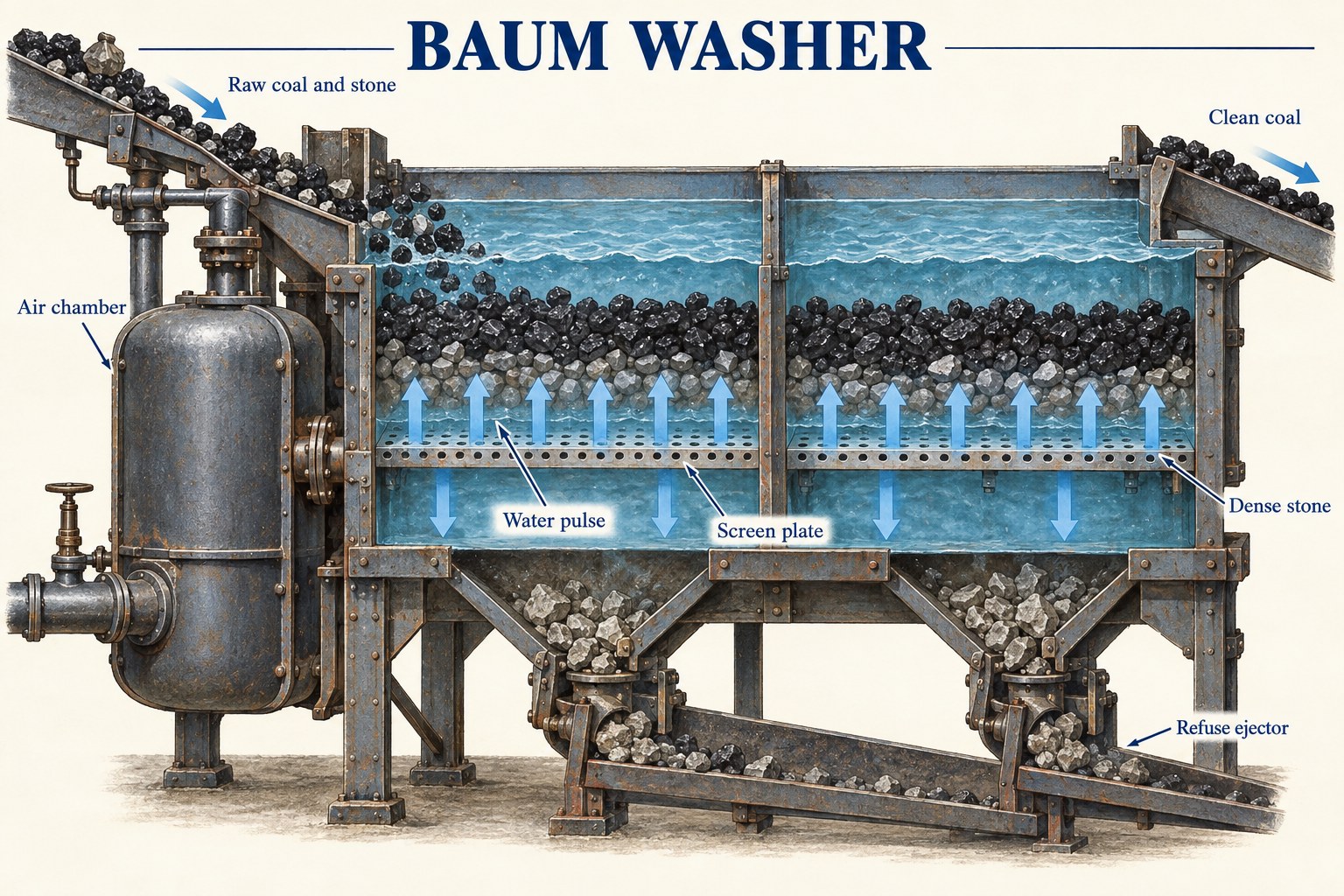
A coal-washing jig, invented by Baum in 1892, in which the pulsing of the water is produced by compressed air admitted above the water on one side of the washbox rather than by a mechanical plunger. It became the standard way of cleaning run-of-mine coal in British collieries and stayed so for most of the twentieth century.
Historical usage
Jig washing was already old by 1892 — a pulsing column of water separates coal from stone because the stone is denser and settles through the bed while the coal rides on it — but the pulse had been made by plungers, which are mechanical, heavy and limited in the volume they can move. Baum's change was to make the pulse pneumatically, and it let the machines get much bigger.
In this archive the Baum washer is what the National Coal Board's colliery reports of 1948 record as a mark of a modern surface: Riddochhill had a Baum-type washer by the Blantyre Engineering Company, and so did Polkemmet, Randolph, Wellesley and Loanhead. A colliery with screens and a Baum washer could sell clean graded coal; Glentaggart, in the same set of reports, had one screen and no washing at all.
How it worked
Raw coal is fed onto perforated screen plates inside a washbox filled with water. Compressed air is forced into a large air chamber on one side of the vessel and released and cut off in turn, which pushes the water down and lets it draw back, pulsing it up and down through the screen plates. The bed of coal and stone on the plates is lifted and dropped with each pulse, and over a few seconds the denser refuse works its way to the bottom and the coal rises. A typical machine has several compartments end to end for a primary and then a secondary separation, each with its own screen plate and a refuse ejector to draw the settled stone away.
Why it was used
Because screening alone cannot separate coal from stone of the same size, and a dirty coal fetched a lower price or none at all. The Baum jig cleaned run-of-mine coal in bulk, cheaply, without chemicals, and at a scale a plunger jig could not reach, which is why it displaced the older washers and outlasted them.
Risks & limitations
A jig separates by density in water and struggles as the particles get finer, because very small coal and very small stone both move with the water rather than through it. Cleaning the finest fraction needed froth flotation instead, which is why the largest post-nationalisation washeries added it alongside the jigs rather than replacing them. A washery also has to put the water somewhere, and the tailings lagoons and slurry ponds that went with it are a lasting part of what collieries left behind.
Regional variation
Not regional: a patented machine, sold across the British coalfields and abroad, and usually named in colliery records by its maker as well as its type — the Blantyre Engineering Company built the ones in the Scottish reports here, and Simon-Carves built Baum jigs under licence elsewhere.
Related terminology
Mines associated with this term
5 examples chosen from 16 linked records — the term page is not an index.
- Bowburn Colliery — County Durham (well documented example)
Named 3 times in this record, first in the summary: “…Board in 1947. Its surface plant was rebuilt in 1931-32 around a Baum washer handling 135 tons an hour, and by the late 1930s it was raising…” - Brackley Colliery — Greater Manchester (well documented example)
Named in this record’s workings: “…Bros. sets, one to each pit, and washed from 1938 in a Simon-Carves Baum jig of 125 tons an hour.” - Cronberry Moor Colliery — East Ayrshire (well documented example)
Named twice in this record, first in the history: “…a day by longwall and stoop and room working, with two screens and a Baum-type washer by the Blantyre Engineering Company, which also washed the coal from…” - Enterkine Colliery — South Ayrshire (well documented example)
Named twice in this record, first in the history: “…695 tons a day by stoop and room and longwall working, with a Baum washer, baths and a canteen. A No. 12 was added by 1954, when 409 worked…” - Foulshiels Colliery — West Lothian (well documented example)
Named twice in this record, first in the history: “…it had 428 employees, 580 tons a day by longwall, four screens and a Baum washer, and drew all its electricity from Loganlea. The peak workforce was…”
Sources
- (primary) Riddochhill Colliery, Canmore / National Record of the Historic Environment 132665 — Historic Environment Scotland
- (secondary) Glossary of mining terms — North Staffordshire Miners' Group, Apedale Heritage Centre — North Staffordshire Miners' Group
Record created: 10 September 2026 · Last researched: 10 September 2026