 MineArchive
Marine Colliery explosion, 1927
An underground gas and coal-dust explosion in the Black Vein seam at Marine Colliery killed around 52 men in the early hours of 1 March 1927, one of the major South Wales colliery disasters of the interwar period.
| Date | 1 March 1927 |
|---|---|
| Mine | Marine Colliery |
| Region | Blaenau Gwent |
| Type | Explosion |
| Fatalities | 52 (Reported predominantly as 52 men killed; one Northern Mine Research Society overview page gives 51 and a separate heritage-catalogue reference (not independently verified) gives 53 — 52 is the best-supported figure across the sources actually consulted.) |
| Context | During active mining |
Location
Plotted at Marine Colliery. Recorded location. The large pin is the mine; the small round markers are the nearest mines on record. Click one for its page. View on full map
Cause
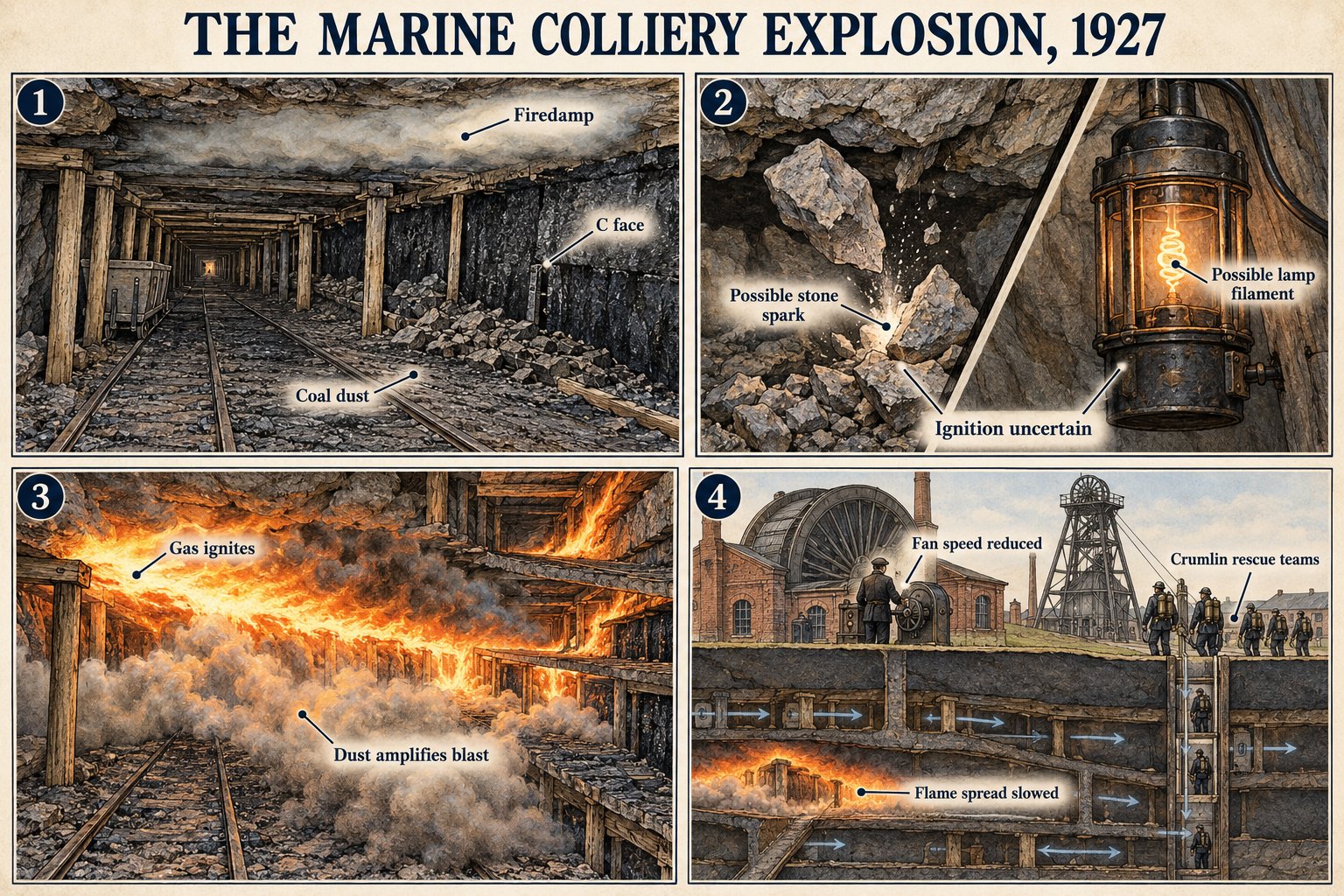
The official Inspector of Mines report (Mr Henry Walker) concluded an explosive firedamp/air mixture at the 'C' face was ignited either by stones falling on stones already fallen, or at the bare glowing filament of an electric lamp, with coal dust amplifying the blast; the precise ignition source was never conclusively established.
What happened
The explosion came at 12:50am on 1 March 1927 at the Black Vein seam's 'C' face, roughly 350 yards down and about 1½ miles from the shaft on the eastern side of the workings. Colliery manager Edward Gay ordered the ventilation fan slowed down, a decision credited with holding back the spread of flame and limiting further deaths.
Rescue & recovery
Manager Edward Gay reached the pit at 1:05am and the Crumlin Rescue Station was alerted; rescue parties made repeated descents over several days, recovering all bodies by 11 March 1927.
Investigation & inquiry
An inquest was held by coroner W. R. Dauncey at Tredegar Town Hall, running from 12 July to 3 August 1927 and hearing evidence from 79 witnesses; the jury returned a verdict of accidental death and recommended safety improvements including mandatory pre-shift searches and enhanced examiners' reporting.
Memorials & commemoration
A memorial tablet to the 41 of the 52 dead who were Cwm residents was unveiled at the Cwm Institute on 29 September 1927.
What's uncertain
Points where sources disagree or the record could not be settled; both accounts are kept. All open questions in the archive.
- Reported predominantly as 52 men killed (NMRS disaster page, welshcoalmines.co.uk); an NMRS overview page separately gives 51 — kept as an unresolved minor discrepancy rather than silently rounded. (uncertain) 1,2
Recorded claims
Individual factual claims, each attached to the source(s) that support it below. Where sources disagree, both are kept.
- Reported predominantly as 52 men killed (NMRS disaster page, welshcoalmines.co.uk); an NMRS overview page separately gives 51 — kept as an unresolved minor discrepancy rather than silently rounded. (uncertain) 1,2
- Colliery manager Edward Gay's decision to reduce ventilation fan speed after the explosion is credited with slowing the spread of flame and limiting further fatalities. 2
Related terminology
Mining terms this disaster is structurally linked to, with the nature of the relationship.
- Coal (contextual relationship)
Named in this record’s cause: “…fallen, or at the bare glowing filament of an electric lamp, with coal dust amplifying the blast; the precise ignition source was never…” - Coal Dust (contextual relationship)
Named twice in this record, first in the summary: “An underground gas and coal-dust explosion in the Black Vein seam at Marine Colliery killed around 52…” - Colliery (contextual relationship)
Named 3 times in this record, first in the summary: “…gas and coal-dust explosion in the Black Vein seam at Marine Colliery killed around 52 men in the early hours of 1 March 1927, one of the…” - Firedamp (contextual relationship)
Named in this record’s cause: “…Inspector of Mines report (Mr Henry Walker) concluded an explosive firedamp/air mixture at the 'C' face was ignited either by stones falling on…” - HM Chief Inspector of Mines (contextual relationship)
Named in this record’s cause: “The official Inspector of Mines report (Mr Henry Walker) concluded an explosive firedamp/air mixture…”
Sources
- (secondary) Marine Colliery Explosion — Cwm — 1927 — Northern Mine Research Society
- (secondary) Marine Colliery, Cwm — welshcoalmines.co.uk
Record created: 26 August 2026 · Last researched: 26 August 2026