 MineArchive
Six Bells Colliery shaft-sinking accident, 1895
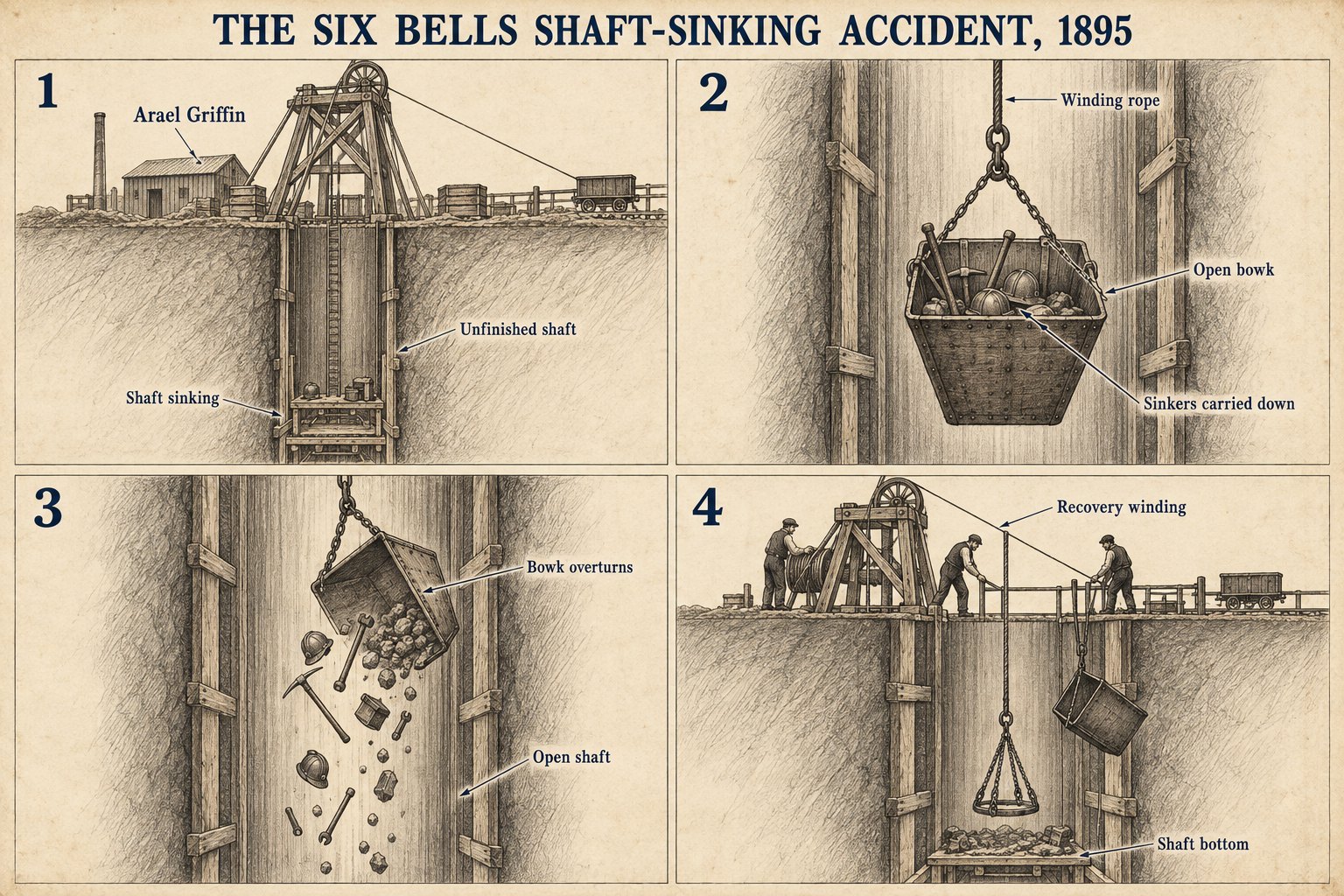
Four men sinking the shafts at Arael Griffin — later Six Bells Colliery — were killed on 9 February 1895 when they fell from the bowk carrying them down the shaft. Two more men died the same way before the sinking was finished.
| Date | 9 February 1895 |
|---|---|
| Mine | Six Bells Colliery |
| Region | Blaenau Gwent |
| Type | Winding / Shaft Accident |
| Fatalities | 4 (William Matthews (36), Thomas Day (42), John Lamb (37) and William Lusty (21), all engaged in sinking the pit. Two further sinkers died in separate falls from the bowk during the same sinking: Eli Morgan on 11 April 1895 and Jacob Herbert (40) on 2 May 1895 — which is why some accounts give the February toll as six.) |
| Context | During active mining (During shaft sinking, three years before the colliery wound its first coal.) |
Cause
The men fell from the bowk — the large bucket slung from the winding rope that carried sinkers and spoil up and down an unfinished shaft — and dropped to the shaft bottom.
What happened
The two shafts at Arael Griffin were still being sunk in February 1895, three years before the colliery wound any coal. On Saturday 9 February the bowk carrying a party of sinkers went over and four men fell to the shaft bottom: William Matthews, Thomas Day, John Lamb and William Lusty. Sinking a shaft was the most dangerous phase of a colliery's life and the bowk was the reason why — an open bucket on a rope, with nothing between the men riding in it and several hundred feet of shaft. It happened twice more at Six Bells before the shafts were finished: Eli Morgan fell from the bowk on 11 April and Jacob Herbert on 2 May, the same year. By the following year the Inspector of Mines recorded 173 men employed on the sinking, 101 of them at surface.
Investigation & inquiry
No formal inquiry report is recorded for this accident; it is recorded through the Inspector of Mines fatality returns and contemporary newspaper reports.
Recorded claims
Individual factual claims, each attached to the source(s) that support it below. Where sources disagree, both are kept.
- Four men were killed on 9 February 1895 when they fell from the bowk during shaft sinking: William Matthews (36), Thomas Day (42), John Lamb (37) and William Lusty (21). 1,2
- Two further sinkers died in separate falls from the bowk during the same sinking — Eli Morgan on 11 April 1895 and Jacob Herbert (40) on 2 May 1895 — which is why some accounts give the February toll as six. 1
- The Inspector of Mines list for 1896 records 173 men employed on the sinking, 101 of them at surface. 1
Related terminology
Mining terms this disaster is structurally linked to, with the nature of the relationship.
- Colliery (contextual relationship)
Named 3 times in this record, first in the summary: “Four men sinking the shafts at Arael Griffin — later Six Bells Colliery — were killed on 9 February 1895 when they fell from the bowk…” - HM Chief Inspector of Mines (contextual relationship)
Named twice in this record, first in the narrative: “…and Jacob Herbert on 2 May, the same year. By the following year the Inspector of Mines recorded 173 men employed on the sinking, 101 of them at surface.” - Kibble (relevant method/equipment)
The bowk was a kibble on the largest scale — an open bucket slung from the winding rope, carrying both spoil and the sinkers themselves. - Shaft (contextual relationship)
The accident belongs to shaft sinking, the most dangerous phase in a colliery's life. - Shaft Sinking (contextual relationship)
Six men died sinking these shafts, four of them in one fall from the bowk on 9 February 1895 and two more the same way before the sinking was finished.
Sources
- (primary) Six Bells Colliery (Arael Griffin Nos 4 & 5) — Northern Mine Research Society
- (secondary) Arrael Griffin Colliery, Six Bells — list of fatalities 1890-1988 — Out of the Blue Artifacts
Record created: 24 August 2026 · Last researched: 24 August 2026