 MineArchive
Six Bells Colliery explosion, 1960
A firedamp and coal dust explosion tore through the 'W' district of the Old Coal seam at Six Bells Colliery, Abertillery, at about 10:45 on the morning of 28 June 1960. Forty-five of the 48 men working in the district were killed. It remains the worst colliery disaster in Britain since the Second World War.
| Date | 28 June 1960 |
|---|---|
| Mine | Six Bells Colliery |
| Region | Blaenau Gwent |
| Primary type | Explosion |
| Associated types | Gas / Asphyxiation |
| Fatalities | 45 (Forty-five of the 48 men at work in the district died. Lethal concentrations of carbon monoxide were found afterwards, indicating the men lost consciousness quickly and died within minutes. The dead, aged from 18 to 60, included Frederick White, undermanager of the No.5 Pit; the Welsh Coal Mines death roll records three fathers who died alongside their sons.) |
| Injuries | Three men in the district survived. |
| Context | During active mining (A mid-morning explosion in a working district of a producing pit.) |
Cause
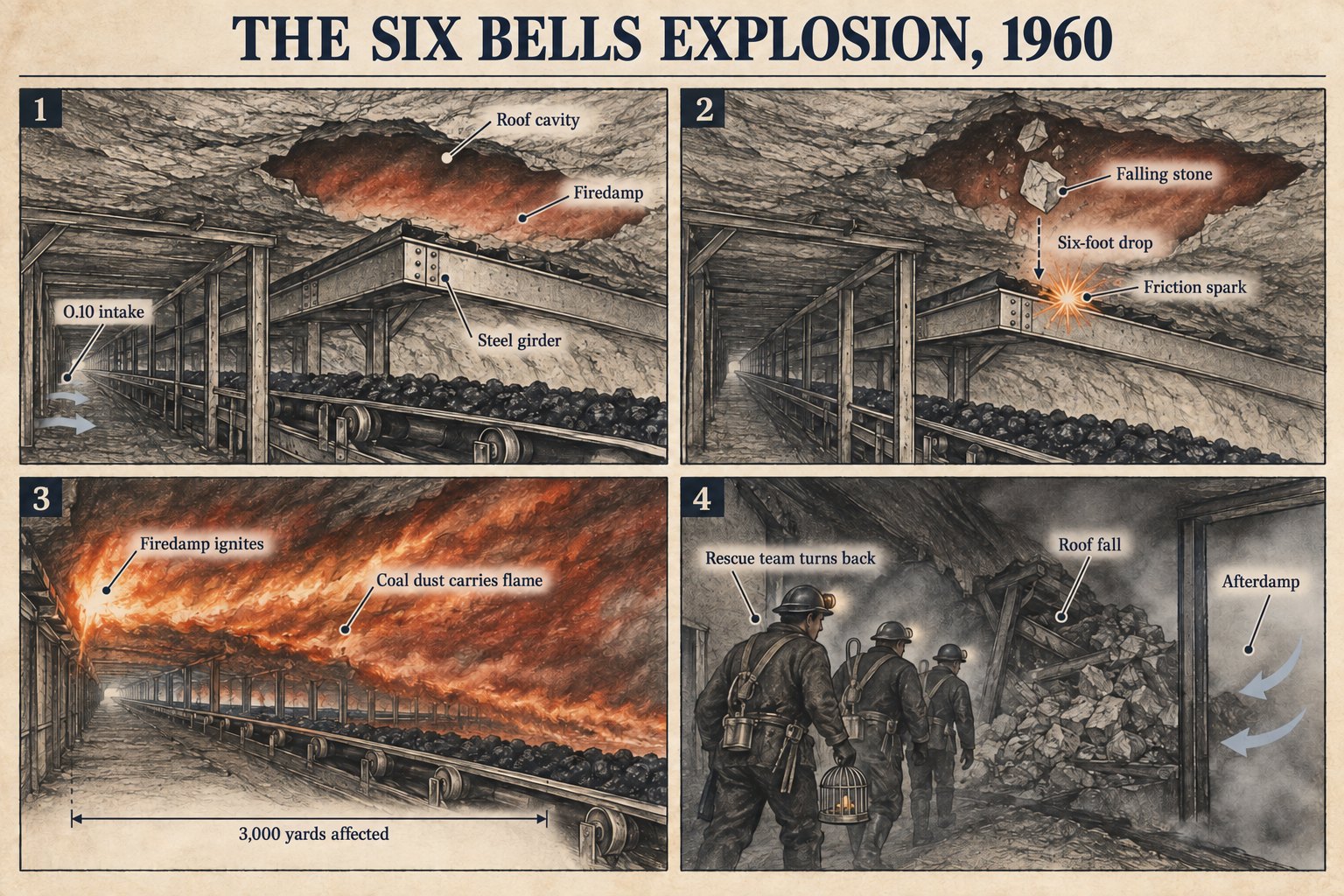
The official inquiry found the probable cause to have been firedamp ignited by a spark struck when a falling stone hit a steel girder; the ignition then propagated through coal dust. Specifically, a piece of quartzitic rock fell about six feet from the roof cavity at the O.10 intake roadhead ripping onto a steel conveyor-canopy girder. The inquiry stressed that no one could say with certainty where or how the explosion began.
Contributing factors
The gassiness of the Old Coal seam, and the presence of coal dust able to carry an ignition beyond the initial flash of firedamp. The inquiry found that the firedamp accumulation might have been prevented by a hurdle sheet near the face ripping; that the rock fall might have been prevented had the roof between the last steel arch and the new ripping face been supported immediately after a round of shots fired there about seven hours earlier; and that the coal-dust explosion might have been confined to the O.10 unit had there been sufficient stone-dust barriers suitably placed. The colliery's dust sampling had been missed in December 1959 and April 1960.
What happened
At about a quarter to eleven on the morning of Tuesday 28 June 1960, an explosion ripped through the 'W' district of the Old Coal seam at Six Bells. Of the 48 men working in that district, 45 were killed. The blast itself did not account for all of them: lethal concentrations of carbon monoxide were found in the district afterwards, and the evidence pointed to men losing consciousness rapidly and dying within minutes of the explosion. The colliery was a large one, employing 1,291 men that year and raising 338,000 tonnes, and the district that was destroyed was only part of it — but the toll made this the worst thing to happen in a British coal mine since the war. The toll would have been far higher on a normal production shift: maintenance work was under way on the O.10 face, where 125 men would usually have been employed. The 'W' district lay between a mile and a mile and a quarter from the shafts, its three longwall faces advancing towards the old workings of Marine Colliery, where an explosion had killed 52 men in 1927. The inquiry report's own figures for the colliery differ from those above: 1,213 men below ground and 239 on the surface, with about 1,800 tons of saleable coal raised a day, some 830 tons of it from the Old Coal seam.
Rescue & recovery
The first sign of trouble at the surface was a cloud of dust seen at both shafts. S. Holland, the deputy responsible for inspecting the airways, went inbye to investigate, found a body near the old T intake and a fall of roof almost blocking the main intake, and reported to the manager, who withdrew the men from the pit and put the emergency procedure into operation. The manager then returned underground with Holland, an overman and P. J. McLaughlin, captain of the colliery rescue team, carrying a canary; they found up to two per cent firedamp in the main return, and turned back when the canary died fifteen yards further in. Rescue brigades from Porth Central Rescue Station and Six Bells Colliery went down soon after 1 p.m. under the Superintendent of Crumlin Rescue Station, set up a fresh-air base and, working first by way of O.7 crosscut and the main return and then through a hole enlarged over the fall, explored every road and face. Rescue teams were dealing with an atmosphere heavy with afterdamp: they reported stagnant air and no survivors, and the work became recovery rather than rescue.
Investigation & inquiry
An official inquiry opened in September 1960, sitting for eight days from 19 September in No.2 Court of the Civic Centre, Newport, conducted by T. A. Rogers, H.M. Chief Inspector of Mines and Quarries; his report went to the Minister of Power on 15 December 1960 and was presented to Parliament in January 1961. Microscopic examination of more than 500 samples showed that flame had swept about 3,000 yards of roadway and every face except O.10; the district's mechanical and electrical apparatus and its safety lamps were examined and none could have caused the explosion. The inquiry concluded that the explosion was caused by firedamp ignited by a spark from a stone striking a steel girder, and recorded the lethal carbon monoxide concentrations found in the district. Rogers put it with care: no one could say with certainty where or by what means the explosion started, but he thought it began as an ignition of firedamp in the roof ripping of the O.10 intake roadhead, set off by frictional heat when a piece of quartzitic rock fell about six feet from a roof cavity exposed by shotfiring onto a steel girder of a conveyor canopy, and that the explosion which spread through the district was mainly one of coal dust raised on the conveyor roads. A National Union of Mineworkers inspector, A. Davies, took a minority view that a shot fired in the ripping had ignited the gas; the direction of the flame did not support it.
Changes to practice & legislation
Rogers's recommendations: that the working party of the Coal Industry National Consultative Council reviewing coal-dust explosion hazards consider, as a matter of urgency, further precautions on the conveyor roads nearest the face; that management treat firedamp ignition by falling rock as a further reason to prevent falls at roadheads and to keep rippings, cavities and waste edges ventilated; that the National Coal Board give managers the fullest specialist help on firedamp drainage and ventilation, and intensify its work on means for deputies to test for gas in places out of easy reach; that shotfiring be done with meticulous care, with the best stemming material investigated and foam injection into ripping shotholes tried; that South Wales mining engineers look again at reducing large roadhead cavities; and that the Ministry review the use of air ejectors underground. Whether and how each was acted on is not recorded.
Memorials & commemoration
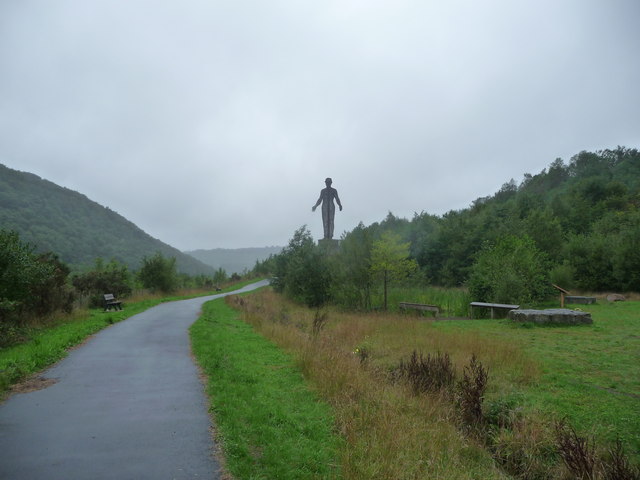
The Guardian of the Valleys, a 20-metre figure of a miner by Sebastian Boyesen, was unveiled on the former colliery site at Parc Arael Griffin on 28 June 2010, the fiftieth anniversary, by Rowan Williams, then Archbishop of Canterbury. Though raised for the Six Bells dead it is dedicated to mining communities everywhere, and an earlier colliery memorial stands nearby.
What's uncertain
Points where sources disagree or the record could not be settled; both accounts are kept. All open questions in the archive.
- A National Union of Mineworkers inspector, A. Davies, argued that a shot fired in the ripping ignited the gas; the inquiry rejected this because the direction of flame did not support it. (disputed) 3,6
- The inquiry report gives 1,213 men employed below ground and 239 on the surface, and about 1,800 tons of saleable coal a day; Wikipedia gives 1,291 men and 338,000 tonnes for 1960. (disputed) 1,3
Recorded claims
Individual factual claims, each attached to the source(s) that support it below. Where sources disagree, both are kept.
- The official inquiry held in September 1960 concluded that the explosion was caused by firedamp ignited by a spark from a stone falling onto a steel girder. 1,2
- Forty-five of the 48 men working in the 'W' district of the Old Coal seam were killed; the explosion occurred at about 10:45 a.m. 2
- Lethal concentrations of carbon monoxide were found in the district, indicating that the men lost consciousness rapidly and died within minutes. 1,2
- The Guardian of the Valleys, a 20-metre miner's figure by Sebastian Boyesen, was unveiled on the colliery site on 28 June 2010 by Archbishop Rowan Williams and is dedicated to all mining communities. 1
- The public inquiry sat in No.2 Court of the Civic Centre, Newport, from 19 to 28 September 1960, conducted by T. A. Rogers, H.M. Chief Inspector of Mines and Quarries; the report went to the Minister of Power on 15 December 1960 and was presented to Parliament in January 1961. 3,4,5
- Rogers concluded that no one could say with certainty where or how the explosion started, but thought it began as a firedamp ignition in the O.10 intake roadhead ripping, caused by frictional heat from quartzitic rock falling about six feet onto a steel conveyor-canopy girder, and spread through the district mainly as a coal-dust explosion. 3,6
- A National Union of Mineworkers inspector, A. Davies, argued that a shot fired in the ripping ignited the gas; the inquiry rejected this because the direction of flame did not support it. (disputed) 3,6
- The inquiry found that a hurdle sheet at the face ripping, immediate support of the roof after shotfiring about seven hours earlier, and sufficient stone-dust barriers might each have prevented or confined the disaster. 3,6
- Rescue brigades from Porth Central Rescue Station and Six Bells Colliery went down soon after 1 p.m. under the Superintendent of Crumlin Rescue Station; an earlier party's canary died in the main return, and the brigades found stagnant air and no survivors. 3,6
- The toll would have been worse but for maintenance work on the O.10 face, where 125 men would normally have been employed. 5
- The inquiry report gives 1,213 men employed below ground and 239 on the surface, and about 1,800 tons of saleable coal a day; Wikipedia gives 1,291 men and 338,000 tonnes for 1960. (disputed) 1,3
- The Welsh Coal Mines death roll records three fathers killed with their sons (Griffiths, Morgan and Partridge). 7
Related terminology
Mining terms this disaster is structurally linked to, with the nature of the relationship.
- Canary (contextual relationship)
Named twice in this record, first in the rescue and recovery: “…P. J. McLaughlin, captain of the colliery rescue team, carrying a canary; they found up to two per cent firedamp in the main return, and…” - Crosscut (contextual relationship)
Named in this record’s rescue and recovery: “…Station, set up a fresh-air base and, working first by way of O.7 crosscut and the main return and then through a hole enlarged over the fall,…” - Fresh Air Base (contextual relationship)
Named in this record’s rescue and recovery: “…1 p.m. under the Superintendent of Crumlin Rescue Station, set up a fresh-air base and, working first by way of O.7 crosscut and the main return and…” - Ripping (contextual relationship)
Named 7 times in this record, first in the cause: “…fell about six feet from the roof cavity at the O.10 intake roadhead ripping onto a steel conveyor-canopy girder. The inquiry stressed that no…” - Stemming (contextual relationship)
Named in this record’s changes to practice: “…reach; that shotfiring be done with meticulous care, with the best stemming material investigated and foam injection into ripping shotholes…”
Photographs & further reading
This page doesn't try to reproduce everything — these are the best original sources found for this disaster.
A full account drawn from the inquiry report: the district, the shifts before, the rescue, the conclusions and recommendations.
View sourceA section-by-section digest of T. A. Rogers's inquiry report, with the names of the 45 men killed.
View sourceThe 45 men killed, with their ages, jobs and home streets.
View sourceAnniversary coverage with accounts from survivors and families.
View sourceCatalogue of the archive's copy of the inquiry report and its five plans of the W District and the explosion evidence.
View sourceSources
- (secondary) Six Bells Colliery — Wikipedia
- (secondary) Six Bells Colliery — Welsh Coal Mines
- (secondary) Six Bells Colliery Explosion – Newport – 1960 — Northern Mine Research Society
- (primary) Report on the causes of, and circumstances attending, the Explosion which occurred at Six Bells Colliery, Monmouthshire, on 28th June, 1960 (T. A. Rogers, H.M. Chief Inspector of Mines and Quarries, January 1961) — HMSO, via Durham Mining Museum
- (primary) Explosion at Six Bells Colliery Monmouthshire (GB0218.D4805) — Gwent Archives
- (primary) Six Bells Colliery, Monmouthshire. Disaster, 28th June 1960 — Durham Mining Museum (pitwork pages)
- (secondary) Arael Griffin, Six Bells, 28th of June 1960: death roll — Welsh Coal Mines
Record created: 24 August 2026 · Last researched: 16 September 2026