 MineArchive
East Benhar Colliery
| Also known as | East Benhar No. 2 Mine |
|---|---|
| Location | Fauldhouse, West Lothian — 55.8382, -3.7279 (approximate) |
| Commodity | Coal |
| Type | Coal |
| Worked | c. 1938–September 1957 |
| Operators | Barr & Thornton Ltd (1938–1947, owner) National Coal Board (1947–1957, owner) |
Overview
The last mine to work coal in the Benhar area, driven in the lands of Polkemmet by Barr and Thornton in the late 1930s to take the Virtuewell and the Ladygrange, a seam not worked in the district before. It passed to the National Coal Board in 1947 with about a hundred men, and closed in 1957 after output per man-shift had halved and the union's own safety officer reported that further development would endanger lives.
History
The Benhar area south of Fauldhouse had been worked for coal since the early 19th century, and some twenty mines operated around the village before the last of them closed in 1974. East Benhar was late and separate. The Airdrie and Coatbridge Advertiser reported on 30 July 1938 that Barr and Thornton had recently put down mines at East Benhar to work the Virtuewell, six feet thick here, and the Ladygrange, a thinner seam not hitherto worked in the area. The 1945 List of Mines records East Benhar No. 2 mine under Barr and Thornton, manager W. T. Fisher, with 55 men below ground and 22 on the surface working the Ladygrange coal; the 1948 list has the same manager under the National Coal Board with 86 below and 24 above.
The end came quickly after that. By October 1956 the Edinburgh Evening News was reporting a meeting of about 150 miners at which Alex Edgar, the Scottish area agent of the National Union of Mineworkers, told them that unless they accepted the Board's proposal to pay off 39 men the pit would be closed on economic grounds; they voted 38 to 25 to accept, against a promise that the pit would run another twelve to eighteen months if manpower came down to 111. Output had fallen as low as 11.4 hundredweight per man-shift, and coal had been produced at East Benhar for about twenty years. The West Lothian Courier of 6 September 1957 reported the closure: the mine had lost £11,596 in the first three months of that year, its hundred underground and surface workers had been given notice the previous Friday, and output was down to 11.7 hundredweight per man-shift against 23.5 when the mine was nationalised in 1947. The union's safety and technical officer had surveyed the mine the previous October and reported that further development of coal in the area would endanger lives, with very difficult conditions to be met in working it. Samuel McMillan, the former union branch secretary at Benhar, said the closure was inevitable and that there was no case the union could offer to keep the mine open. Most of the men were promised work at Polkemmet Colliery at Whitburn, three miles off, and the closure left Greenrigg as the only pit still working at Fauldhouse.
Geology
The mine worked Coal Measures seams on the West Lothian side of the Central Scottish coalfield: the Virtuewell, six feet thick at East Benhar, and the Ladygrange, a thinner seam that had not been worked in the district before Barr and Thornton took it. The closure reporting attributes the difficulty partly to insufficient cover of solid material between the coal seams and the surface.
Geological setting: Sedimentary Beds and Seams (well documented example)
Workings
A mine rather than a shaft pit, driven from the surface; the Lists of Mines record it as East Benhar No. 2 mine. It worked the Ladygrange coal through the 1940s under a single manager, W. T. Fisher, both before and after nationalisation.
Closure
Closed in September 1957 on economic and safety grounds after a year of talks between the National Coal Board and the union. Output per man-shift had fallen from 23.5 hundredweight at nationalisation in 1947 to 11.7, the mine had lost £11,596 in the first quarter of 1957, and a union safety survey of October 1956 concluded that further development would endanger lives.
Related mines
- Benhar Colliery — East Benhar takes its name from this colliery and worked the same Benhar ground, but is a separate and much later mine, driven in the late 1930s and closed in 1957.
Nearby mines
- Fallahill Colliery — 0.1 miles (0.2 km) SW
- Benhar Colliery — 0.4 miles (0.6 km) NW
- Braehead Colliery — 0.7 miles (1.2 km) S
- Greenrigg Colliery — 0.8 miles (1.2 km) N
- Greenrigg Pit — 0.8 miles (1.3 km) N
Straight-line distance, within 9 miles (15 km). Show on the map.
What's uncertain
Points where sources disagree or the record could not be settled; both accounts are kept. All open questions in the archive.
- The BGS mine-plans catalogue holds a Mining Remediation Authority abandonment plan titled 'Benhar' (catalogue S412, Ball, dated 1962); the catalogue gives no location and the plan's details do not clearly tie it to this working, so it may belong to another of the same name. (uncertain) 3
Recorded claims
Individual factual claims, each attached to the source(s) that support it below. Where sources disagree, both are kept.
- The Airdrie and Coatbridge Advertiser of 30 July 1938 reported that Barr and Thornton had recently put down mines at East Benhar to work the Virtuewell, six feet thick, and the Ladygrange, a thinner seam not previously worked in the area. 1
- The 1945 List of Mines gives 55 below ground and 22 on the surface under Barr and Thornton; the 1948 list gives 86 below and 24 above under the National Coal Board, both under manager W. T. Fisher. 1
- The West Lothian Courier of 6 September 1957 reported the closure: a loss of £11,596 in the first quarter, a hundred workers given notice, output down to 11.7 hundredweight per man-shift from 23.5 at nationalisation, and a union safety survey concluding that further development would endanger lives. 1
- Some twenty mines worked around Fauldhouse, the last closing in 1974; East Benhar was the last to work coal in the Benhar area, and its closure left Greenrigg as the only pit at Fauldhouse. 2,1
- The BGS mine-plans catalogue holds a Mining Remediation Authority abandonment plan titled 'Benhar' (catalogue S412, Ball, dated 1962); the catalogue gives no location and the plan's details do not clearly tie it to this working, so it may belong to another of the same name. (uncertain) 3
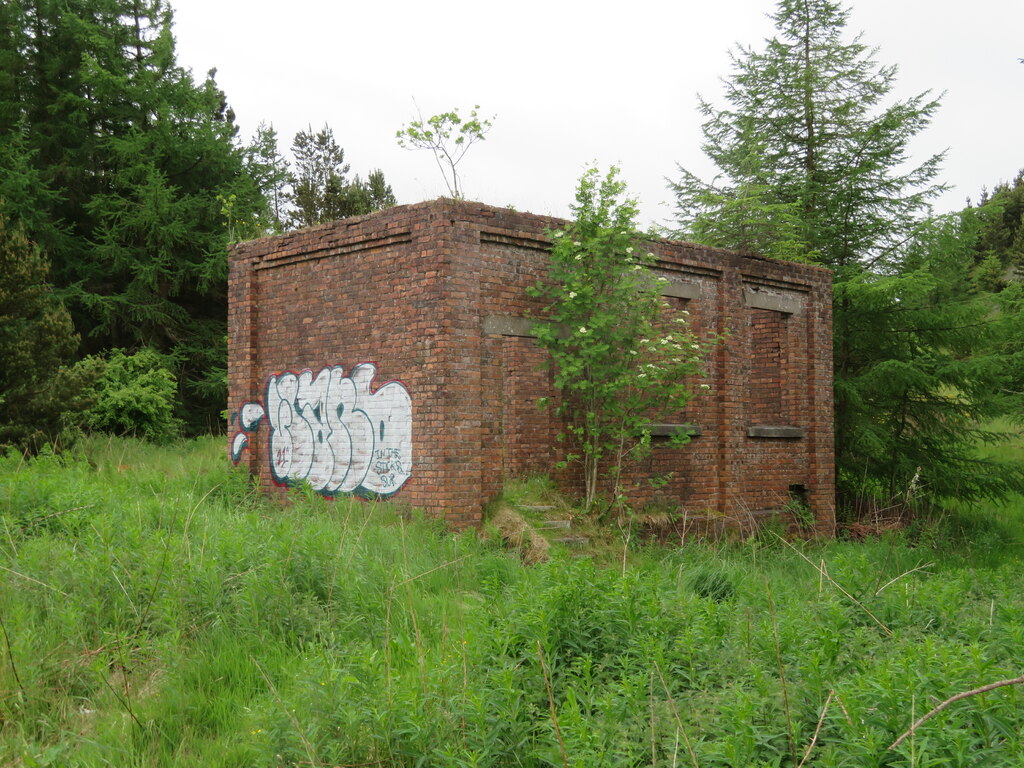
- A Geograph photograph of 2009 shows colliery ruins at East Benhar in square NS9161, the photographer noting that the Fauldhouse Hills, once busy with collieries and their railways, are now densely forested. 4
Photographs & further reading
The site record, transcribing the 1945 and 1948 Lists of Mines and three newspaper reports covering the sinking, the 1956 redundancy vote and the 1957 closure.
View sourceThe record for the older and separate Benhar Colliery in Whitburn parish, worked by George Simpson from the early 19th century, which gives the district its name.
View sourceSources
- (secondary) East Benhar No.2 mine — Scottish Shale (Museum of the Scottish Shale Oil Industry)
- (secondary) Fauldhouse — Wikipedia
- (primary) BGS / Mining Remediation Authority mine plans: BENHAR — British Geological Survey / Mining Remediation Authority
- (observational) Colliery ruins, East Benhar (Geograph, Richard Webb, 2009, square NS9161) — Geograph Britain and Ireland
Record created: 11 September 2026 · Last researched: 24 September 2026