 MineArchive
Ganister
| Also known as | Gannister (Common alternative spelling in Sheffield records) |
|---|---|
| Category | Commodities |
| Commodity page | Ganister → |
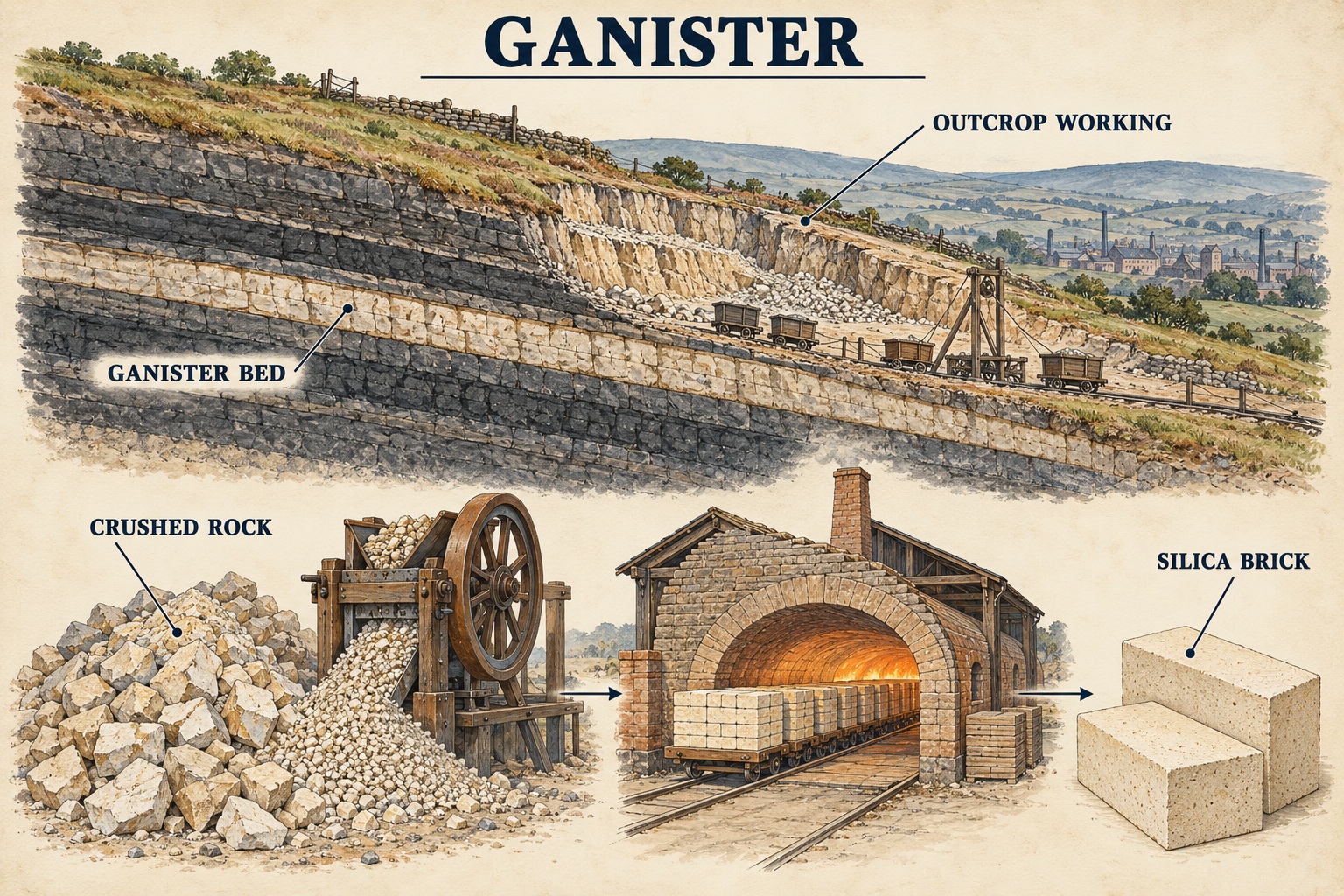
A hard, fine-grained quartzose sandstone — an orthoquartzite — cemented by secondary silica, breaking with a splintery fracture and running over 90% silica with only traces of alumina and lime. It occurs as a seatearth in the Coal Measures: a bed within the ordinary coal sequence rather than a vein, which is why it was worked along its outcrop rather than sunk to.
Historical usage
The word was coined by Cornish miners for the quartzose seatearths of the English Coal Measures, and the industry it named belonged to Sheffield. Ganister mining developed above the Don valley from the 1860s, supplying the Oughtibridge Silica Fire Brick Company founded in 1856; the Worrall, Wadsley and Loxley districts were reckoned the source of the best 'true' ganister in the country. It was often worked with coal from the same ground in so-called mixed mines. Comparable deposits are known in Nova Scotia, the United States and the Sydney Basin.
How it worked
Because the ganister is a bed, working followed the outcrop around the valley sides, opening the nearest ground first and moving progressively along as it was exhausted — at Wharncliffe Wood the mines moved steadily north across the wood over eighty years. The rock was crushed and fired into silica brick rather than used as quarried.
Why it was used
For the silica content and what it does under heat. Silica brick holds its strength at furnace temperatures, and ganister's purity — over 90% silica, almost no alumina or lime to flux it — makes a refractory that will line an acid Bessemer converter. The Bessemer process was developed in Sheffield in 1856; the ganister mines opened in the 1860s. That is not a coincidence, it is the whole industry.
Value over time
Ganister has no independent market history — it rises and falls with steel. The trade ran from the mid-19th century to the interwar period at its height, sustained entirely by furnace linings for the iron and steel industry on its doorstep, with the Oughtibridge company incorporated in 1918 and taken over by Steetley in 1947. The switch from acid Bessemer converters to basic dolomite linings removed the material's principal use, and the decline of Sheffield steel removed the rest; the Wharncliffe Wood mines closed around the end of the Second World War.
Hazards & challenges
This is the most silica-rich material in the archive, over 90% quartz, and it was mined underground and crushed dry — the two conditions that produce silicosis. Sheffield's ganister mines and metal grinding trades together made the city a recognised centre of what was then called industrial fibroid phthisis, and ganister mining near Sheffield was investigated by E. L. Collis as Medical Inspector of Factories in 1917. That investigation is reported in secondary accounts of the district rather than read here at first hand, and the underlying occupational-health literature could not be reached, so no figures for cases or deaths are given. What is not in doubt is the exposure: a rock that is nine-tenths silica, worked in confined headings.
Risks & limitations
A refractory is only wanted while the process it lines is wanted, and ganister was tied to one. Acid-lined converters gave way to basic processes using dolomite linings, and as Sheffield's steel industry contracted the demand for its refractories went with it. The mines closed around the end of the Second World War.
Regional variation
In Britain ganister means the Sheffield district — Oughtibridge, Worrall, Wadsley and Loxley — and the term travelled from Cornwall with the miners who coined it. 'Gannister' is the common alternative spelling in local records.
Related terminology
Coal, Colliery Brickworks, Fireclay
Mines associated with this term
5 examples chosen from 10 linked records — the term page is not an index.
- Branthwaite Colliery — Cumbria (well documented example)
Named 3 times in this record, first in the summary: “…at Branthwaite in west Cumbria, worked for coal, fireclay and ganister into the 1920s under the Workington Iron & Steel Branch of United…” - Butsfield Quarry — County Durham (well documented example)
Named 8 times in this record, first in the summary: “A small ganister quarry on the moor edge west of Consett, worked by the Consett Iron…” - Commondale Quarry — North Yorkshire (well documented example)
Returned alongside the clay in 1897 and 1905, and on its own in 1922 — the few people the returns put below ground were probably after this rather than the clay. - Gillhead Colliery — Cumbria (well documented example)
Named 3 times in this record, first in the summary: “…most of its life employing between thirty and fifty men, and sold ganister and fireclay alongside its coal. It was worked by Lucock & Carlton…” - Healeyfield Mine — County Durham (well documented example)
Named 5 times in this record, first in the history: “…with J. W. Nelson as agent and eighteen men underground, working ganister — the hard, near-pure silica sandstone quarried for the linings of…”
See every mine that worked ganister →
Sources
- (observational) The Lost Ganister and Clay Mines of Sheffield project: 2017 - to date — 28DaysLater.co.uk
- (secondary) Ganister — Wikipedia
- (secondary) Oughtibridge Silica Firebrick Co — Grace's Guide
Record created: 25 August 2026 · Last researched: 26 August 2026