 MineArchive
Healeyfield Mine
| Also known as | Dene Howl Mine, Dean Howl Mine |
|---|---|
| Location | Dene Howl, Healeyfield, near Castleside, County Durham — 54.8349, -1.8903 (approximate) |
| Commodities | Lead, Ganister |
| Type | Metal |
| Worked | Working by the late 18th century–1930 |
| Maximum depth | Unknown. |
| Operators | W. and M. Howe |
Overview
Healeyfield was a lead mine at Dene Howl, in the parish of Healeyfield south-west of Consett, worked from at least the late eighteenth century. Two of its structures are listed: the ruin of a mid-nineteenth-century mine building, and a reservoir probably of the late eighteenth century which Historic England describes as a rare survivor of an industry once very important to the area's economy. By 1930 a working of the same name at Castleside was returning not lead but ganister, the hard silica rock used for furnace linings.
History
The parish of Healeyfield lies south-west of Consett in County Durham and is old ground — first documented in the Boldon Book as Heleie, and held by the Chilton family for some two centuries from a charter of 1280. The mining is later, and the documentary record this archive has been able to read is thin, but the buildings themselves date it.
The mine's reservoir, which dams the stream in Dene Howl, is probably of the late eighteenth century, so the working was already substantial by then: a mine builds a reservoir when it needs a reliable head of water for dressing or for power. It was listed Grade II on 24 June 1987, and the listing calls it a rare survivor of an industry once very important to the area's economy — a judgement about the Derwent valley lead trade as much as about this one wall.
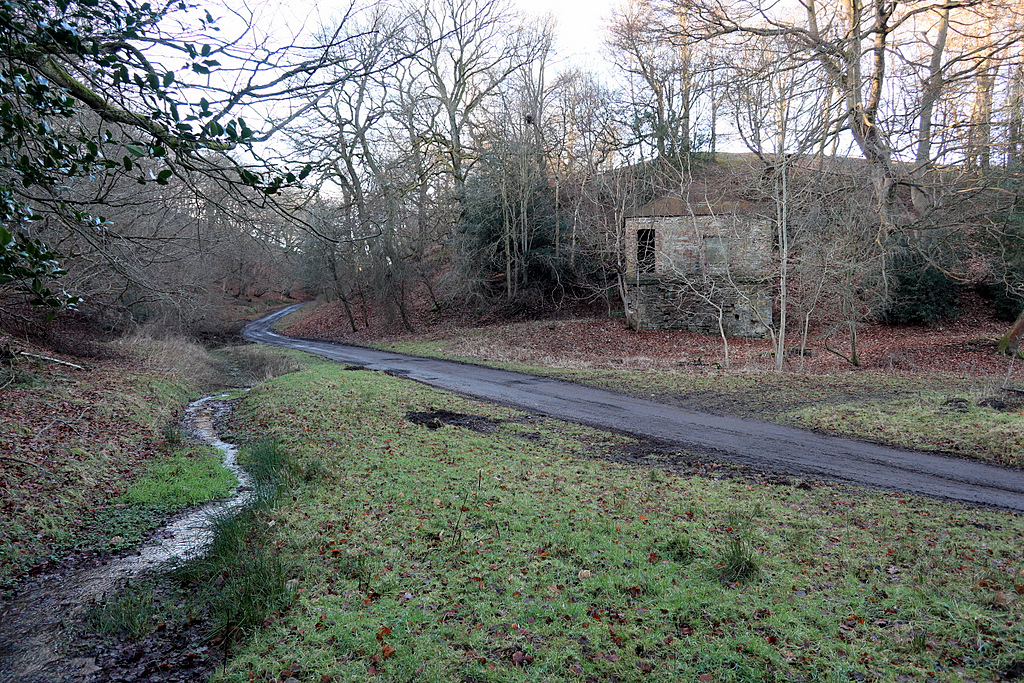
About 300 metres north-east of Dene Howl Farm stand the remains of the mine itself, probably of the mid nineteenth century and listed on the same day. What survives is the ruin of a rectangular building of coursed sandstone rubble with ashlar dressings, roofless, standing to a maximum height of about three metres, with a flat stone lintel over the wooden jambs of an empty doorway on its west side.
The site did not stop when the lead did. The 1930 List of Mines under the Metalliferous Mines Act enters Healeyfield at Castleside under W. and M. Howe of 8 Deneburn, with J. W. Nelson as agent and eighteen men underground, working ganister — the hard, near-pure silica sandstone quarried for the linings of steel furnaces, and a natural product for ground on the edge of Consett, whose ironworks was one of the largest in the country. Whether that ganister working reused the lead mine's ground or merely its name is not established.
Geology
This is the eastern edge of the North Pennine orefield, where lead occurs in near-vertical veins cutting a Carboniferous sequence of limestones, sandstones and shales, richest where a vein crosses a competent bed and poorer in the shales between. The ganister returned in 1930 belongs to the same sequence but to a different part of it: ganister is a very fine, hard sandstone of high silica content, formed as a seatearth beneath a coal seam, and it is quarried for refractory brick rather than for any metal in it. One ground, two industries, a century apart.
Geological setting: Veins and Lodes (historical documentary reference)
Workings
Centred on Dene Howl, where the surviving structures stand: the mine building 300 metres north-east of the farm, and the reservoir 100 metres east of it, a coursed squared sandstone wall about a metre and a half high and six metres long damming the stream in the Howl. An engine house also survives on the site. Nothing on record establishes the depth of the workings, the number of shafts or levels, or which vein was followed.
Closure
The closure date is not known for either phase. The lead working is documented here only by its listed structures, dated to the late eighteenth and mid nineteenth centuries; the ganister working was still returning eighteen men underground in 1930. The general collapse of British lead mining in the last quarter of the nineteenth century, under cheap imported ore, is the ordinary explanation for the end of a mine like this, but no source states it of Healeyfield.
What remains
The mine site has been extensively cleared over the years, and Dene Howl is now a farmstead. What remains is listed and standing: the roofless ruin of the mid-nineteenth-century mine building, which was overgrown at the time of its survey, and the reservoir wall damming the stream, likewise overgrown when listed. An engine house at Dene Howl survives and has been photographed, and a track runs past the former mine reservoir.
The Grade II listed ruin of a rectangular mine building of coursed sandstone rubble with ashlar dressings, roofless and standing to about three metres, with a flat stone lintel over an empty doorway; the Grade II listed reservoir wall, coursed squared sandstone about 1.5 m high and 6 m long, damming the stream in Dene Howl; and an engine house.
Nearby mines
- Crookhall Colliery — 2.7 miles (4.3 km) E
- Delves Colliery — 2.7 miles (4.3 km) E
- Tin Mill Colliery — 2.7 miles (4.3 km) NE
- Butsfield Quarry — 3.1 miles (5.0 km) SE
- Iveston Colliery — 4.0 miles (6.4 km) E
Straight-line distance, within 9 miles (15 km). Show on the map.
What's uncertain
Points where sources disagree or the record could not be settled; both accounts are kept. All open questions in the archive.
- The BGS mine-plans catalogue holds a BGS plan titled 'Healeyfield Mine.' (catalogue SP2087, undated in the catalogue); the catalogue gives no location and the plan's details do not clearly tie it to this working, so it may belong to another of the same name. (uncertain) 5
Recorded claims
Individual factual claims, each attached to the source(s) that support it below. Where sources disagree, both are kept.
- The remains of a lead mine about 300 metres north-east of Dene Howl Farm, probably mid 19th century, were listed Grade II on 24 June 1987: coursed sandstone rubble with ashlar dressings, roofless, the ruin of a rectangular building surviving to a maximum height of about 3 metres with a flat stone lintel over the wood jambs of an empty door on the west side. 1
- The reservoir for the lead mine, about 100 metres east of Dene Howl Farm and probably late 18th century, is a coursed squared sandstone wall about 1.5 metres high and 6 metres long damming the stream in Dene Howl; it was overgrown at the time of survey and is described in its listing as a rare survivor of an industry once very important to the area's economy. 2
- The 1930 List of Mines records Healeyfield at Castleside, owned by W. and M. Howe of 8 Deneburn with J. W. Nelson as agent, working ganister with eighteen men underground. 3
- An engine house survives at Dene Howl and has been photographed. 4
- The BGS mine-plans catalogue holds a BGS plan titled 'Healeyfield Mine.' (catalogue SP2087, undated in the catalogue); the catalogue gives no location and the plan's details do not clearly tie it to this working, so it may belong to another of the same name. (uncertain) 5
Photographs & further reading
The Historic England listing text for the mine's reservoir, which dates it to probably the late 18th century and calls it a rare survivor of an industry once very important to the area's economy.
View sourceSources
- (primary) Former Lead Mine circa 300 metres north-east of Dene Howl Farm, Healeyfield (listed building 1185973) — Historic England, via British Listed Buildings
- (primary) Former Lead Mine Reservoir about 100 metres east of Dean Howl Farm, Healeyfield (listed building 1299439) — Historic England, via British Listed Buildings
- (primary) 1930 List of Mines under the Metalliferous Mines Act: Durham — Durham Mining Museum
- (observational) Engine house, Dene Howl (photograph) — Geograph Britain and Ireland
- (primary) BGS / Mining Remediation Authority mine plans: HEALEYFIELD MINE. — British Geological Survey / Mining Remediation Authority
Record created: 5 September 2026 · Last researched: 5 September 2026