 MineArchive
Commondale Quarry
| Also known as | Commondale Clay Pit, Commondale Brickworks Quarry |
|---|---|
| Location | Commondale, on the northern edge of the North York Moors, North Yorkshire — 54.4851, -0.9780 (approximate) |
| Commodities | Brick Clay, Fireclay, Ganister |
| Type | Clay |
| Worked | 1860–1947 |
| Operators | Cleveland Fire Brick & Pottery Co. (1860–1867, owner) Crossley & Son, Commondale (1871–1947, owner) Commondale Brick & Pipe Co. Ltd (1890–1900, owner) Crossley's Commondale Pipe Co. Ltd (1930–1935, owner) |
Overview
The clay working that fed the Commondale brickworks on the North York Moors. A Stokesley printer started it in 1860 on a seam of fireclay and a new railway; the Crossleys ran it for seventy-five years, made art pottery from it for four of them, and closed in 1947. Most of the village is built of its brick.
History
John Slater Pratt was a printer and businessman from Stokesley with a small but successful shop, who produced over three hundred titles between 1841 and 1853 and made what would be about thirty thousand pounds today. In 1860 he spent it on a plot of land at Commondale. He had found that the area had a source of fireclay, and a new commercial railway line had opened nearby; he set up the Cleveland Fire Brick and Pottery Company to make building materials and pottery and send them across the country.
Pratt died in 1867 and production stopped. The works stood idle until 1871, when the business was sold to John Crossley of Stockton, a builder's merchant, who renamed it the Commondale Brick, Pipe and Pottery Company and ran it with his son Alfred. The two wanted different things from it. John concentrated on building materials; Alfred, taken with the Linthorpe Art Pottery that had opened at Middlesbrough in 1879, began the following year to make red and buff terracotta with painted and glazed decoration.
The art pottery lasted four years. Facing competition and the rising cost of materials and production, the pottery side closed in 1884; Alfred left the company and went to live and work in America. He came back to England in 1893, rejoined the firm, eventually took over as manager and brought his own family into it. The works never made pottery again.
It made brick and pipe instead, trading as Crossley and Son, and the trade took it a long way: St William's Church at Dormanstown and the Ship Inn at Marske are theirs, and bricks stamped Commondale turn up all over North Yorkshire and the North East. In the 1930s the firm developed the Crossley Roadway Paver for paving streets. It never caught on, being dearer than the slag bricks Middlesbrough used, and Bush Street in that town is one of the few places it was laid.
The quarry behind all this is returned to the Mines Department from 1894, and its figures swing violently: four people in 1894, 68 in 1896 with 64 of them at surface, 66 in 1897, then nothing at all in 1900 and 1902 with the working returned as standing. Seven in 1905. Six in 1922, worked occasionally or only for a short portion of the year. The 1935 return records the mine idle. What it produced changed too: clay, then clay and ganister, then ganister alone in 1922, then Lias clay in 1935.
Brick and pipe manufacture continued until 1947, when production ceased and the site closed down.
Geology
Fireclay, which is what John Slater Pratt came for in 1860, and the Lias clay named in the 1935 return. Ganister lies in the same ground: the returns for 1897, 1905 and 1922 record it alongside or instead of the clay.
Workings
Overwhelmingly a surface working: the 1896 return puts 64 of 68 people above ground and the 1897 return 58 of 66. The few below ground suggest a small underground working for the ganister rather than the clay.
Closure
The 1935 return records the clay working as idle. Brick and pipe manufacture at Commondale continued until 1947, when production ceased and the site closed down.
What remains
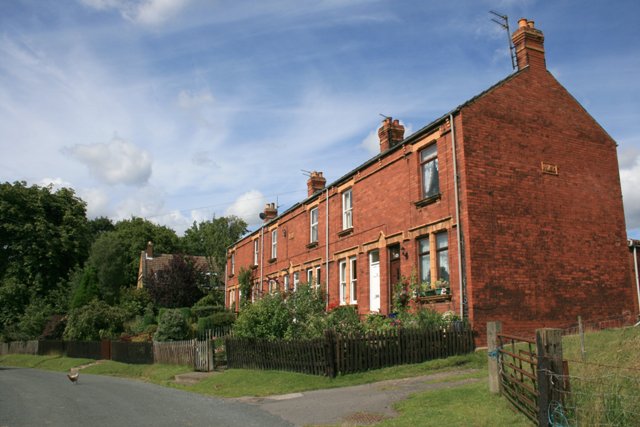
Nothing is recorded of the quarry itself as it now stands, and the works are gone. The village survives, built largely of its own brick, including a row of cottages dated 1903 on the gable. Commondale wares are held by Kirkleatham Museum, and photographs of the works by Preston Park Museum at Stockton.
The village's brick houses and cottages, including a row dated 1903 on its gable built by the brickworks company.
Nearby mines
- Belman Bank Alum Works — 2.6 miles (4.1 km) NW
- Warren Moor Mine — 2.6 miles (4.1 km) W
- Aysdalegate Mine — 2.8 miles (4.5 km) N
- Stanghow Mine — 3.2 miles (5.2 km) N
- Slapewath Ironstone Mine — 3.6 miles (5.8 km) N
Straight-line distance, within 9 miles (15 km). Show on the map.
Recorded claims
Individual factual claims, each attached to the source(s) that support it below. Where sources disagree, both are kept.
- The official returns give clay from Commondale in 1894, 1896, 1900 and 1902; clay and ganister in 1897 and 1905; ganister alone in 1922; and Lias clay in 1935. The owners were the Commondale Brick & Pipe Co. Ltd. in the 1890s and Crossley's Commondale Pipe Co. Ltd. in the 1930s. 1
- Employment was four in 1894, 68 in 1896 (64 at surface), 66 in 1897, then nothing at all in 1900 and 1902 with the working returned as standing. Seven people in 1905, six in 1922 with the mine worked occasionally or only for a short portion of the year, and the 1935 return records it idle. 1
- A row of cottages at Commondale, dated 1903 on the nearest gable, was built by the brickworks company in a distinctive red brick. 2
- Commondale Pottery was founded not by a potter but by John Slater Pratt, a printer and businessman from Stokesley who produced over three hundred titles between 1841 and 1853 and made a small fortune, about thirty thousand pounds in today's money. In 1860 he used it to buy a plot of land at Commondale and set up the Cleveland Fire Brick and Pottery Company, having found that the area had a source of fireclay and that a new commercial railway line had opened nearby. 3
- Pratt died in 1867 and production ceased. The works remained idle until 1871, when the business was sold to John Crossley of Stockton, who renamed it the Commondale Brick, Pipe and Pottery Company and ran it with his son Alfred. 3
- Alfred Crossley was inspired by the Linthorpe Art Pottery, which opened at Middlesbrough in 1879, and from 1880 began producing red and buff terracotta pieces with painted and glazed decoration. Facing competition and rising costs, the pottery side of the business closed in 1884 and Alfred left for America; he returned to England in 1893, rejoined the company and eventually became its manager. The site never made pottery again. 3
- Trading as Crossley and Son, the works built a number of buildings in the North East, including St William's Church in Dormanstown and the Ship Inn at Marske, and bricks with Commondale in them can be found around North Yorkshire and the North East. In the 1930s the firm developed the Crossley Roadway Paver for paving streets; it was dearer than the slag bricks Middlesbrough used and never really caught on, and Bush Street in that town is one of the few places it was laid. 3
- The manufacture of bricks and pipes continued in Commondale until 1947, when production ceased and the site closed down. 3
Photographs & further reading
Forty years of returns, the two owners, and the swings from sixty-eight people to none and back.
View sourceThe brickworks company's own housing, dated 1903 on the gable and built in the red brick the works made.
View sourceHow a Stokesley printer's fortune started the works in 1860, the Crossleys who ran it for seventy-five years, the four years of art pottery, and the Roadway Paver that never caught on. With photographs of the wares and of the workroom about 1902.
View sourceSources
- (primary) Commondale (Clay) — Durham Mining Museum
- (observational) Row of Cottages, Commondale (Geograph 510628) — Geograph
- (secondary) The Commondale Brickworks and Pottery — Tees Valley Museums
Record created: 11 September 2026 · Last researched: 11 September 2026