 MineArchive
Stanghow Mine
| Also known as | Stanghow Ironstone Mine |
|---|---|
| Location | Stanghow, south-east of Guisborough, North Yorkshire — 54.5314, -0.9909 (approximate) |
| Commodity | Ironstone |
| Type | Ironstone |
| Worked | 1871 (sinking)–1921 |
| Maximum depth | Shafts 126 ft (about 38 m) |
| Operators | Stanghow Iron Company (1881–1891, owner) Cochrane & Co. Ltd (1892–1928, owner) |
Overview
A Cleveland ironstone mine between Guisborough and Stanghow, worked from the early 1870s through a long succession of owners — George Withes, the Stanghow Iron Company, Downey & Co. and finally Cochrane & Co. — and closed in the mid-1920s. It stood on private land at about 133 metres, a mile and a half from Spa Wood.
History
Stanghow's shafts were sunk in 1871, 126 feet deep, and production began in 1872 under the Stanghow Ironstone Company. The company built the terraced housing at Margrove Park in the early 1870s for the workers of its several local ironstone mines, and the row is still there. Downey and Company appear alongside from 1889. In 1892 the Stanghow Ironstone Company went into liquidation, and the following year the Cochrane Iron Company took out the lease and held it until 1928.
The mine's own end came well before that. The last stone was worked in 1921, and the mine was officially abandoned in 1928, seven years later — which accounts for the spread of closing dates across the other sources, none of which distinguishes the two. Its dates are given as 1873 to 1925 at NZ654156, or as 1872 to 1926 with Cochrane & Co. Ltd holding the lease to 1928; and the caption to a photograph of the surviving ventilation shaft has Cochrane working the mine until 1924. The mine sat in the same tight cluster as the workings already in this archive: Spa Wood a mile and three-quarters off, Spa a mile and a half, South Skelton just under a kilometre, Boosbeck a mile and a third, and its ore, like theirs, went to the Teesside furnaces.
Geology
The mine worked the Cleveland ironstone of the Lias, the bedded Jurassic ore of the Cleveland Hills, at about 133 metres above sea level on the moor edge south-east of Guisborough.
Geological setting: Sedimentary Beds and Seams (well documented example)
Workings
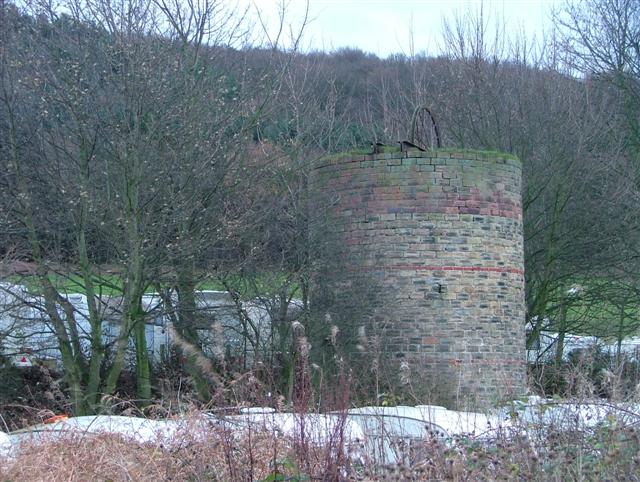
Shafts sunk in 1871 to 126 feet, with furnace ventilation — the disused furnace ventilation shaft at Margrove Park is among the few structures left. The working is classed as a mine rather than a drift or a quarry.
Closure
The last stone was worked in 1921 and the mine was officially abandoned in 1928. The other sources give closing dates between 1921 and 1928 because they do not separate the end of working from the formal abandonment: 1925 and 1926 in the mine lists, and 1924 in the caption to the photograph of the surviving ventilation shaft.
What remains
The site is private land. A disused furnace ventilation shaft survives at the Margrove Park caravan site, one of the few remains of the mine; the terraced housing the Stanghow Iron Company built at Margrove Park in the early 1870s for the workers of its several local ironstone mines is still there too.
The furnace ventilation shaft at Margrove Park, and the company's terraced housing of the early 1870s in the same place.
Nearby mines
- Aysdalegate Mine — 0.5 miles (0.7 km) S
- South Skelton Mine — 0.6 miles (1.0 km) N
- Slapewath Ironstone Mine — 0.7 miles (1.2 km) W
- Boosbeck Mine — 0.8 miles (1.3 km) N
- Spa Mine — 0.9 miles (1.5 km) W
Straight-line distance, within 9 miles (15 km). Show on the map.
What's uncertain
Points where sources disagree or the record could not be settled; both accounts are kept. All open questions in the archive.
- Buddlepit gives the mine as worked from 1872 to 1926; the Wikipedia table of Cleveland ironstone mines gives 1873 to 1925 at NZ654156. (disputed) 1,2
Recorded claims
Individual factual claims, each attached to the source(s) that support it below. Where sources disagree, both are kept.
- Buddlepit gives the mine as worked from 1872 to 1926; the Wikipedia table of Cleveland ironstone mines gives 1873 to 1925 at NZ654156. (disputed) 1,2
- George Withes in 1875, the Stanghow Iron Co. from 1881 to 1888, Downey & Co. in 1889, Stanghow Iron Co. Ltd in 1890-91, Cochrane & Co. from 1892 and Cochrane & Co. Ltd from 1894 to 1928. 2
- The Stanghow Ironstone Company built the mine in 1872 and went into liquidation in 1892; Cochrane and Company took out the lease the following year and worked the mine until 1924, and it was officially abandoned in 1928. 3
- The Stanghow Iron Company built the terraced housing at Margrove Park in the early 1870s for the workers of its several local ironstone mines. 3
- The shafts were sunk in 1871 to a depth of 126 feet and production began in 1872. 4
- The last stone was worked in 1921 and the mine was officially abandoned in 1928. 4
Photographs & further reading
The Northern Mine Research Society data for the mine: working period, the full succession of owners from 1875, coordinates and elevation, and its own bibliography including Gill and Burt's The Mines of Yorkshire.
View sourceA survey of the whole industry with a table of its mines, giving Stanghow's dates, working type and grid reference alongside its neighbours.
View sourceA photograph of one of the mine's few surviving structures, whose caption sets out the 1872 founding, the 1892 liquidation, Cochrane's lease from 1893 to 1924 and the formal abandonment in 1928.
View sourceLease holders and a dated timeline: the 126-foot shafts of 1871, production from 1872, the Stanghow Ironstone Company's liquidation in 1892, the Cochrane Iron Company's lease to 1928, the last stone in 1921 and the formal abandonment, with a plan of the workings overlaid on modern mapping.
View sourceSources
- (secondary) Ironstone mining in Cleveland and North Yorkshire — Wikipedia
- (secondary) Stanghow Mine — Buddlepit Mine Database (from Northern Mine Research Society data)
- (observational) Disused Furnace Ventilation Shaft, Margrove Park Caravan Site — Geograph
- (secondary) Stanghow Ironstone Mine — East Cleveland's Industrial Heartland
Record created: 12 September 2026 · Last researched: 12 September 2026