 MineArchive
West Stanley Colliery explosion, 1909
A coal-dust explosion at West Stanley Colliery — the Burns Pit — on the afternoon of 16 February 1909 killed some 167 men and boys across four seams, among them children of thirteen and fourteen. Around thirty came out alive, twenty-six of them led out by a deputy who kept them together in the dark.
| Date | 16 February 1909 |
|---|---|
| Mine | West Stanley Colliery |
| Region | County Durham |
| Primary type | Explosion |
| Associated types | Gas / Asphyxiation, Rescue |
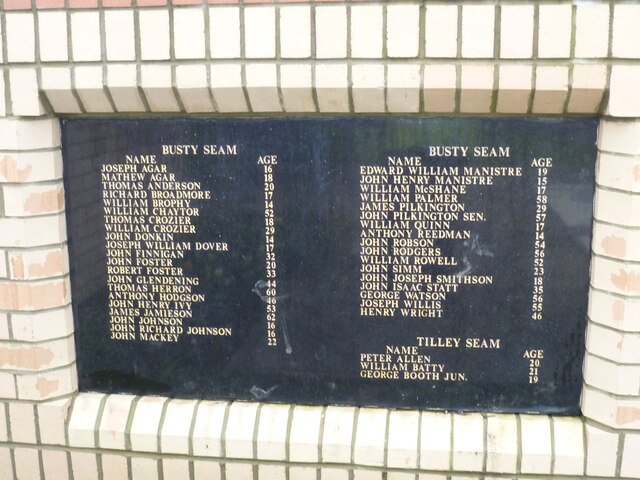
| Fatalities | 167 (167 by the per-seam count (18 in the Tilley, 63 in the Towneley, 38 in the Busty and 48 in the Brockwell); NMRS records 165 bodies recovered and two never recovered. Wikipedia gives 168. The dead included boys as young as thirteen.) |
| Injuries | Around thirty men and boys survived — twenty-six brought out of the Tilley seam by deputy Mark Henderson, and four others rescued separately: Matt Elliot from the Busty, severely burned, and Robert Leadbitter, John Smith and Paddy Joyce from the Towneley. Leadbitter died 33 hours later. |
| Context | During active mining (An afternoon explosion reaching four worked seams at once.) |
Cause
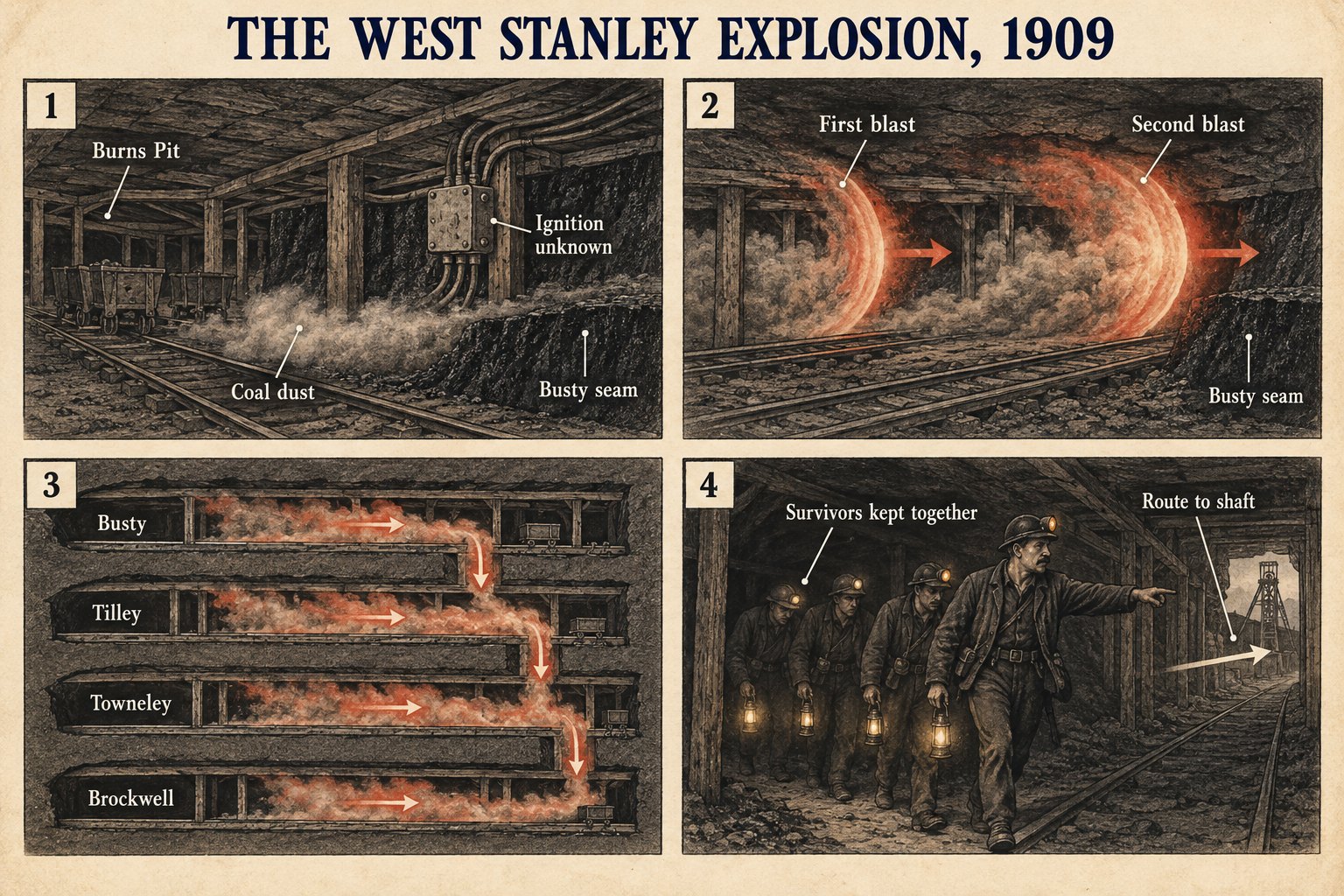
A coal-dust explosion originating in the Busty seam. The jury could not determine the ignition source.
Contributing factors
Professor W. M. Thornton of Armstrong College gave evidence that a train of coal dust between the terminals of a junction box or switch could have arced and set the dust alight. Faulty lamps, shot-firing and mechanical friction were all considered and ruled out.
What happened
At about a quarter to four on the afternoon of 16 February 1909 a muffled explosion was heard in Stanley, and some fifty seconds later a second blast sent flame out of the shaft top and into the sky. The explosion had begun in the Busty seam and it did not stay there: coal dust carried it through the Tilley, the Towneley and the Brockwell as well, killing men and boys in all four. Underground, a deputy named Mark Henderson gathered thirty-four survivors and started them towards the shaft. Seven broke away and rushed it, and died. Henderson held the remaining twenty-seven together in the dark and had them sing — the hymn remembered is 'Lead Kindly Light' — while they waited; during the singing a fourteen-year-old, Jimmy Gardner, died. Henderson then made five separate trips through the workings and brought twenty-six of them out alive. Four others were rescued elsewhere in the pit, Paddy Joyce last of all, who put his survival down to loose coal letting fresh air through to him.
Rescue & recovery
Rescue and recovery went on across four seams. Around thirty men and boys came out alive; 165 bodies were recovered and two were never brought out. Mass funerals were held on 21 February, with an estimated 200,000 mourners, most of the dead buried in communal trenches at the Anglican St Andrew's and the Roman Catholic St Joseph's.
Investigation & inquiry
The inquest, under coroner John Graham, sat from 18 February to 29 March 1909. The jury concluded that this had been a coal-dust explosion but could not fix the source of ignition, the engineers disagreeing over whether electrical arcing or frictional sparking had started it. It found the colliery's safety measures had been properly maintained and assigned no culpability to the management.
Memorials & commemoration
Three memorials stand in Stanley: an ornate pedestal and urn unveiled in 1913, a 1995 memorial built around a colliery winding wheel, and a 2005 headstone marking the mass graves. The pitman poet Tommy Armstrong published a broadsheet ballad for the victims.
What's uncertain
Points where sources disagree or the record could not be settled; both accounts are kept. All open questions in the archive.
- The dead numbered 167 by the per-seam count — 18 in the Tilley, 63 in the Towneley, 38 in the Busty and 48 in the Brockwell. (disputed) 2
- The death toll is given as 168 elsewhere, with 29 survivors. (disputed) 3
Recorded claims
Individual factual claims, each attached to the source(s) that support it below. Where sources disagree, both are kept.
- The explosion occurred at about 3:45 p.m. on 16 February 1909, a second blast following some fifty seconds later and sending flame out of the shaft. 1,2
- The dead numbered 167 by the per-seam count — 18 in the Tilley, 63 in the Towneley, 38 in the Busty and 48 in the Brockwell. (disputed) 2
- The death toll is given as 168 elsewhere, with 29 survivors. (disputed) 3
- Deputy Mark Henderson led thirty-four survivors towards the shaft; seven rushed it and died, and he kept the remaining twenty-seven together and singing before making five trips to bring twenty-six out alive. 2
- Four further men were brought to the surface alive — Matt Elliot from the Busty seam and Robert Leadbitter, John Smith and Paddy Joyce from the Towneley; Leadbitter died 33 hours later. 1,2
- The jury found this to be a coal-dust explosion but could not determine the ignition source, and assigned no culpability to the management; Professor W. M. Thornton gave evidence that arcing across coal dust in a junction box could have caused it. 1,3
- Mass funerals were held on 21 February with an estimated 200,000 mourners, most of the dead buried in communal trenches at St Andrew's and St Joseph's. 3,2
Related terminology
Mining terms this disaster is structurally linked to, with the nature of the relationship.
- Afterdamp (hazard involved)
Survivors in the sealed-off districts waited in air going bad while rescue worked towards them. - Coal (contextual relationship)
Expert evidence pointed at coal dust itself as the ignition source: a train of it between the terminals of a junction box or switch, arcing and setting the dust alight, after lamps and shot-firing were ruled out. - Deputy (relevant method/equipment)
Mark Henderson was a deputy — the official responsible for the safety of a district, and the reason twenty-six men came out of the Tilley seam alive. - Firedamp (contextual relationship)
Firedamp was ruled out as the agent here: the jury found this to be a coal-dust explosion. - Shot-firing (contextual relationship)
Named in this record’s contributing factors: “…or switch could have arced and set the dust alight. Faulty lamps, shot-firing and mechanical friction were all considered and ruled out.”
Sources
- (primary) West Stanley Colliery Explosion, 1909 — Northern Mine Research Society
- (secondary) Coal Mining in Stanley — Stanley Town Council
- (secondary) West Stanley Pit disasters — Wikipedia
Record created: 24 August 2026 · Last researched: 24 August 2026