 MineArchive
West Stanley Colliery
| Also known as | Burns Pit, Stanley Colliery |
|---|---|
| Location | Stanley, north-west Durham, County Durham — 54.8668, -1.6743 (exact) |
| Commodity | Coal |
| Type | Coal |
| Worked | 1832–1936 |
| Operators | The Burn family (1832–1936), James Joicey & Co. (1850–1860), South Derwent Coal Co. Ltd (1910–1936) |
Overview
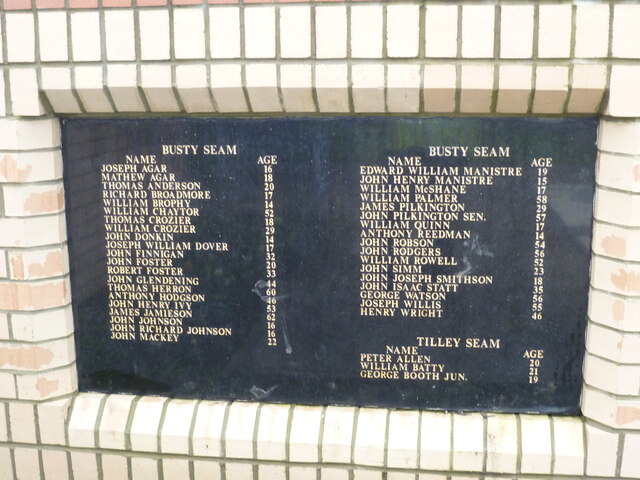
The Burns Pit — a Durham colliery working four seams through four shafts, and the scene in February 1909 of one of the worst disasters in British mining, when a coal-dust explosion killed some 167 men and boys and a deputy sang his way out with twenty-six of them.
History
West Stanley Colliery opened in 1832 and worked about seventy acres through four shafts, reaching several seams. It was owned by the Burn family, which is why it was known locally as the Burns Pit. An explosion in April 1882 killed thirteen men (see Disasters, below). Twenty-seven years later, on the afternoon of 16 February 1909, a coal-dust explosion tore through four seams at once and killed some 167 men and boys — one of the worst mining disasters Britain has had. The colliery worked on until 1936.
The museum's record fills in the pits and the owners. The colliery began under James Joicey before the Burns took it: the Kettledrum Pit was opened in 1859, the Mary sunk from October 1860, the Lamp Pit in 1874 and the New Pit in August 1876, the last outliving the colliery's closure on 19 March 1936 by a year. The Owners of West Stanley Colliery held it in the 1900s and the South Derwent Coal Company from the 1910s. Its workforce, 557 in 1900, fell to 186 in 1910 after the explosion and recovered to around 500 through the 1920s; the output was gas, manufacturing and steam coal, with coking coal added from 1905, from the Brockwell, Busty, Tilley and Towneley seams once the Five Quarter and Hutton had been given up.
Geology
The Durham coalfield's bedded Carboniferous seams were worked here at four levels — the Tilley, Towneley, Busty and Brockwell — and it was that vertical stacking that made 1909 so bad: an explosion beginning in one seam reached all four. Coal dust rather than gas was the agent. Dry dust raised into the air by a first ignition burns as it goes, and will carry an explosion the length of a mine that firedamp alone would never reach.
Geological setting: Sedimentary Beds and Seams (well documented example)
Workings
Four shafts serving four worked seams — Tilley, Towneley, Busty and Brockwell — across a take of roughly seventy acres.
Closure
West Stanley closed in 1936. The Coal Authority holds a three-sheet abandonment plan for the colliery dated 1903, covering earlier workings.
What remains
The colliery site has been cleared and built over; the disaster is what remains publicly visible, through the memorials in the town.
Nothing of the colliery. Three memorials to the 1909 disaster stand in Stanley: an ornate pedestal and urn unveiled in 1913, a 1995 memorial built around a colliery winding wheel, and a 2005 headstone marking the mass graves.
Redevelopment
The site is absorbed into the town of Stanley.
Related mines
- Stobswood Colliery — Both owned by the Burn family.
Nearby mines
- Beamish Colliery — 0.7 miles (1.1 km) N
- Louisa Colliery — 1.0 miles (1.6 km) W
- Craghead Colliery — 1.1 miles (1.8 km) S
- West Pelton Colliery — 1.4 miles (2.3 km) E
- Handen Hold Colliery — 1.5 miles (2.4 km) E
Straight-line distance, within 9 miles (15 km). Show on the map.
Disasters & major incidents
-
West Stanley Colliery explosion, 1882
1882 · Explosion · 13 fatalities
At about 1 a.m. on 19 April 1882 an explosion in the Busty seam of John Henry Burn's West Stanley Colliery killed thirteen of the eighteen men underground. A large stone had fallen from the roof of a bord and released a pocket of firedamp, which fired at the men's Clanny lamps. -
West Stanley Colliery explosion, 1909
16 February 1909 · Explosion · 167 fatalities
A coal-dust explosion at West Stanley Colliery — the Burns Pit — on the afternoon of 16 February 1909 killed some 167 men and boys across four seams, among them children of thirteen and fourteen. Around thirty came out alive, twenty-six of them led out by a deputy who kept them together in the dark.
Recorded claims
Individual factual claims, each attached to the source(s) that support it below. Where sources disagree, both are kept.
- The colliery opened in 1832 and closed in 1936, working roughly seventy acres through four shafts. 1
- A coal-dust explosion on 16 February 1909 killed some 167 men and boys across four seams — one of the worst mining disasters in British history. 2,3
- A three-sheet Coal Authority abandonment plan for West Stanley is dated 1903. 4
- The Durham Mining Museum places West Stanley at NZ 210 525, opened 1832 and closed 19 March 1936, with the Kettledrum Pit (1859), Mary Pit (sinking from 9 October 1860), Lamp Pit (1874) and New Pit (15 August 1876, closed 9 February 1937). Owners run from James Joicey in the 1850s to David Burns in the 1860s, John Henry Burn in the 1880s, the Owners of West Stanley Colliery in the 1900s and the South Derwent Coal Co. Ltd from the 1910s. Employment stood at 311 in 1883, 505 in 1894, 557 in 1900, 186 in 1910 (the year after the disaster), 489 in 1921, 529 in 1927 and 432 in 1935; the output was gas, manufacturing and steam coal, with coking coal from 1905. The Five Quarter and Hutton seams were abandoned by 1905, and by the 1920s only the Brockwell, Busty, Tilley and Towneley were worked. 5
Sources
- (secondary) West Stanley Pit disasters — Wikipedia
- (primary) West Stanley Colliery Explosion, 1909 — Northern Mine Research Society
- (secondary) Coal Mining in Stanley — Stanley Town Council
- (primary) Mine plan D1534: West Stanley (3 sheets) — British Geological Survey / Mining Remediation Authority mine plans catalogue
- (primary) West Stanley Colliery (Durham Mining Museum) — Durham Mining Museum
Record created: 24 August 2026 · Last researched: 24 September 2026