 MineArchive
Brayton Domain Colliery
| Location | Aspatria, west Cumberland, Cumbria — 54.7567, -3.3256 (approximate) |
|---|---|
| Commodity | Coal |
| Type | Coal |
| Worked | to Before 1947 |
| Maximum depth | Unknown. |
| Operators | Joseph Harris (1880–?) |
Overview
A West Cumberland colliery on the Brayton estate at Aspatria, worked through at least five pits by the Harris family and closed before 1947. It raised coking, gas, household and steam coal, and gave its name to the colliery village of Harriston. An explosion in the Yard Band seam of its No. 4 pit in April 1915 killed seven.
History
The colliery was worked on the Brayton estate near Aspatria, and is recorded in the 1860s under the representatives of John Harris and in the 1880s under Joseph Harris. At least five pits were sunk across the take. The returns show the working moving between them over time: the No. 3 pit raising coking, gas, household and steam coal from 1894 to 1902, the No. 4 pit alongside it and then alone through the 1900s, and the No. 5 pit from 1915 into the 1940s. The colliery village of Harriston was built to serve the mine and named after Joseph Harris, its owner.
At about eleven in the morning on 26 April 1915, an explosion in a district of the Yard Band seam of the No. 4 pit killed seven of the eight men at work there (see Disasters, below). HM Inspector of Mines set out the case against the two officials responsible in his annual report, and one of them, the deputy and shotfirer Joseph Rumney, was himself among the dead.
The colliery closed before nationalisation in 1947. The Brayton Domain Colliery Company itself dates from 1822, formed by Joseph Harris, whose family worked the Aspatria pits for some 120 years. The No. 4 pit's record of single deaths runs through the years before the explosion: John Sandwith in March 1903, and in March 1908 Alexander Sewell of Harriston, a shiftman of 32 killed by a fall of roof, whose inquest opened in the Harriston Reading Room. The colliery's abandonment plans, nineteen of them across the numbered pits, are held by the Mining Remediation Authority.
Geology
The colliery worked the Coal Measures of the Cumberland coalfield inland from the Solway coast. The Yard Band seam, four feet thick under a strong blue shale roof, is described in the Inspector's report on the 1915 explosion — and that roof is part of the story: it was strong enough that in some cases no fall occurred for three months after the timber had been withdrawn, leaving large open areas of goaf standing next to the pillars being worked, and gas gathering in them.
Workings
At least five pits, numbered 1 to 5, spread across the estate. The Yard Band seam worked in the No. 4 pit was four feet thick with a strong blue shale roof, and was worked bord and pillar, the pillars being extracted alongside a ten-foot downthrow fault against which the goaf had been laid for some years. The goaf was left to the rise so that any gas given off would rise into it. No naked lights were used in the mine.
Closure
The colliery had closed before nationalisation in 1947; no precise date is recorded.
What remains
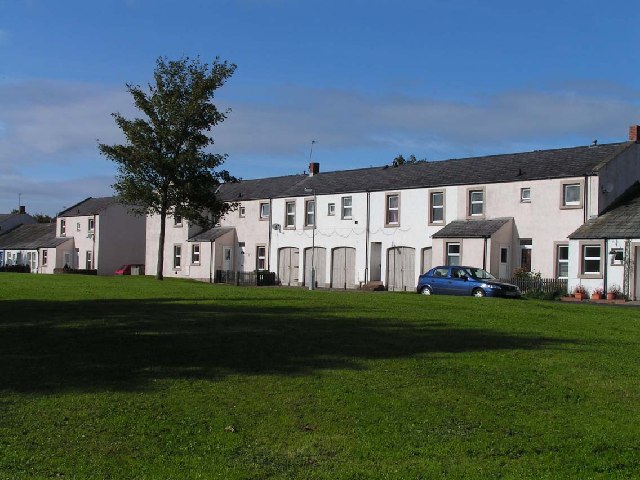
The colliery village of Harriston survives at Aspatria, built to serve the mine and named after its owner Joseph Harris.
The colliery village of Harriston; no colliery structures are recorded as surviving.
Nearby mines
- Bullgill Colliery — 3.6 miles (5.8 km) SW
- Birkby Colliery — 5.0 miles (8.0 km) SW
- Ellenbank Colliery — 5.6 miles (9.1 km) SW
- Dearham Colliery — 5.7 miles (9.2 km) SW
- Ruthwaite Mine — 6.1 miles (9.9 km) SE
Straight-line distance, within 9 miles (15 km). Show on the map.
Disasters & major incidents
-
Brayton Domain Colliery Explosion, 1915
26 April 1915 · Explosion · 7 fatalities
At about eleven in the morning on 26 April 1915, a shot of gelignite was fired into an almost entirely undermined rib of coal in the Yard Band seam of Brayton Domain No. 4 Colliery, next to a goaf whose condition nobody had checked. The gas in it exploded. Seven of the eight men at work in the district died of their burns over the following weeks, among them the deputy and shotfirer himself.
What's uncertain
Points where sources disagree or the record could not be settled; both accounts are kept. All open questions in the archive.
- The colliery village of Harriston at Aspatria was built to serve the mine and named after Joseph Harris, its owner. (uncertain) 1
Recorded claims
Individual factual claims, each attached to the source(s) that support it below. Where sources disagree, both are kept.
- The colliery is recorded under the representatives of John Harris in the 1860s and under Joseph Harris in the 1880s. 1
- At least five pits were worked. The No. 3 pit returned coking, gas, household and steam coal from 1894, the No. 4 pit from 1894 into the 1930s, and the No. 5 pit from 1915 into the 1940s. 1
- The seam worked in the district where the 1915 explosion occurred was four feet thick with a strong blue shale roof, worked bord and pillar, the pillars being extracted alongside a ten-foot downthrow fault. No naked lights were used in the mine. 2
- The colliery village of Harriston at Aspatria was built to serve the mine and named after Joseph Harris, its owner. (uncertain) 1
- The Brayton Domain Colliery Company was formed in 1822 by Joseph Harris, and over some 120 years his family worked several pits in the Aspatria area. 3
- John Sandwith was killed at the No. 4 pit on 26 March 1903 and Alexander Sewell, a shiftman of Harriston aged 32, by a fall of roof there on 3 March 1908; the inquest on Sewell opened in the Reading Room at Harriston. 4
- On 26 April 1915 a shot of gelignite fired into a thin rib beside an old bord in the Yard Band seam of the No. 4 pit ignited gas in the goaf; all seven men burned died within the following weeks. 5
- The Mining Remediation Authority holds abandonment plan NW1338 for the Thirty Inch and Yard seams at Brayton Domain, among nineteen catalogue entries for the colliery's numbered pits. 6
Photographs & further reading
The Inspector's own account of the explosion in his annual report, setting out how the shot was fired into a rib next to an unexamined goaf, the three points he drew from it, and the inquest jury's recommendation.
View sourceA local-history site on the Aspatria pits, their accidents and the 1915 disaster, hosting Terry Carrick's History of Mining in the Aspatria Area.
View sourceSources
- (primary) Durham Mining Museum: Brayton Domain Colliery — Durham Mining Museum
- (primary) Report of HM Inspector of Mines on the explosion at Brayton Domain (No. 4) Colliery, 26 April 1915 — HM Inspector of Mines, via the Durham Mining Museum
- (secondary) Brayton Domain Collieries (Rumneys: genealogy and local history) — Rumneys
- (secondary) Brayton Domain Collieries: colliery accidents (Rumneys) — Rumneys (transcribed West Cumberland Times reports)
- (secondary) Brayton Domain Colliery No 4 Pit explosion, Aspatria, 1915 (NMRS) — Northern Mine Research Society
- (primary) BRAYTON DOMAIN (Mine Remediation Authority abandonment plan NW1338, BGS mine plans catalogue) — British Geological Survey / Mining Remediation Authority
Record created: 3 September 2026 · Last researched: 24 September 2026