 MineArchive
Haig Colliery explosion, 1931
A firedamp explosion in the Main Band seam, over two miles underground at Haig Colliery, killed 27 miners and injured 13 more on the evening of 29 January 1931.
| Date | 29 January 1931 |
|---|---|
| Mine | Haig Colliery |
| Region | Cumbria |
| Type | Explosion |
| Fatalities | 27 |
| Injuries | 13 men were injured. |
| Context | During active mining |
Cause
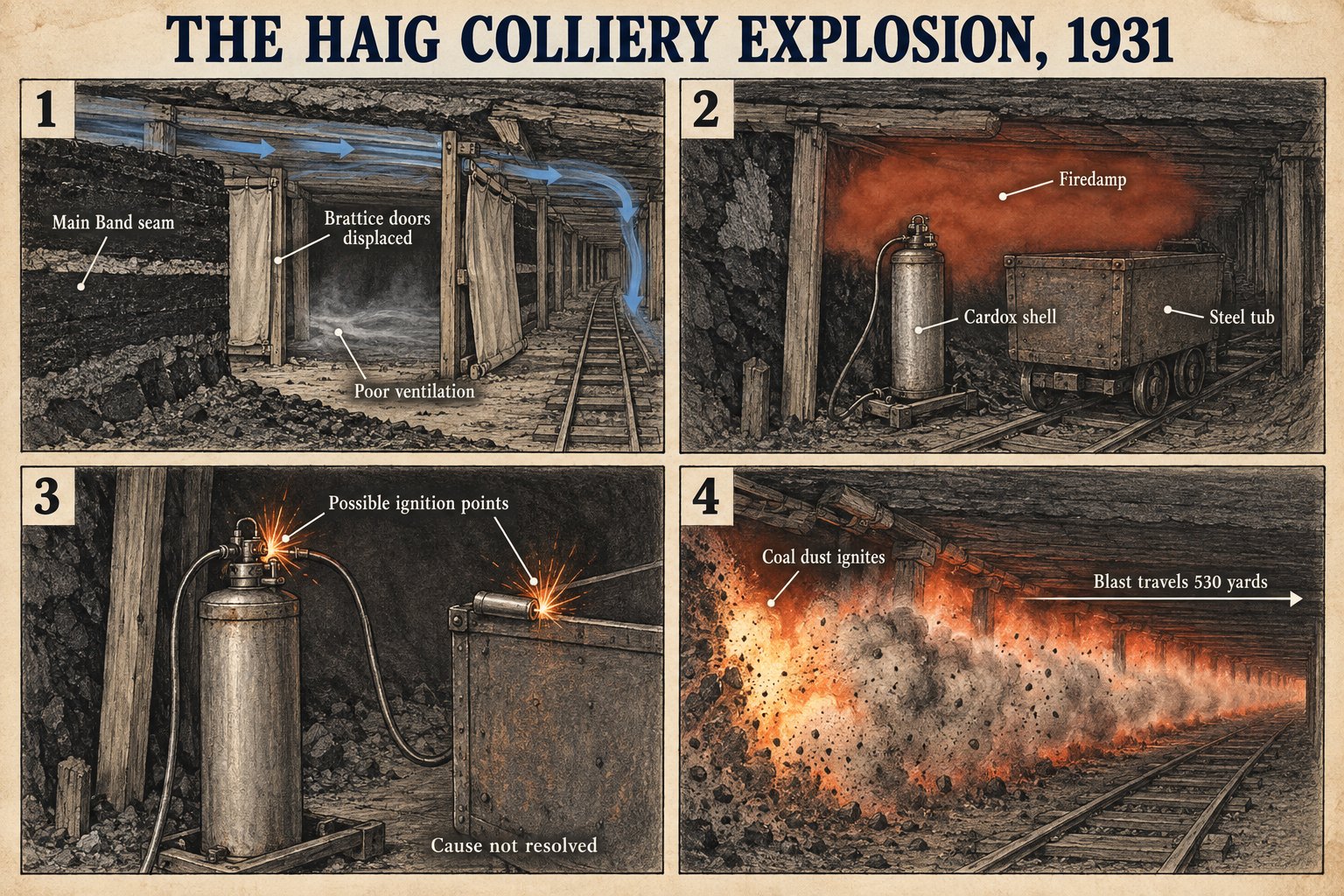
The colliery had a special arrangement to break difficult coal using Cardox — a compressed-gas blasting cartridge, safer than explosive charges in a gassy mine — fired from a portable shell. During the firing of a Cardox shell in Bailey's place, firedamp that had accumulated there because ventilation brattice doors were out of position was ignited, most likely either by a spark from the exploder or by a spark or heat generated when the Cardox cartridge struck the end of a steel tub.
What happened
At around 8.15pm on Thursday 29 January 1931, an explosion occurred in the Main Band seam of Haig Pit, over two miles underground, killing 27 miners and injuring a further 13. It was the third of three major explosions to strike the colliery, following disasters in 1922 and 1928.
Investigation & inquiry
A three-day inquiry, opened in February 1931 by the Chief Inspector of Mines, Sir Henry Walker, concluded that the initial ignition was an explosion of firedamp which was then propagated through coal dust, carrying the blast some 530 yards. The inquiry found the responsible deputy had not checked for gas immediately before the shell was fired, only beforehand, and that limestone dust applied underground as a safety measure to suppress coal dust had instead bonded with it rather than mixing through it, allowing the coal dust to propagate the explosion further than it should have. The inquiry reached no firm conclusion on the precise ignition source and closed without a definitive finding.
Recorded claims
Individual factual claims, each attached to the source(s) that support it below. Where sources disagree, both are kept.
- The mine used Cardox — a compressed-gas blasting cartridge considered safer than explosive charges — to break difficult coal, and the explosion happened while a Cardox shell was being fired in Bailey's place. 1
- Limestone dust applied as a safety measure had bonded with the coal dust rather than mixing through it, which the inquiry found allowed the explosion to propagate roughly 530 yards along the workings. 1
- Haig Colliery had already suffered a major explosion on 12 February 1928, in which thirteen men and officials were killed during exploration work in a sealed-off area. 1
Related terminology
Mining terms this disaster is structurally linked to, with the nature of the relationship.
- Brattice (contributing factor)
The 1931 inquiry found firedamp had accumulated in Bailey's place because of the derangement of the brattice doors. - Deputy (contributing factor)
The disaster's own recorded investigation findings explicitly describe the responsible deputy not checking for gas immediately before the shell was fired. - Firedamp (contextual relationship)
Firedamp again, in the Main Band seam over two miles underground — 27 killed and 13 injured, nine years after the 1922 explosion at the same colliery. - HM Chief Inspector of Mines (contextual relationship)
Named in this record’s investigation: “A three-day inquiry, opened in February 1931 by the Chief Inspector of Mines, Sir Henry Walker, concluded that the initial ignition was an…” - Shot-firing (contextual relationship)
Named in this record’s cause: “…arrangement to break difficult coal using Cardox — a compressed-gas blasting cartridge, safer than explosive charges in a gassy mine — fired from…”
Sources
- (secondary) Haig Colliery Explosion - Whitehaven - 1931 — Northern Mine Research Society
- (secondary) Haig Colliery Disaster, 1931 — Newcastle University Co-Curate
Record created: 21 August 2026 · Last researched: 21 August 2026