 MineArchive
Blenkinsopp Colliery
| Also known as | Blenkinsop Colliery, Wrytree Colliery |
|---|---|
| Location | Greenhead, near Haltwhistle, Northumberland — 54.9758, -2.5233 (approximate) |
| Commodity | Coal |
| Type | Coal |
| Worked | Before 1842–2002 |
| Maximum depth | Unknown. |
| Operators | Blenkinsopp Coal and Lime Co., M. Thompson and Sons, Langley Brick Co. Ltd, Blenkinsopp Collieries Ltd (?–2002) |
Overview
A drift mine at Greenhead near Haltwhistle whose entrance, dated 1842, lies within twenty metres of Blenkinsopp Castle; worked with Wrytree under a limestone roof, it was the last drift mine in Northumberland when it closed in 2002.
History
Coal was worked at Blenkinsopp, on the Tipalt Burn at Greenhead, before 1842, the date carved on the drift entrance; the Quarry Pit was sunk in 1836 and the Engine Pit from January 1848, and the colliery sent its coal away on the Newcastle and Carlisle Railway. The Blenkinsopp Coal and Lime Company owned it in the 1840s and 1850s and M. Thompson and Sons from the 1860s, when it worked the Little Limestone coal for coking and household use with 300 to 400 men. Two stonemen, James Auld and John Fairlamb Bell, were killed by an explosion of gunpowder in March 1890. The Little Limestone was abandoned in 1908 and again in 1935, and through the 1920s and 1930s the mine passed between small companies — Gapshields, Greenhead and District, Byron and Blenkinsopp — with fewer than thirty men. It revived after the war: the Langley Brick Company held it in the 1960s and Blenkinsopp Collieries Ltd in the 1980s, working it together with Wrytree, to which it was connected underground. A miner writing at the end described about eighty men (down from 125), old machinery joined by a longwall shearer and roadheaders, and a seam unusual for its limestone roof, which would hang over the goaf and then drop in blocks larger than cars. A whin dyke stood between the mine and eight million tons of reserves; without government aid to drive through it, the last face was worked out and the mine closed in 2002, the drift and ventilation shafts capped.
Geology
The Little Limestone coal of the Carboniferous Limestone series, worked beneath a limestone roof about five and a half feet above the floor; a whin dyke (the Whin Sill intrusion) cut off reserves to the north.
Workings
A drift from 1842 at Blenkinsopp with the Engine, John and Quarry pits, later worked together with the Wrytree drift, connected underground; latterly a longwall shearer face and roadheaders, with ventilation shafts.
Closure
Closed in 2002 when the last face was finished, after government aid to drive through the whin dyke to new reserves was refused; the drift and ventilation shafts were capped.
What remains
The drift has been filled and its entrance blocked, though the 1842 stone portal remains visible; the coal-handling area has been cleared, the workshop buildings remain in other use, and the former office has been converted for housing.
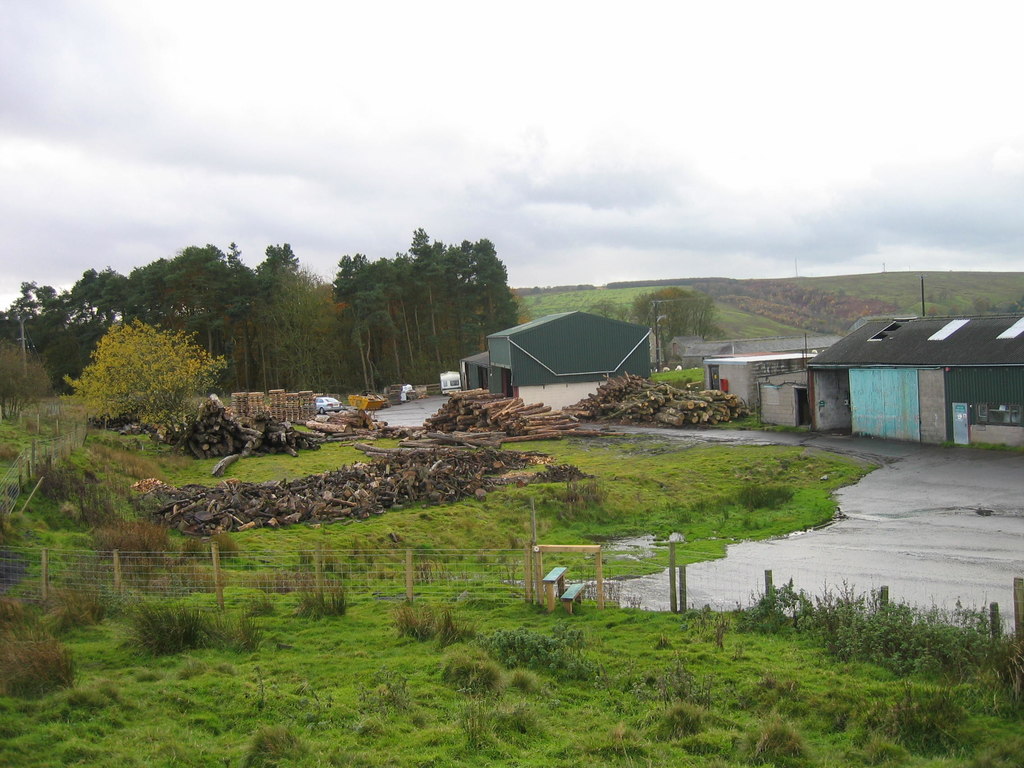
The 1842 drift portal and the workshop buildings; at Wrytree, sheds and a yard now used for timber.
Redevelopment
The office building converted to a house; the workshops reused.
Related mines
- Plenmeller Colliery — Both worked the Little Limestone coal of the South Tyne coalfields near Haltwhistle.
Nearby mines
- Plenmeller Colliery — 8.6 km SE
- Church Burn Mine — 10.6 km SE
- Water House Mine — 14.4 km E
Straight-line distance, within 15 km. Show on the map.
Recorded claims
Individual factual claims, each attached to the source(s) that support it below. Where sources disagree, both are kept.
- Blenkinsop Colliery opened before 1842 and closed in 2002; Quarry Pit sunk 1836, Engine Pit from 10 January 1848; owners from the Blenkinsopp Coal & Lime Co. (1840s) to Blenkinsopp Collieries Ltd (1980s); Little Limestone seam. 1
- Employment was 307 in 1894 and 396 in 1905, but only 17 in 1927, 24 in 1935 and 15 in the 1960s. 1
- Blenkinsopp and Wrytree, connected underground, were the last drift mine in Northumberland, employing about 80 men; the drift entrance is dated 1842 and lies under 20 metres from a castle; the seam has a limestone roof. 2,3
- A whin dyke had to be breached to reach 8 million tons of reserves; the DTI refused aid (about £1.5 million was needed), and the mine closed after its last face with the drift and shafts capped. 2
- James Auld, 25, and John Fairlamb Bell, 33, stonemen, were killed by an explosion of gunpowder at 6 a.m. on 6 March 1890. 1
- The drift has been filled and the entrance blocked, the original 1842 stone entrance remaining visible; the coal handling area has been cleared, the workshops remain and the office is being converted for residential use. 1
Photographs & further reading
A miner's first-hand account and photographs from the mine's last months.
View sourceSources
- (secondary) Durham Mining Museum - Blenkinsop Colliery — Durham Mining Museum
- (observational) Blenkinsopp - Wrytree Pit — Healey Hero (contributor's account)
- (observational) Site of Wrytree Drift (coal mine) — Geograph
Record created: 21 September 2026 · Last researched: 21 September 2026