 MineArchive
South Tyne Colliery
| Location | Haltwhistle Burn, Haltwhistle, Northumberland — 54.9769, -2.4578 (approximate) |
|---|---|
| Commodities | Coal, Fireclay |
| Type | Coal |
| Worked | Early 1850s–24 September 1931 |
| Maximum depth | Unknown. |
| Operators | Smith & Hastwell (1860–1869), William Hudspith (1890–1899), Blackett & South Tyne Collieries Ltd (1910–1931) |
Overview
Haltwhistle's main colliery and the town's biggest employer from the mid-nineteenth century. It worked the Little Limestone coal from two successive sites along the Haltwhistle Burn and closed in 1931.
History
The first South Tyne Colliery was opened by the early 1850s, with a shaft along the Haltwhistle Burn north of the town. The first edition Ordnance Survey shows tile and brick works beside it. Nelson and Co. of Carlisle were making firebricks on the site by 1848, probably from clay raised in sinking the shaft. A waggonway ran down the valley to the railway sidings east of Haltwhistle station, and a spur delivered concessionary coal straight to Oakwell Terrace.
The colliery became Haltwhistle's biggest employer and built the terraced housing on the town's north-eastern edge. Smith & Hastwell owned it in the 1860s, William Hudspith in the 1890s, and Blackett & South Tyne Collieries Ltd in the 1910s. Fireclay was raised as well as coal from 1882. A second South Tyne Colliery opened further down the valley in 1871. The first closed during the 1920s.
Employment grew from 152 in 1894 to 687 in 1927, all on the Little Limestone coal. The coal was sold for coking, gas and steam raising by the 1920s. The Little Limestone was abandoned on 24 September 1931 and the colliery closed. In 1939 the Tyne Fire Clay Company took over the old company's buildings to open a fireclay works, which made salt-glazed pipes into the 1960s.
Geology
Carboniferous sandstones, shales and limestones with thin coals and fireclays: an 1874 section of the colliery level records sandstone, shale with ironstone, limestone, coal and fireclay to about 270 feet, ending in the sandstone of Lees Hall Quarry. The Little Limestone coal was the seam worked from at least 1905 to 1930.
Workings
A shaft at the first site and a level at the second, joined to the Newcastle and Carlisle Railway sidings by a waggonway down the Haltwhistle Burn. A level or adit higher up the valley served as a secondary entrance. Brick, tile and fireclay works stood alongside.
Closure
The Little Limestone seam was abandoned on 24 September 1931 and the plans deposited that year; the fireclay workings followed in 1934. The reason for closure is unknown.
What remains
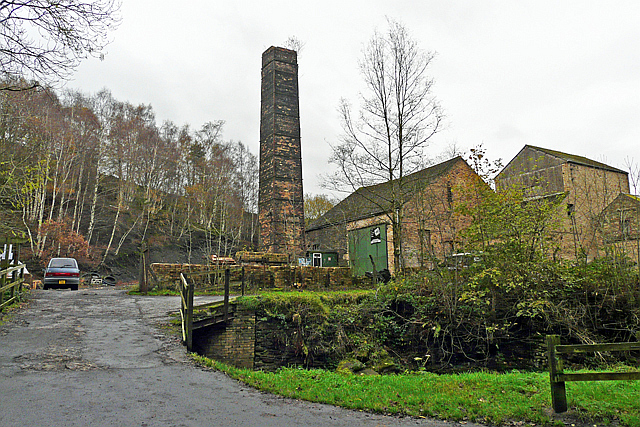
Little survives of the first site beyond parts of the waggonway and an air shaft. At the second site a range of two-storey brick buildings (smithy, joiners' shop, stores and offices) stands, and a 2014 photograph shows the works chimney.
The line of the waggonway along the Haltwhistle Burn, an air shaft, two-storey brick workshop and office buildings, and a brick chimney at the later works site.
Redevelopment
The Tyne Fire Clay Company reused the colliery buildings for a brick and pipe works from 1939 into the 1960s. The waggonway route down the valley is now a footpath.
Nearby mines
- Blenkinsopp Colliery — 2.6 miles (4.2 km) W
- Plenmeller Colliery — 3.3 miles (5.4 km) SE
- Church Burn Mine — 4.7 miles (7.6 km) SE
- Roachburn Colliery — 6.5 miles (10.4 km) SW, Cumbria
- Water House Mine — 6.4 miles (10.4 km) E
Straight-line distance, within 9 miles (15 km). Show on the map.
What's uncertain
Points where sources disagree or the record could not be settled; both accounts are kept. All open questions in the archive.
- The South Tyne Colliery opened a pit at the later works site in 1906. (disputed) 2
Recorded claims
Individual factual claims, each attached to the source(s) that support it below. Where sources disagree, both are kept.
- The first South Tyne Colliery shaft had been sunk and opened by the early 1850s. 1
- A second South Tyne Colliery opened further down the Haltwhistle Burn in 1871. 1
- The South Tyne Colliery opened a pit at the later works site in 1906. (disputed) 2
- Employed 687 people in 1927, 560 of them underground. 3
- The Little Limestone seam was abandoned on 24 September 1931. 3,4
- The colliery was Haltwhistle's biggest employer from the mid-nineteenth to the early twentieth century and built terraced housing on the town's north-eastern edge. 1
- An 1874 section of the colliery level records sandstones, shales, limestones, thin coals and fireclays to about 270 feet. 5
Photographs & further reading
Owners, employment 1894-1930, seams, abandonment and recorded fatalities.
View sourceThe town's archaeology and history, with a section on coal mining along the Haltwhistle Burn.
View sourceSources
- (primary) Haltwhistle: Northumberland Extensive Urban Survey — Northumberland County Council
- (observational) The Old Brickworks (photograph, 2014) — Geograph
- (primary) South Tyne Colliery — Durham Mining Museum
- (primary) Catalogue of Plans of Abandoned Mines for South Tyne Colliery — Durham Mining Museum
- (primary) South Tyne Colliery: shaft details — Durham Mining Museum
Record created: 1 October 2026 · Last researched: 2 October 2026